Introduction
One of the undisputed stars among Georgetown's special collections is the collection of autographs of Catholic saints, beati, and outstanding historical figures named for Francis X. Talbot, S.J. (1889-1953), who served for 13 years as literary editor of the Jesuit magazine America and followed that up with another eight (1936-1944) as its editor-in-chief. Talbot's own papers are at Georgetown, a rich mine of literary correspondence from a variety of authors. So, too, are the surviving papers of America itself, a potentially rich resource for research in a variety of fields.
Ironically, it was Talbot's leaving America to take up the post of regional director for the Institute of Social Order that provided the impetus for the formation of the collection, which was assembled over a period of years by Mary Benjamin, long the dean of American autograph dealers. Since Talbot's new job meant his leaving New York City, the collection formed to honor him was initially meant to have a New York address; a further irony springs from the selection of Georgetown as the collection's permanent home.
The collection was first publicly displayed, however, in New York in 1944, at a testimonial dinner given for Talbot at the Hotel Commodore on September 26, the Feast of the Jesuit Martyrs of North America. The date was selected to reflect perhaps the best-known of Talbot's books, Saint among Savages, a biography of Saint Isaac Jogues. And so, while the company partook in a pre-dinner "informal reception to Father Talbot" in the West Ballroom, it also had the first chance to view the nascent collection. Of the five items singled out for description in the commemorative brochure for the dinner, only two remain in the collection as it stands today, but one of them is undoubtedly the highest in a collection of "high spots," the document signed by Saint Ignatius Loyola in 1551 and later adorned with a fragment of bone from his skeleton.
That the Ignatian autograph is at the heart of the collection is no surprise. While the surviving correspondence is scanty, it seems that Walter R. Benjamin, Mary Benjamin's father and predecessor as a dealer, loaned the document to Father Talbot in 1928 in hopes of finding out more about it; queried as to where he himself had got it, he could reply only "I must have owned it 20 years or more,--and have no idea where I got it. Probably at some auction. Much stuff is sent over here by Europe, for auction, as prices run higher here." Talbot in turn sent the document to Father Timothy Barrett, S.J., at Woodstock College. It was Barrett who tracked down what little is known of the document's previous history: that it was owned in 1657, when it was copied for the Jesuit archives, by a Herr Hermann Mylius of Cologne, who stated that his father obtained it by trade from a Lutheran family in that city in return for a letter written by Luther himself. The letter remained at Woodstock until 1935, upon the death of Father Barrett, who had had it framed and hung over his bed. From there, after some little difficulty, it was recovered by Talbot.
From the time the collection came to Georgetown until the death of Father Talbot it was continually growing and changing. Miss Benjamin made quite clear in her correspondence with Father Yates and others at Georgetown that she wanted the collection to contain only "the cream." Thus a number of documents and letters in the original collection were returned to be replaced by yet better examples, and at the same time new names were represented. With the exception of a final gift made in 1972, an autograph letter written by St. Euphrasie Pelletier, the last item to join the collection is one of its greatest treasures: the manuscript of the sonnet by St. Philip Neri, presented to the collection on the occasion of Father Talbot's death.
The exhibit, which will continue into 1998, is intended in some measure to recognize the 450th anniversary of the publication of the Exercitia spiritualia of St. Ignatius; obviously, too, it honors the generosity of its donor, Miss Mary Benjamin, and the memory of Father Talbot, for whom it is named. It could not have been mounted without the assistance of a number of people, including virtually every member of the staff of the Special Collections Division, but most especially Professor Roberto Severino of Georgetown's Department of Italian and Rev. Joseph A. Tylenda, S.J., librarian of the Woodstock Theological Center Library.
George M. Barringer
Assistant University Librarian, Special Collections & Archives
Items in the Exhibition
Wilhelm IV, duke of Bavaria (1493-1550)
Letter signed, Munich, "mittwoche nach Trinitatis" (i.e., 26 May) 1535. 1 page, in German.
Wilhelm successfully defended Bavaria from the incursion of Lutheran and Anabaptist teachings. In this letter to two of his retainers in the camp besieging the Anabaptists in Münster, he requests a report on current events and adds that nothing should be said there about decisions taken at a recent Diet in Worms.
Cardinal Reginald Pole (1500-1558)
Letter signed, to an unnamed recipient, Cambrai, 18 May 1537. 5 1/2 pages, in Italian.
Pole was among the most important of English clerics who resisted Henry VIII's break with Rome. The letter reports on events during Pole's unsuccessful mission as papal legate in an attempt to involve Charles V and Francis I in active intervention in England.
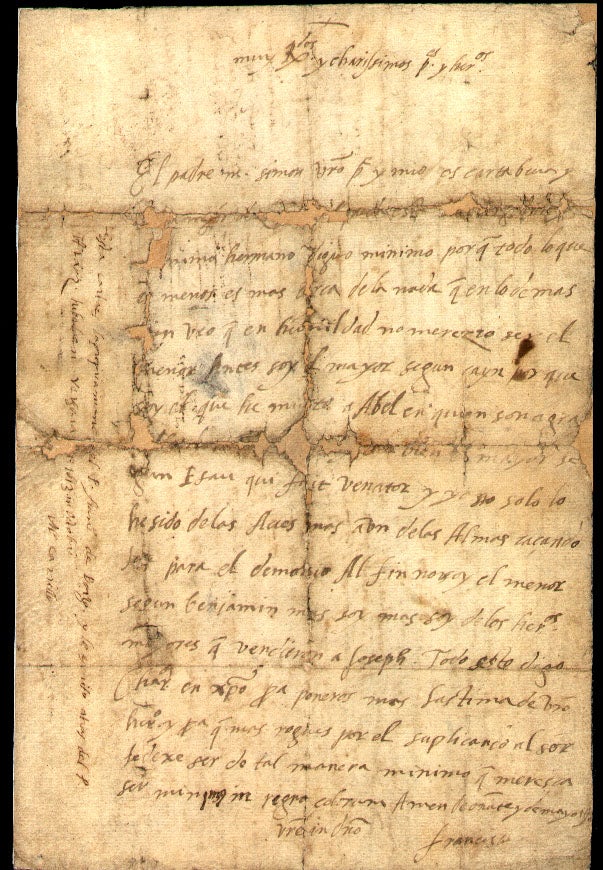
Saint Francis Borgia (1510-1572)
Autograph letter, signed, Oñate, 19 May [1551] 1 page, mounted, in Spanish.
The "second founder" of the Society of Jesus addresses his "most reverend and dear fathers and brothers," a group of Jesuits living in Portugal, with an impassioned declaration of his own sinfulness and humility, going so far as to claim [in translation] "I have been like Esau, a mighty hunter, and chased not only birds, but souls, acting as beater for the Devil."
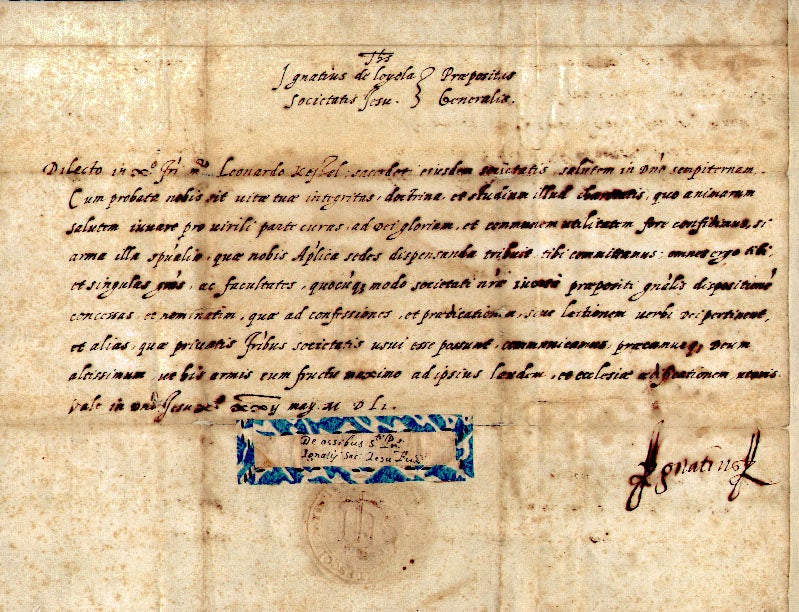
Saint Ignatius Loyola (1491-1556)
Document signed [Rome] 22 May 1551. 1 page, in Latin.
A grant of faculties (or celebret) by the founder and first general of the Society of Jesus to Leonard Kessel, S.J. The document was enriched at an early date with the addition of a fragment of bone from the skeleton of Loyola.
Saint Philip Neri (1515-1595)
Autograph manuscript, "Per la festa di san Luca vangelista dell'anno 1556." 1 page, in Italian.
Draft of a sonnet, one of a small number of surviving manuscripts of early literary pieces written by the founder of the Congregation of the Oratory. The year date is questionable, given the handwriting, and the actual day and month of composition are unknown.
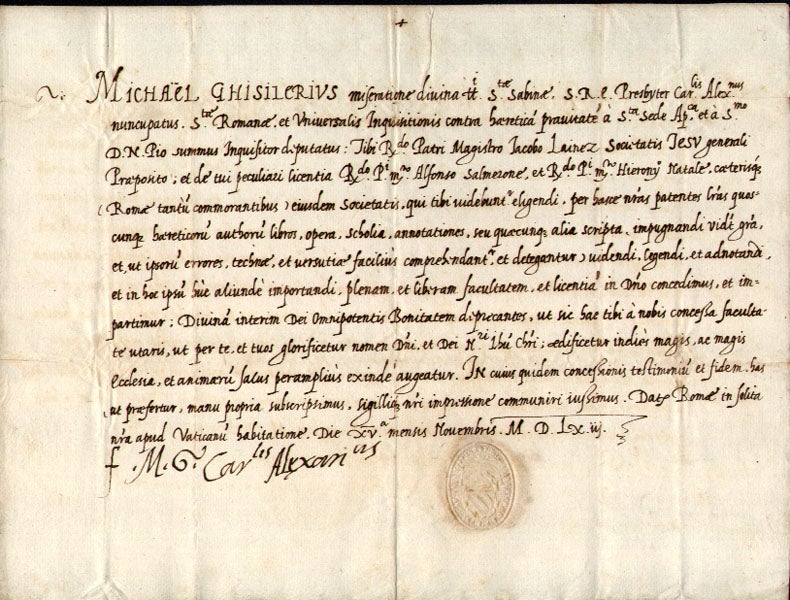
Saint (Pope) Pius V (1504-1572)
Document signed, Rome, 15 November 1563. 1 page, with integral blank leaf and traces of seal, in Latin.
Writing as head of the Inquisition, then-Cardinal Ghisleri grants faculties for the reading of works by heretical authors to the newly-appointed Jesuit papal theologians at the reconvened Council of Trent. The document is the work of a master calligrapher.
Saint Charles Borromeo (1538-1584)
Autograph letter signed, to the Cardinal of Pisa, 23 March 1571. 1 page, with integral address leaf, in Italian.
A tantalizing letter regarding Borromeo's repeated interrogation of a man in an affair hinting perhaps at heresy, but with nothing at all specified except the interrogator's caution in proceeding.
Saint Camillus de Lellis (1550-1614)
Document signed [Rome] 12 October 1599. 1 page, with integral blank leaf, in Italian.
Document acknowledging the receipt of 125 scudi from a will for the order Lellis founded, the ministri delli infermi (Fathers of a Good Death), and promising to say the proper number of masses in return for the donation.
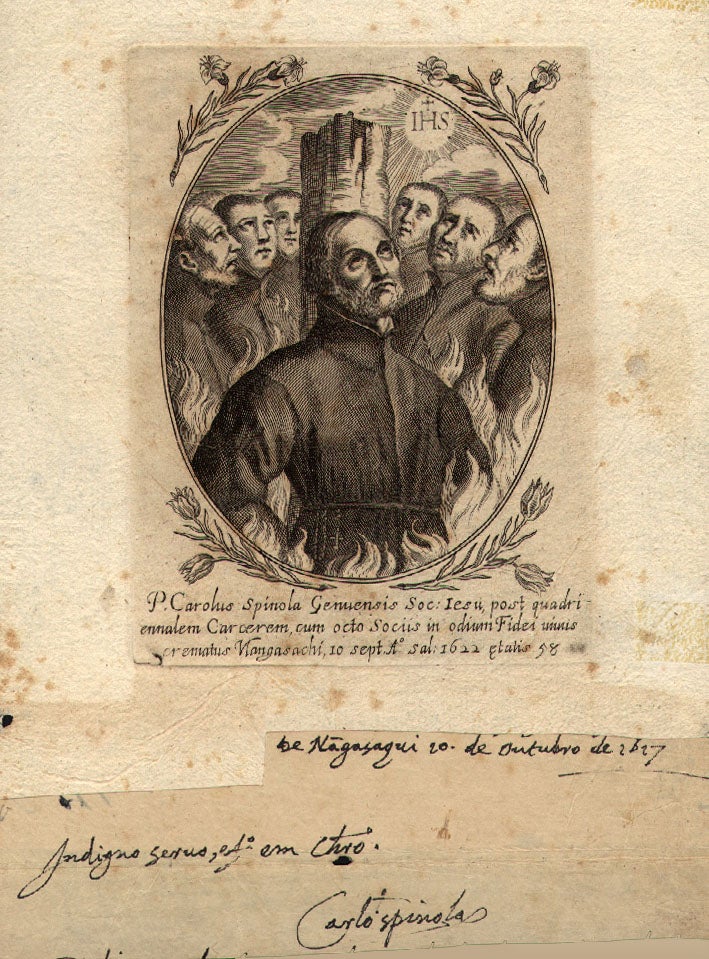
Blessed Charles Spinola, S.J. (1564-1622)
Autograph letter signed (fragment), Nagasaki, 20 October 1617. In Portuguese.
A clipped signature, providentially including the site and date of writing. Spinola, together with eight others, was martyred in Nagasaki after four years' imprisonment. With an early engraving of the martyr.
Saint Robert Bellarmine (1542-1621)
Autograph letter signed, to Archangelo Burratti, Rome, 21 December 1618. 2 pages, with integral address leaf, in Italian.
A revealing letter explaining how much Bellarmine's nephew deserves to be invested with the order of St. Stephen (to which Burratti belongs) and agreeing, though not wholeheartedly, to aid a fairly uneducated protegé of Burratti in finding some sort of position.
Saint Joseph Calasanz (1556-1648)
Autograph letter signed, to Fr. Stephano delli Angeli, Rome, 3 July 1632. 1 1/2 pages, with integral address leaf, in Italian.
A lengthy discussion of the best manner of proceeding in the complex process of liquidating a substantial amount of real property and other assets. Signed in Italian, as "Giuseppe della Matre Dei."
Saint Vincent de Paul (1581-1660)
Autograph letter signed, to Fr. du Festel, 28 November 1642. 3 pages, in French.
The founder of the Vincentians and the Sisters of Charity gives copious account of "nos petites nouvelles," including a mission to the Barbary Coast aimed at ransoming some 80 galley slaves. He further insists that the order's houses should continue to be known as "Missions," the name not changing to the proposed "Seminaries."
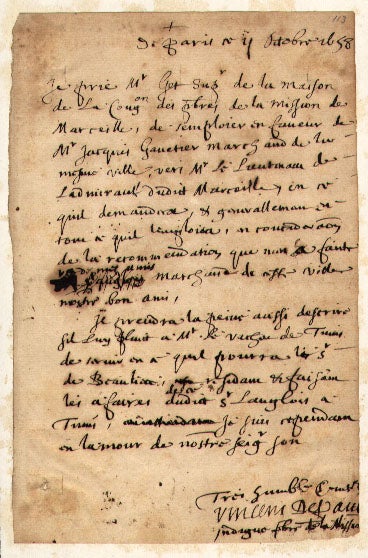
Saint Vincent de Paul (1581-1660)
Autograph letter signed, to Fr. Get, Paris, 11 October 1658. 1 page, mounted, in French.
The letter asks for the cooperation of the superior of the mission in Marseilles for the purposes of the merchant of the same city Jacques Gavetier, "nostre bon ami."
Jacques Courtois, S.J. ("le Bourguignon") (1621-1676)
Autograph letter signed, to Alberto Vangeuti, Rome, 2 November 1662. 1 page, in Italian.
Signing in Italian ("Jacomo Cortesi"), the Jesuit brother, formerly a celebrated painter of battle scenes, requests the aid of his correspondent. Courtois dedicated his art to the depiction of sacred subjects after becoming a Jesuit in 1655.
Saint (Cardinal) Gregory Barbarigo (1625-1697)
Letter signed, to Msgr. Isimbardi, Padua, 18 March 1674. 1 page, with integral blank leaf, in Italian.
A letter of recommendation written for Nicolo de Caris of Dalmatia, with an autograph addition at the end of the main text.
Father Paolo Segneri, S.J. (1624-1694)
Autograph letter signed, 13 March 1678. 1 1/2 pages, with integral blank leaf, in Italian.
The famed Jesuit preacher inquires about the printing of some of his sermons and regrets that he cannot grant a share of some recent charitable gifts to a group of English Benedictines.
Saint Alphonsus Liguori (1696-1787)
Autograph letter signed, not dated. 2 pages, in Italian; with integral blank leaf bearing certification of the letter as evidence in the cause of Liguori's canonization, dated 1833.
The founder of the Congregation of the Most Holy Redeemer (Redemptorists) complains of a number of difficulties with possible changes and reassignments of clerical personnel.
Saint Alphonsus Liguori (1696-1787)
Autograph manuscript, not dated. 2 pages, in Italian, the second with certification of the manuscript as evidence in the cause of canonization, 1838; with integral blank leaf.
Notes on various readings in theology.
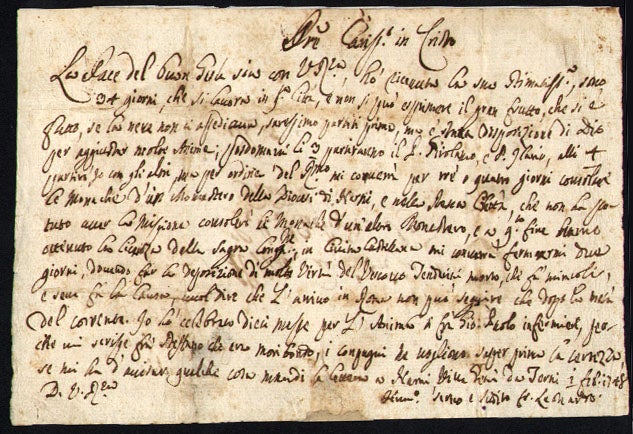
Saint Leonard of Port Maurice (1676-1751)
Autograph letter signed, to Fr. J. Natale, Terni, 1 February 1748. 1 page, in Italian.
The letter gives a brief account of various of his pastoral activities and of projects for the near future.
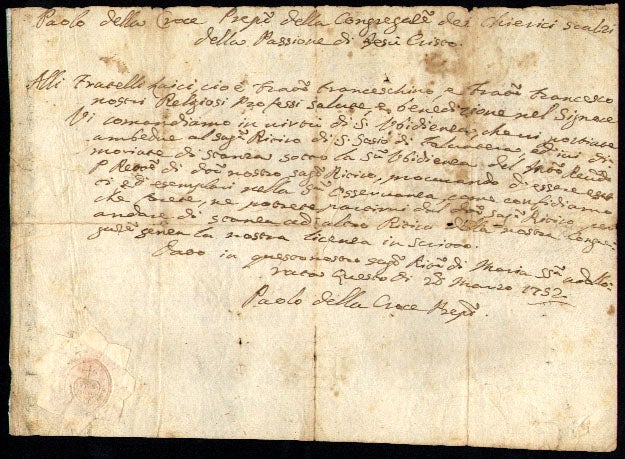
Saint Paul of the Cross (1694-1775)
Autograph document signed, 28 March 1752. 1 page, in Italian.
The document commands two lay brothers to a forced retreat, not to be ended without specific permission, so that they may gain further insight into the concept of obedience.
Stephen Moylan (1734-1811)
Autograph letter signed, to Robert Morris, White Plains, 5 and 9 November 1776. 3 pages, in English.
Moylan was an organizer of the Friendly Sons of St. Patrick in Philadelphia (1771) and served as the only Catholic among Washington's aides-de-camp during the Revolution. In this letter he comments to the financier Morris on Howe's ultimately abortive attempts to force his way up the Hudson.
Father Jean François Rivet (d. 1804)
Autograph letter signed, to Secretary of War James McHenry, Vincennes, 28 November 1796. 3 pages, in French.
Rivet, a missionary appointed by John Carroll, Bishop of Baltimore, also carried an "official" notice of his missionary status from the U.S. government. In this letter he reports to his governmental master on rumors of a French return to Louisiana and Canada.
Father François Antoine Matignon (1753-1818)
Autograph note signed, Boston, 1 September [no year] 1 page, in English.
Matignon's pastoral work accounted for the first successful Catholic parish in Boston. In this note he seeks a place as ship's cabin-boy for "a mulatoe boy of nearly seventeen."
Bishop Jean-Louis Lefebvre de Cheverus (1768-1836)
Autograph letter signed, to William Williamson, Boston, 11 February 1820. 3 pages, in English.
Cheverus was the first bishop of Boston, from 1808; he arrived there in 1796. He gives a series of numbered responses to questions posed by Williamson about the Catholic Church, and especially as to how it is constituted in the United States.
Blessed Maddalena Gabriella di Canossa (1754-1835)
Autograph letter signed, to Msgr. Antonio Traversi, Trento, 12 July 1828. 3 pages, in Italian.
Sister Maddalena refers to the inauguration of her religious house and to various difficulties in finding suitable companion priests for travelling. At the end she conveys greetings from the sister of Fr. Antonio Rosmini-Serbati, who, with Sister Maddalena's support, had in that year founded the Institute of Charity (Canossian Institute).
Blessed Maria Christina of Savoy (1812-1836)
Autograph letter signed, to "Carissima Amica," Cascina, 2 September 1829. 1 1/2 pages, in Italian.
The letter recounts a variety of personal details (what the weather is like, who Mamma is writing to, and the like) to her unnamed but obviously well-known correspondent.
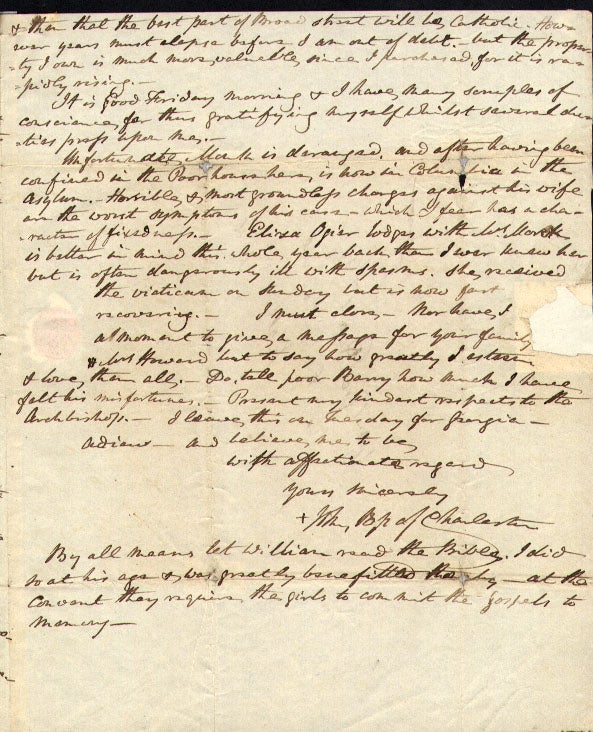
Bishop John England (1786-1842)
Autograph letter signed, to William George Read, Charleston, 31 March 1836. 3 pages, in English.
The first bishop of Charleston writes at length about refusing the bishopric of Haiti and preaching in the South Carolina Senate. He adds a postscript of a very modern note: "By all means let William read the Bible. I did so at his age & was greatly benefitted thereby -- at the Convent they require the girls to commit the Gospels to memory --"
Father Pierre Jean de Smet, S.J. (1801-1873)
Autograph letter signed, to J. N. Nicollet, Green River, 3 July 1840. 1 page, with integral address leaf, silked, in French.
The Jesuit missionary recounts his reception among various Indian tribes following his first visit to the Flatheads and recommends various men to Nicollet for a forthcoming expedition, including the legendary Jim Bridger, with whom he has often spoken and who is acclaimed by the mountain men as "le meilleur guide et interprête de ces pays."
Bishop John Joseph Hughes (1797-1864)
Autograph letter signed, to William George Read, New York, 14 July 1842. 2 1/2 pages, in English.
The coadjutor bishop of New York gives his correspondent a vivid account of how the lack of sufficient churches--and priests to serve them--prevents wide-scale conversions of Protestants and the unchurched. In December of 1842 Hughes succeeded to the bishopric.
Bishop John Joseph Hughes (1797-1864)
Autograph letter signed, to George F. Leitch, New York, 5 February 1844. 1 page, in English.
The bishop provides news of a mutual friend, the Jesuit missionary de Smet, who has just left Belgium on an expedition via Cape Horn to Oregon: "It is probable that none of us shall ever see him again...."
Saint Vincent Mary Pallotti (1798-1850)
Autograph letter signed, to the count Montini, 13 December 1849. 1 page, with integral address leaf, in Italian.
The founder of the Pious Society of Missions (Pallottines) requests of his noble correspondent the use of a coach in order to visit the sick in various unsavory parts of a Rome still wracked by civil strife.
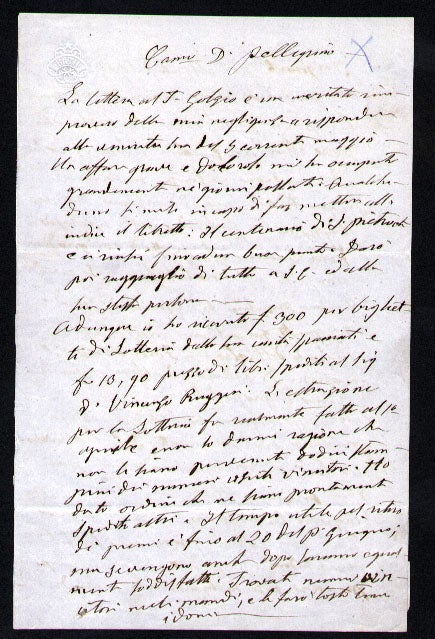
Saint John Bosco (1815-1888)
Autograph letter signed, to Fr. T. Pellegrino, 27 May 1867. 2 1/2 pages, in Italian.
Bosco was founder of the Salesian Society. In this letter he comments on the efforts of an unnamed party to put one of his books on the Index, on receiving money from a lottery, and on the beneficial introduction of gas for light and heating.
Cardinal James Gibbons (1834-1921)
Autograph letter signed, to Miss Bessie Whittemore, Baltimore, 18 March 1892. 1 page, with integral blank leaf, in English.
Gibbons answers Miss Whittemore's request for the reason he is so attached to the Catholic Church: "I love & cherish her because she is 'the Spouse of Christ without spot or wrinkle,' though alas! I cannot say the same of many of her children."
Saint (Pope) Pius X
Autograph letter signed, to Cardinal Bartolomeo Bacilieri, Rome, 27 April 1911, 1 page, with integral blank leaf, in Italian.
The Pope delegates to his correspondent the somewhat uncertain task of answering some questions posed by the mother superior of a convent.
Mother Alphonsa (1851-1926)
Autograph letter signed, to "dearest Lucia," 6 May [1913?] 2 1/2 pages, in English.
Mother Alphonsa (Rose Hawthorne Lathrop, daughter of Nathaniel Hawthorne) provides information on her work with the Servants of Relief for Incurable Cancer, the Dominican-connected order she founded in 1899-1901. She concludes: "I am a religious now, but that only deepens one's interest in all the world, & I love my friends very much."
Cardinal Désiré Félicien François Joseph Mercier (1851-1926)
Autograph letter signed, to "cher ami" [Malines?] 13 October 1924. 2 1/2 pages, in French.
The cardinal comments at length on the faults and relative unsuitability for publication of a recent speech he has delivered, but he nonetheless promises to send along the complete text.

Blessed Damien Joseph de Veuster (1840-1889)
Autograph note signed, to Dr. S. B. Swift, Molokai [undated, but probably early 1889] 1 page, in English.
A brief note asking Dr. Swift to visit, likely written just prior to Damien's final illness; on the verso Swift has copied out a prescription previously given to Damien by one of Swift's predecessors, Dr. Mouritz.
Father Lambert L. Conrardy
Autograph note signed, to Dr. S. B. Swift, Kalawao, 30 March 1889. 1 page, in English.
The note from Damien's colleague that summoned Swift to attend to the latter's terminal illness.
S. B. Swift, M.D.
Autograph manuscript [Molokai] 30 March-12 April 1889. 6 pages, in English.
The day-by-day log of treatment provided by Swift to Father Damien during his last illness. According to witnesses, Father Damien apparently refused all treatment after the final date in the log; he died on April 15th.
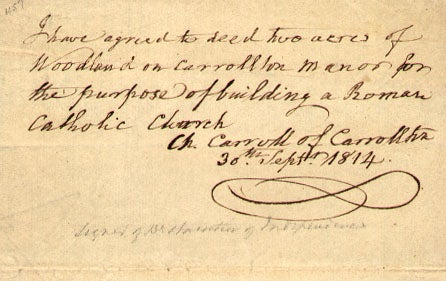
Charles Carroll of Carrollton (1737-1832)
Autograph document signed [Maryland] 30 September 1814. 1 page, in English.
The cousin of Archbishop John Carroll, reputedly at the time one of the wealthiest men in America, agrees "to deed two acres of Woodland on Carrollton Manor for the purpose of building a Roman Catholic Church." With Carroll's autograph comment on the verso, noting that the church was built and the deed executed on 9 June 1819.
Archbishop John Carroll (1735-1815)
Autograph letter signed, to William Orbison, Baltimore, 19 August 1815. 1 page, with integral address leaf, in English.
Carroll's final letter in a correspondence concerning land to be sold by Carroll to raise funds for a Catholic church in Huntingdon, Pennsylvania, negotiations for which had dragged on for well over a year--and would continue.
Father Lewis Barth (1764-1844)
Autograph letter signed, to William Orbison, Philadelphia, 5 October 1815. 1 page, with integral address leaf, in English.
The final communication in the negotiations carried on by Barth, then local vicar-general, the late Bishop Egan of Philadelphia, and Archbishop Carroll to secure money to establish a Catholic church in Huntingdon. Barth refused the bishopric of Philadelphia after Egan's death.
Cardinal John Henry Newman (1801-1890)
Autograph letter signed, to "dear Madam," Oxford, 6 April 1841. 3 pages, in English.
Newman, not yet a Roman Catholic, writes extensively on the authority of the Church of England in disciplinary matters: "Those who wilfully sin against the authority of the Church, are guilty; but who of men can tell whether this or that man has sinned wilfully? We leave this to God."
Father Gerard Manley Hopkins, S.J. (1844-1889)
Autograph letter signed, to Rev. Edward William Urquhart, "Epiphany" (i.e., 6 January) 1865. 4 pages, in English.
The Jesuit poet comments at length about Savonarola, for whom he feels such enthusiasm "that I can conceive what it must have been to have been of his followers ... it is easy to imagine oneself a painter of his following." He concludes his comments on the Italian reformer thus: "How strangely different is the fate of two reformers, Savonarola and Luther! The one martyred in the Church, the other successful and the admired author of world-wide heresy in schism."
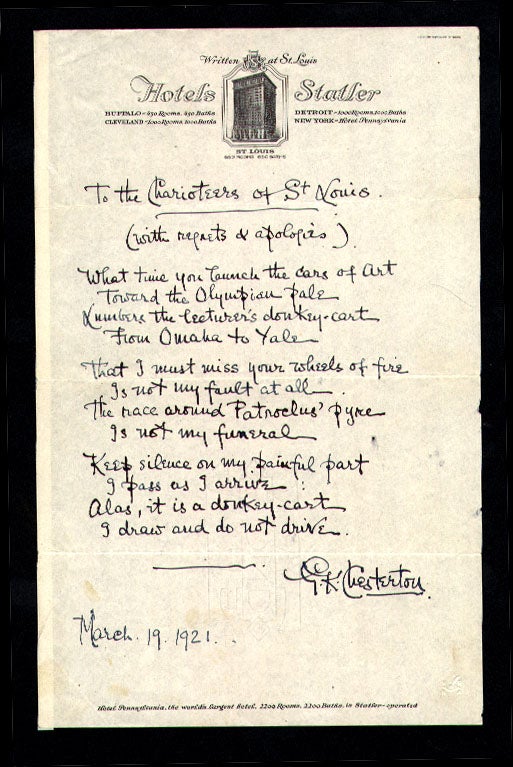
Gilbert Keith Chesterton (1874-1936)
Autograph letter (in verse) signed, "to the Charioteers of St. Louis," St. Louis (?), 19 March 1921. 1 page, in English.
A humorous turn-down of an invitation to speak, possibly addressed to a student group at St. Louis University, since at the bidden time "Lumbers the lecturer's donkey-cart / From Omaha to Yale."