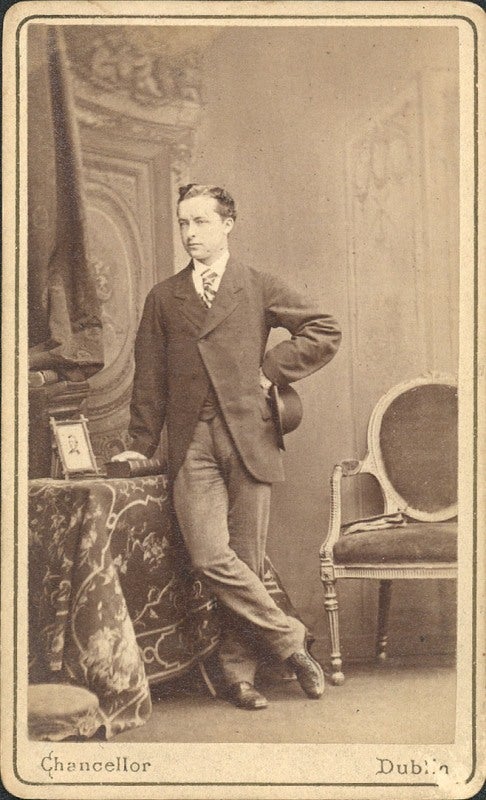
Francis A. Barnum, while a student at Georgetown, ca. 1869
Francis Barnum was born into a well-known Baltimore family in 1849. His father owned Barnum’s hotel, one of the great hostelries of the South in the middle of the 19th century. He was educated at Georgetown College and, after a period of world travel, joined the Society of Jesus in 1880.
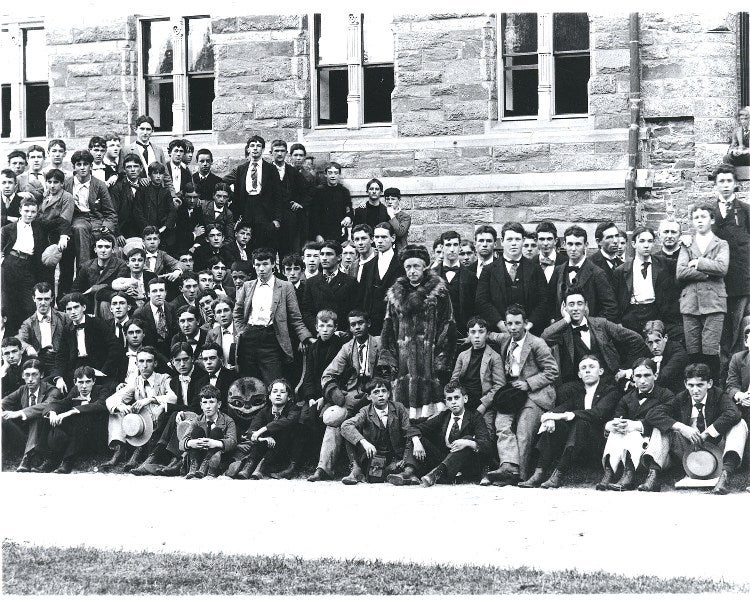
Francis A. Barnum, S.J., in Native Alaskan dress, surrounded by Georgetown students in front of Healy Hall
Fr. Barnum spent most of the 1890s in Alaska. He left in 1898, serving briefly as chaplain on Ward's Island in New York Harbor, before returning to Georgetown – with a least one souvenir of his time in Alaska.
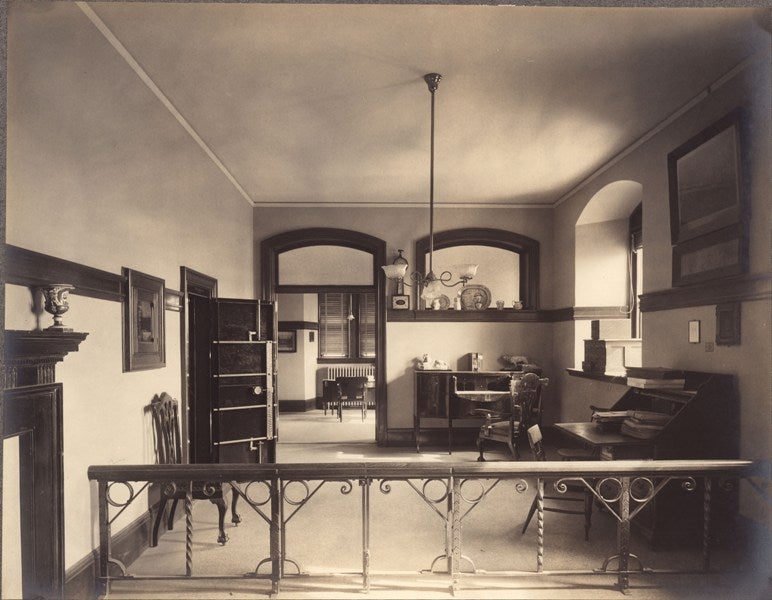
The University Archives in Healy Hall while Fr. Barnum was Archivist. Photograph by John Brosnan, S.J.
In 1898, Fr. Barnum returned to campus as librarian of Riggs Library. Discovering important historical documents with significant research value scattered in closets and attics across the University, he decided to gather them together for safekeeping and to make them accessible to researchers, becoming the first University Archivist in fact, if not in name. He officially served as served as Archivist from 1913 until his death in 1921. The first person to attempt to systematically organize the records in the University Archives, the notes and memoirs he wrote during his tenure are among the most vivid surviving accounts of day-to-day life on Georgetown’s campus, from his school days in the 1860s through the early twentieth century.
Fr. Barnum died at Georgetown in 1921 and is buried in the Jesuit Cemetery on campus.
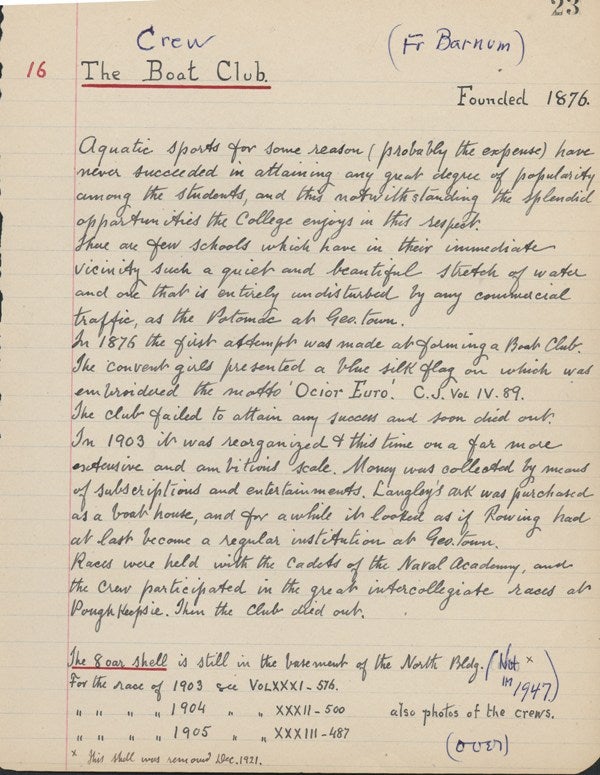
Fr. Barnum’s notes on The Boat Club [Crew], written some time after 1905
. . . In 1876 the first attempt was made at organizing a Boat Club. The [Visitation] convent girls presented a blue silk flag on which was embroidered the motto “Ocior Euro” C[ollege J[ournal] vol. IV.89. The club failed to attain any success and soon died out . . .
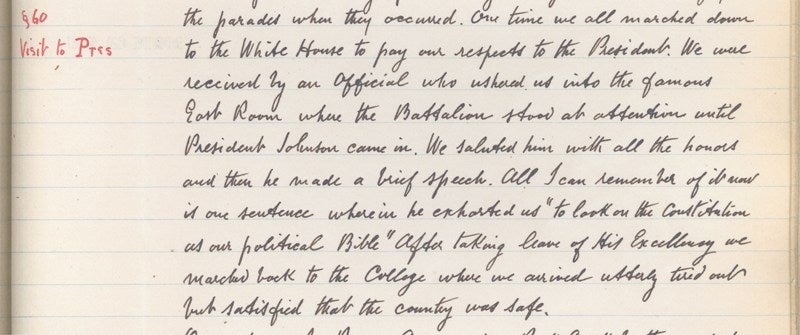
Extract from Fr. Barnum’s 43 page memoirs, Student Life at Georgetown in the Late Sixties
Section 60 Visit to Pres
One time we all marched down to the White House to pay our respects to the President. We were received by an official who ushered us into the famous East Room where the Battalion stood at attention until President Johnson came in. We saluted him with all the honors and then he made a brief speech. All I can remember of it now is one sentence wherein he exhorted us “to look on the Constitution as our political Bible.” After taking leave of His Excellency we marched back to the College where we arrived utterly tired out but satisfied that the country was safe.
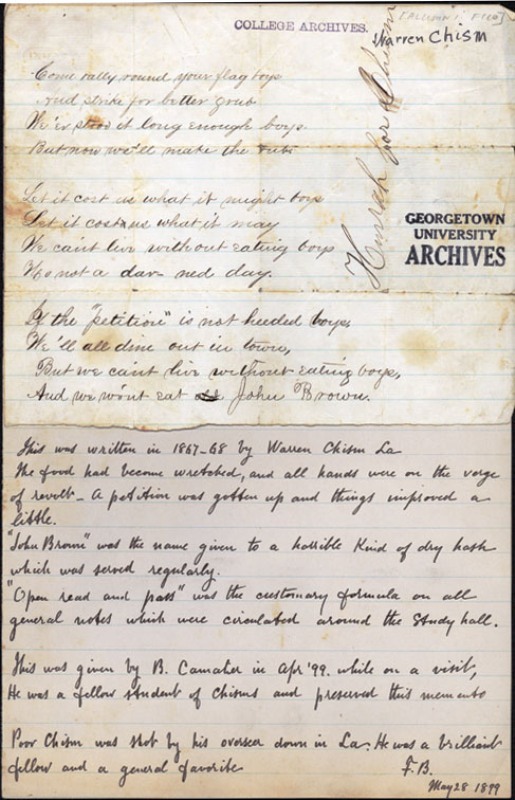
Poem from the University Archives written by student Walter Chism during the 1867-1868 academic year. The poem criticizes food on campus. The notes added at the bottom are in Fr. Barnum’s hand and are dated May 28, 1899
Walter Chism and Fr. Barnum had been classmates at Georgetown, a fact that explains why Fr. Barnum could assert that Walter was a brilliant fellow and a general favorite. As with many documents in the Archives, Fr. Barnum’s notes expand our understanding of the poem and its context, providing information not readily available elsewhere. Particularly useful in this case are his explanations of terminology used in the poem: that “John Brown” was the name given to a horrible kind of dry hash that was served regularly and that “Open, read and pass” [a notation on the back of the poem] was the customary formula on all general notes which were circulated around the Study Hall.
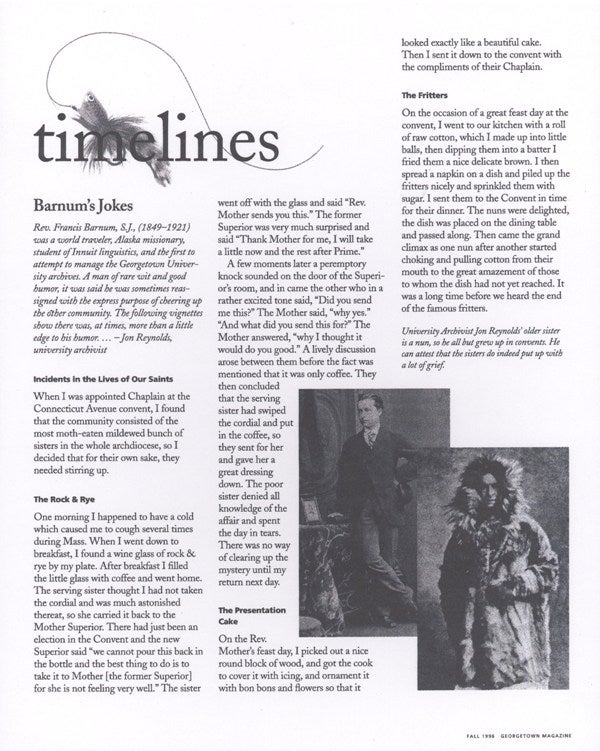
“Barnum’s Jokes” by Jon Reynolds, Georgetown Magazine, fall 1996
Fr. Barnum was well-known for his sense of humor and love of practical jokes. A selection of these jokes were compiled in 1996 by Jon K. Reynolds who served as University Archivist from 1971 to 2000.