Introduction:
 This exhibit attempts to survey the varieties and chart the development of German publishers' bindings during the 19th century. In that century, in the German states as well as elsewhere in Europe and in this country, the confluence of three separate, but significantly linked, influences brought the publisher's binding to its height of technical and artistic development. An explosive growth in popular literacy spawned an unheard-of demand for books; the processes of cloth casing and stamping in gilt proved both effective and flexible for extended binding runs; and publishers turned to edition binders to provide them with products both solid enough to be considered "permanent" and stylish enough to attract a new buying public.
The history of this development in France, in Britain, in the Netherlands, and in the United States is reasonably well known. Books and articles by Sophie Malavieille, Ruari McLean, Douglas Ball, Fons van der Linden, Sue Allen, and many others shed copious light on many aspects of the development of the edition binding even if no one of them attempts a comprehensive view of the subject. A comparable resource for the development of edition binding in Germany is the 1994 Gebunden in der Dampfbuchbinderei: Buchbinden im Wandel des 19. Jahrhunderts, the 20th volume in the series Wolfenbütteler Schriften zur Geschichte des Buchwesens. In addition, two sites currently available on the World Wide Web have also provided a good deal of information: the Deutsche Bibliothek in Leipzig had a showing of Leipziger Verlagseinbände des 19. und frühen 20. Jahrhunderts; the University of Wisconsin hosts German Decorative Trade Bindings, a larger showing for the years 1870-1920. The list of edition binders provided on the latter site is of particular utility, not least in gaining an understanding of the centrality of Leipzig to the German binding industry.
For the purposes of the current exhibit "German" is taken as denoting entities defined by language rather than by politics. In the 19th century the German book trade was centered on Leipzig and its great annual fair, where publishers and booksellers celebrated the continued success of the Bourse and resolved issues affecting the trade. The more than 30 more-or-less independent (before unification) German states, Austro-Hungary, and German Switzerland, all annually well represented at Leipzig, shared a common history in publishers' bindings as they do in language. And while there are great similarities between the work produced in these areas and that made in the Netherlands and in Scandinavia, bindings in both of the latter evolved quite differently in stylistic terms.
Like their counterparts elsewhere in Europe and in America, German binders exploited the possibilities of printed paper boards right from the beginning of the 19th century; in fact, they showed very early a taste for pictorial decoration, something that only became popular somewhat later in England and America. But the doing up of editions, or parts of editions, in cloth "in the English manner" as German publishers and binders tended to call the technique, seems to have caught on relatively late in the German-speaking world. Although the technique was used no later than the early 1840s, before about 1860 cloth casing seems to have been more the exception than the rule. All the more surprising, therefore, that the exhibit includes bindings from the 1850s that make use of one or more secondary colors in addition to gilt stamping and the ground color of the cloth casing; in this purely technical achievement England was not much faster. Certainly too, the binding of the anthology Blüthen und Perlen deutscher Dichtung, dating to 1856, shows awareness of, and the technical ability to meet, the norms established by French edition binders for the decoration of cloth casings.
Despite the claim to bind "in the English manner" German edition binders seem, especially in the 1860s, to have routinely broken one of the cardinal English rules by introducing both modelled figures and literal pictorialism into bindings intended to cover titles published for adults. This tendency, by the way, is one which they shared with their Scandinavian counterparts. And as with the attempts at multiple colors, German binders had little fear of handling materials which we now consider unusual. Velvet was established as a commonplace for devotional works from the 1840s, and virtually anything which could be glued to the surface of an embossed cloth binding was, at one time or another. Mother of pearl, metal studs, and composition "cameos" all appear in the exhibit on bindings produced before 1875.
However late German binders may have been in adopting cloth case binding, they developed fairly early on a taste for making sure the purchaser of a book knew who had bound it. J. R. Herzog in Leipzig and Heinrich Koch in Stuttgart both used discreet binder's tickets inserted in the British fashion at the lower inside corner of the rear pastedown. Examples in the exhibit date from 1864 to 1875, and a Herzog ticket is known on a book published in 1880. During the 1860s and 1870s the designers and/or cutters of binding stamps occasionally signed their work, and the exhibit displays a number of examples. The most numerous of these come from the Leipzig establishment of Hugo Horn, an engraver who advertised himself as a specialist in the production of binding stamps. The most teasing of these engravers' names is that of H. G. Wells, which occurs on a number of probably German books distributed in translation in England and the United States, raising the tantalizing possibility that an English or American engraver was engaged to produce stamps for the English-speaking market. But from the early 1880s - perhaps not at all coincidentally just as the use of tickets seems to have ceased - the technique of stamping the binder's name (and frequently a partial address) on the lower cover in blind, or more rarely in black ink, became quite common. Hardly surprising, then, that this concern with identification became paramount just as the cloth edition binding finally became an expected part of publications intended for the German-speaking mass market.
The decade from about 1875 to 1885 saw the emergence of what seems in retrospect the most characteristic of styles in 19th century German edition binding, the Stil der Neorenaissance, with elaborate interpretations in gilt and anything up to a half-dozen colors of ink of ornamental motifs taken more or less directly from Renaissance sources. Found commonly on relatively expensive illustrated books in its first decade, the Stil der Neorenaissance remained in use for reprint literary offerings up until the First World War. As books in the exhibit show, the style was capable of considerable variation, and Hungarian binders seem to have created their own, somewhat orientalized, version as early as the mid-1880s.
Much less usual, though much more in keeping with the developing American ideal of a uniquely conceived binding for every publication, are the bindings created for a number of novels and other publications written by the Egyptologist Georg Moritz Ebers in the 1870s and early 1880s. Besides the four titles in the current exhibit Ebers' Josua (1890) is also known in a similarly-conceived binding.1 Each of the five titles comes dressed in a casing that suggests in its decorative vocabulary that part of the ancient world which serves as the basis for the book's action or relevance, whether Egyptian or Roman or paleo-Christian.
The Ebers bindings anticipate, albeit within the limitations of conservative symmetrical design, the artistic freedom which characterizes many of the items in the exhibit printed and bound after 1890, though such items as the anthology Künstler Humor (1890?) with its almost comically "Japanese" design and the delightfully eggy Kolumbus-Eier (1897?) visually far outstrip anything suggested by the bindings on the Ebers titles. After the turn of the century binders turned briefly to the sinuous designs commonly lumped together in speaking of German art as Jugendstil; the examples in the exhibit, ranging from the almost vulgar splashiness of Chamisso's Werke (1904?) to the far more sedate treatment given the poems of Richard Wagner (1905), demonstrate all too clearly what was possible - and perhaps what sold best. Just as in the rest of Europe and America the decorated dust jacket (the earliest example in the exhibit is quite late, dating to 1909) ultimately spelled the end of the decorated publisher's binding, and in Germany as in the rest of the world, what was by then the conservative element in the binding trade continued to produce on occasion elegant and distinctive work long after the market had passed elsewhere.
(1) Illustrated in Morris, Ellen K. and Edward S. Levin, The Art of Publishers' Bookbindings 1815-1915. Los Angeles: Dailey, 2000, no. 234.
Binders in the exhibit
Berlin
Wübben und Co.
Berlin-Leipzig
Baumbach & Co.
Budapest
Franklin-Társalat
Gottermayer
Leipzig
Baumbach, Max
Crusius, Hermann
Fikentscher, H.
Hager, Julius
Herzog, J. R.
Hübel & Denck
Knaur, Th.
Leipziger Buchbinderei
Schaeffel, W.
Sperling, H.
Stuttgart
Deutschen Verlags-Anstalt
Koch, Heinrich
Zurich
Hug, Gebrüder
Engravers in the exhibit
Berlin
Schubert, R.
Leipzig
Gerhold, R.
Horn, Hugo
Schüssler
Munich
Brod, M.
Stuttgart
Hasert, C.
Unknown (London? New York?)
Wells, H. G.
Items in the Exhibition:
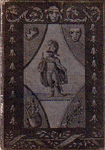
Almanach fürs Theater 1812
Iffland, August Wilhelm, 1759-1814
Berlin: L. Salfeld
1811?
126 x 88 mm.
Blue paper boards printed pictorially in black. Different stock theatrical "characters" depicted on upper and lower covers. Title leaf of this copy missing.
![Gedichte von Johann Georg Jacobi. Erster [Zweiter, Dritter] Theil.](/sites/default/files/images/german_pub_bindings__jacobi.gif)
Gedichte von Johann Georg Jacobi. Erster [Zweiter, Dritter] Theil.
Jacobi, Johann Georg, 1740-1814
Wien: Bey Chr. Kaulfuss und C. Armbruster. Gedruckt bey Anton Strauss
1816
3 volumes, 155 x 97 mm.
Tan paper boards printed in black. A typical printed cover, in the style familiar in both Britain and the United States at the time.
![Almanach der Ritter-Orden von Friedrich Gottschalck . . . Erste [Zweite] Abtheilung . . .](/sites/default/files/images/german_pub_bindings__gottschalck.gif)
Almanach der Ritter-Orden von Friedrich Gottschalck . . . Erste [Zweite] Abtheilung . . .
Jacobi, Johann Georg, 1740-1814
Wien: Bey Chr. Kaulfuss und C. Armbruster. Gedruckt bey Anton Strauss
1816
3 volumes, 155 x 97 mm.
Gray paper boards printed pictorially in black. This title extended to at least one additional volume, not present here.
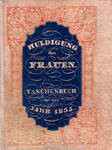
Herausgegeben von J. E. Castelli. Dreizehnter Jahrgang. Mit sechs Kupfern.
Huldigung der Frauen. Taschenbuch für das Jahr 1835.
Wien: bei Fr. Tendler
[1834]
129 x 98 mm.
Paper over vellum, printed (partially ornamentally) in orange and dark blue.

Kisfaludi Kisfaludy Károly' Minden Munkái. A' Kisfaludy-Társaság' Megbizásából. Szerkeszté Schedel Ferencz. Elsó Kötet. Negyedik Kiadás.
Kisfaludy, Károly, 1788-1830
Pesten: Kilián György' Költségein
1843
169 x 120 mm.
Red vertically ribbed cloth, lower cover stamped blind, upper cover stamped blind and ornamentally gilt, spine stamped gilt.
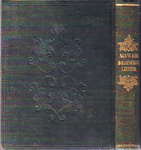
[Quote, in German] Sechste stark vermehrte und verbesserte Auflage.
Auswahl deutscher Lieder, mit ein- und mehrstimmigen Weisen.
Leipzig: Serig'sche Buchhandlung
1844
132 x 106 mm.
Grayish green vertically ribbed cloth, covers stamped in blind, spine stamped gilt.
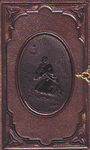
Heilige Anklänge. Gebete für katholische Christen von J. S. Albach, Priester aus dem Orden des H. Franz v. Assisi. [Vignette, with text in German] Achte nach der siebenten abermal vermehrte Originalauflage. Mit sechs Stahlstichen.
Albach, József S., 1795-1853
Pesth: Jm Verlage von Müller's Witwe und Sohn
1844
167 x 106 mm.
Embossed leather, Jesus in the garden on the upper cover, a Maltese cross on the lower cover; a brass clasp is missing from this copy. In the original (much repaired) slipcase.

Plan von Hamburg.
Hamburg: bei G. W. Niemeyer
[1845?]
146 x 109 mm.
Violet moiré cloth, lower cover stamped blind, upper cover blind and emblematically gilt. An advertisement at back advertises this item, in this binding, as being sold "In eleg. Umschlag geb[undet]" ["Bound in an elegant portfolio"]

Tempel der Heiligen zur Ehre Gottes. Vollständiges katholisches Gebet- und Andachtsbuch von A. Hungari. Zweite vermehrte Auflage. . . .
Hungari, Anton, 1809-1881
Frankfurt am Main: Druck und Verlag von Johann David Sauerländer
1845
155 x 103 mm.
Dark blue velvet with applied embossed corners, clasp, and central crucifixes in base metal, identical on both covers.

Des Christen Wandel im Erdenthale und seine Sehnsucht nach der himmlischen Heimath. Ein Gebet- und Erbauungsbuch für katholische Christen aller Stände. Von J. A. Biggel. Zehntes Original-Auflage.
Biggel, J. A.
Stuttgart: Ad. Becher's Verlag
1846
156 x 107 mm.
Very dark brown velvet stamped in blind, with applied gold embossed paper borders and inlaid brown embossed paper (?) crucifixes, identical on both covers.

Der katholische Christ im Gebet.
Neisse: Bei Rosenkranz & Bär
[1849?]
186 x 115 mm.
Dark brown velvet with gold embossed paper borders and greenish embossed paper (?) corners and central crucifixes, identical on both covers. Date from bookplate inserted at front.
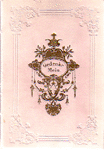
Gedenke Mein! 1851.
Wien: Verlag von Pfautsch & Voss
[1850]
154 x 108 mm.
Pink paper boards stamped in gilt and blind. A relatively late use of traditionally-designed paper boards, but now incorporating gilt stamping instead of simple printing. In original slipcase.
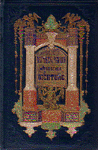
Blüthen und Perlen deutscher Dichtung. Für Frauen ausgewählt von Frauenhand. Achte Auflage.
Hannover: Carl Rümpler
1857 [i.e., 1856]
143 x 100 mm.
"Steel blue" vertically ribbed cloth decorated in the manner of a French binding in percaline mosaïquée, gilt stamping on upper cover and spine combining with red, light green, blue-violet, and white paper onlays. A German-made copy in the French style rather than an import. Advertisements at the back mention numerous books available bound "in the English manner" in cloth, gilt.

Rosengeplauder. Märchen für junge Damen. Von Sophie Bauer. Mit Titelbild.
Bauer, Sophie
Stuttgart: Verlag von Rudolph Chelius
1858
150 x 98 mm.
Dark brown cloth, dark blue on upper cover applied with stencil, stamped in gilt and blind. An unusually early example of the use of a second color on the binding in addition to gilt.
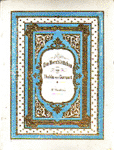
Die Herzblättchen. Erzählungen aus dem Familienleben und der Natur für Kleine Kinder von Thekla von Gumpert. I. Sechste Auflage.
Gumpert, Thekla von, 1810-1897
Glogau: Verlag von Carl Flemming
[1860?]
190 x 149 mm.
Embossed white, light blue, and gilt paper boards executed almost certainly in Germany in a manner reminiscent of the French cartonnages romantiques, a style popularized in France more than a decade earlier. Date inferred; several illustrations (by Paul Thumann) dated 1856.
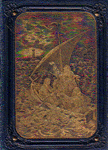
Pharus am Meere des Lebens. Anthologie für Geist und Herz aus den Werken deutscher und ausländischer Schriftsteller älterer und neuester Zeit. Nach den Materien alphabetisch geordnet und herausgegeben von Carl Coutelle. I. Siebente Auflage.
Coutelle, Carl, 1802-1862, ed.
Iserlohn: Verlag von J. Bädeker
1864
158 x 119 mm.
Bound by J. R. Herzog. Dark blue cloth embossed blind, stamped pictorially in gilt, brass studs mounted near each corner of both covers. "J. R. Herzog in Leipzig / Buchbinderei" on ticket on rear paste-down. Pictorial stamp for upper cover derived from the color-printed frontispiece by G. Süst.
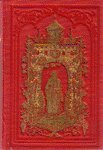
Amaranth. Von Oscar v. Redwitz. Fünfundzwanzigste Auflage.
Redwitz, Oscar, Freiherr von, 1823-1891
Mainz: Verlag von Franz Kirchheim
1868
146 x 104 mm.
Red cloth stamped pictorially in gilt and blind. Upper cover stamp signed at bottom left and right "R. SCHUBERT" and "BERLIN."
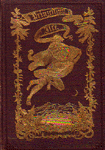
Prinzessin Ilse. Ein Märchen aus dem Harzgebirge von Marie Petersen. Zwölfte Auflage.
Petersen, Marie
Berlin: Verlag von Alexander Duncker, Königl. Hofbuchhändler
1868
141 x 99 mm.
Brown cloth stamped pictorially in gilt and blind, the volume's title given incorrectly on both upper cover and spine as "Prinzessinn Ilse."

Das Wort der Frau. Eine Festgabe von Friedrich von Heyden. Siebzehnte Auflage. Mit 7 Illustrationen von W. Georgy.
Heyden, Friedrich August von, 1789-1851
Leipzig: Friedrich Brandstetter
1869
168 x 135 mm.
Bound by J. R. Herzog. Red cloth embossed blind and stamped in gilt. Upper cover with oval central medallion revealing onlaid "silvered" metal setting with round central painting on mother of pearl under glass. "J. R. HERZOG / BUCHBINDEREI / LEIPZIG" on ticket on rear pastedown.
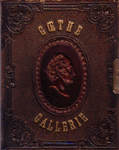
Goethe Gallerie
Kaulbach, Wilhelm von
München: Fried. Bruckmann
1870?
174 x 140 mm.
Brown leather embossed blind, stamped in gilt, upper cover with oval central medallion having composition low-relief bust of Goethe's head, in reddish brown; brass clasp. Album of photographs of paintings by Kaulbach; full-length photograph of Kaulbach, the publisher identified in the composition, at the end.
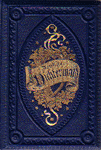
Deutscher Dichterwald. Lyrische Anthologie von Georg Scherer. Mit wielen Porträts und Illustrationen. Vierte Auflage.
Scherer, Georg, 1828-1909, ed.
Stuttgart: Eduard Hallberger
1870?
168 x 122 mm.
Bound by Heinrich Koch. Dark blue cloth embossed blind, stamped symbolically in gilt. "Buchbinderei v. / HEINRICH KOCH / Stuttgart" on ticket on rear paste-down.
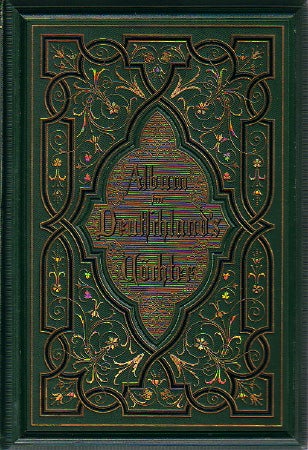
Album für Deutschlands Töchter. Lieder und Romanzen. Mit Illustrationen von Paul Thumann, W. Georgy, J. Hütthaus u. A. Achte Auflage.
Leipzig: C. F. Amelang's Verlag
[1874]
254 x 182 mm.
Bound by J. R. Herzog. Green cloth embossed blind and stamped in Renaissance style in black and gilt. "J. R. HERZOG / BUCHBINDEREI / LEIPZIG" printed on ticket on rear paste-down. Upper cover signed "R. GERHOLD'S GA." and "LEIPZIG" at lower left and right. ["GA" = Gravier Anstalt, or engraving company] With English-language gift inscription dated Christmas, 1876.
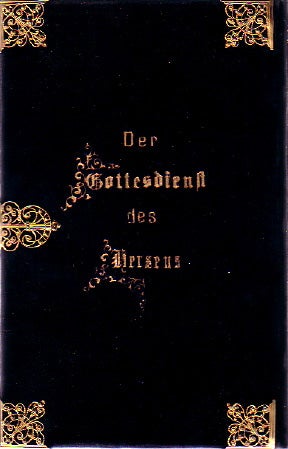
[Title in Hebrew] Der Gottesdienst des Herzens. Israelitisches Gebetbuch für die öffentliche und Privatandacht. Zweiter Band. [line in Hebrew]
Nürnberg: Verlag der Friedr. Korn'schen Buchhandlung
1874
204 x 139 mm.
Dark violet velvet stamped in gilt, with ornamental corners and clasp in gilded brass.
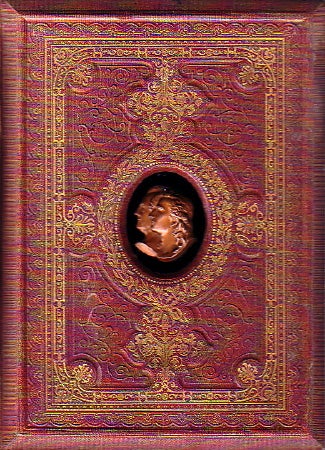
Gedankenharmonie aus Goethe und Schiller. Lebens- und Weisheitsprüche aus deren Werken. Herausgegeben von Rudolf Gottschall. Mit acht Farbendruckbildern von Paul Thumann. Sechste Auflage.
Gottschall, Rudolf von, 1823-1909, ed.
Leipzig: C. F. Amelang's Verlag
1875?
184 x 143 mm.
Bound by J. R. Herzog. Purple cloth embossed blind and stamped gilt in English 60s fashion, central medallion with composition portrait heads of Goether and Schiller in light brown against black velvet field. "J. R. HERZOG / BUCHBINDEREI / LEIPZIG" on ticket on rear paste-down. Date inferred from an included advertisement for another Amelang title known to have been published in 1874.

Schiller's Song of the Bell Translated by W. H. Furness. With Illustrations by C. Jaeger and A. Mueller.
Schiller, Johann Christoph Friedrich, 1759-1805
New York: Stroefer and Kirchner
1879?
340 x 270 mm.
Deep blue cloth stamped ornamentally in black and gilt. Upper cover stamp signed "H. G. WELLS" bottom center. Printed in Munich by F. Straub, and, judging from the heavy endpapers, almost certainly bound in Germany as well.
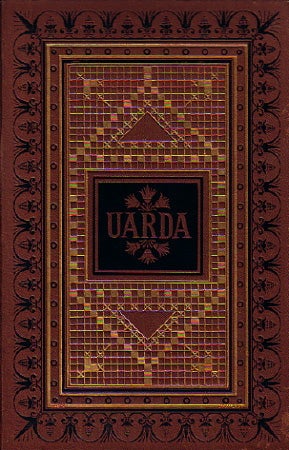
Uarda. Roman aus dem alten Aegypten von Georg Ebers. Achte Auflage. Erster [Zweiter, Dritter] Band.
Ebers, Georg Moritz, 1837-1898
Stuttgart und Leipzig: Druck und Verlag von Eduard Hallberger
1880
3 volumes, 194 x 132 mm.
Brown cloth stamped in Egyptian style in black and gilt. Upper cover stamp signed "Hasert" and "Stuttgart," lower left and right.

Goethes Hermann und Dorothea. Mit Illustrationen von W. von Kaulbach und L. Hofmann Mit Ornamenten von Chr. Neeser.
Goethe, Johann Wolfgang von, 1749-1832München: Verlagsantalt für Kunst und Wissenschaft vormals Friedrich Bruckmann
1880?
298 x 231 mm.
Dark green cloth stamped in Renaissance style in light brown, black, and gilt. Upper cover signed "L. Theyer" and "M. Brod" lower left and right. Brod worked in Munich.

Eine Frage. Idyll zu einem Gemälde seines Freundes Alma Tadema erzählt von Georg Ebers. Zweite Auflage.
Ebers, Georg Moritz, 1837-1898
Stuttgart und Leipzig: Druck und Verlag von Eduard Hallberger
1881
178 x 133 mm.
Red cloth stamped in Roman (or Pompeiian?) style in black, white, green, and gilt.
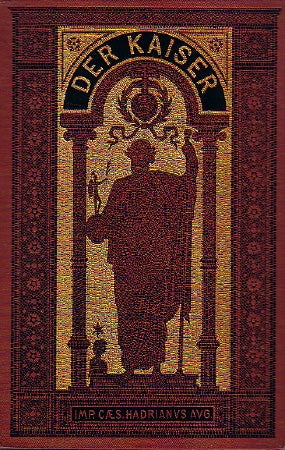
Der Kaiser. Roman von Georg Ebers. Neunte Auflage. Erster [Zweiter] Band.
Ebers, Georg Moritz, 1837-1898
Stuttgart und Leipzig: Druck und Verlag von Eduard Hallberger
1881
2 volumes, 194 x 136 mm.
Reddish brown cloth stamped pictorially in a "mosaic" style suggestive of imperial Rome in black and gilt.

Homo sum. [Quote from Terence, in Latin] Roman von Georg Ebers. Zehnte Auflage.
Ebers, Georg Moritz, 1837-1898
Stuttgart und Leipzig: Deutsche Verlags-Anstalt (vormals Eduard Hallberger)
1882
194 x 136 mm.
Dark green cloth stamped in a "Christian symbolic" style in black and gilt.
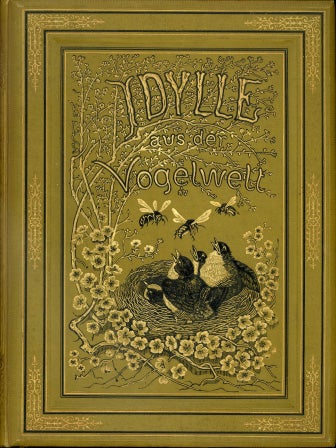
Idylle aus der Vogelwelt. Achtzehn Originalzeichnungen von H. Giacomelli. Mit Gedichten von Julius Sturm. Randzeichnungen von David Franz. Zweite Auflage.
Giacomelli, Hector, 1822-1904
Stuttgart und Leipzig: Deutsche Verlags-Anstalt (vormals Eduard Hallberger)
1882?
307 x 234 mm.
Bound by Deutschen Verlags-Anstalt. Mustard yellow cloth embossed blind, stamped pictorially in black and gilt. "Papier, Druck und Einband von der Deutschen Verlags-Anstalt in Stuttgart." on title verso. Pictorial stamp on upper cover (after drawing by Giacomelli) lettered "C. Hasert Stuttgart" lower left and right.
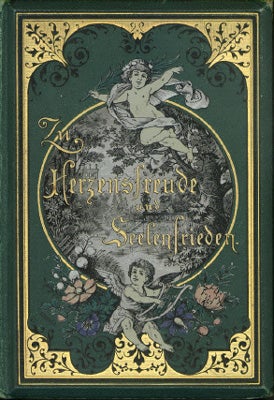
Zu Herzensfreude und Seelenfrieden. Klänge deutscher Dichter aus der neueren und neuesten Zeit.
Löschke, Karl Julius, ed.
Leipzig: Verlag von Th. Knaur
1882?
162 x 120 mm.
Zu Herzensfreude und Seelenfrieden. Klänge deutscher Dichter aus der neueren und neuesten Zeit. Herausgegeben von Karl Julius Löschke, evangelischem Pfarrer in Zindel, Kreis Brieg. Dritte Auflage, durch Dichtungen aus der neuesten Zeit erweitert und mit vielen Illustrationen versehen. Bound by Th. Knaur. Dark green cloth stamped pictorially in dark gray, light gray, pink, black, and gilt. "TH. KNAUR BUCHBINDEREI LEIPZIG." stamped in blind on lower cover. Mounted photograph incorporated into frontispiece.
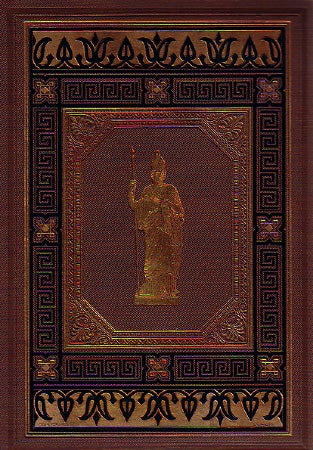
Die schönsten Sagen des Klassischen Altertums. Nach seinen Dichtern und Erzählern von Gustav Schwab. Vierzehnte Auflage, durchgesehen und vermehrt von Dr. Gotthold Ludwig Klee. Erster [Zweiter, Dritter] Teil. Mit 84 [68, 62] Abbildungen.
Schwab, Gustav, 1792-1850
Gütersloh und Leipzig: Druck und Verlag von E. Bertelsmann
1882
3 volumes, 204 x 152 mm.
Brown cloth stamped in Grecian style in black and gilt. Upper cover stamps signed "SCHÜSSLER" and "LEIPZIG" lower left and right. The classical statue depicted at the center of the upper cover varies with each volume.

Bergpsalmen. Dichtung von Joseph Victor von Scheffel. Bilder von Anton von Werner. Holzschnitt der xylographischen Anstalt von A. Closs. Dritte Auflage.
Scheffel, Joseph Viktor von, 1826-1886
Stuttgart: Verlag von Adolf Bonz & Comp.
1883
321 x 250 mm.
Red cloth elaborately embossed blind, stamped in a "medieval" style in gilt.
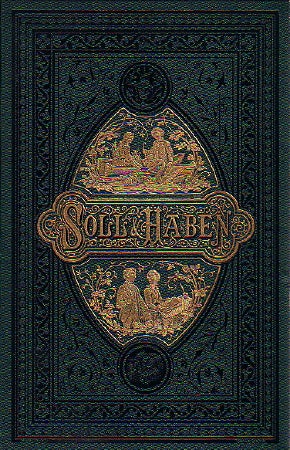
Soll und Haben. Roman in sechs Büchern von Gustav Freytag. [Quote from Julian Schmidt, in German] Neunundzwanzigste Auflage. (Neue Stereotyp-Ausgabe.) Erster [Zweiter] Band.
Freytag, Gustav, 1816-1895
Leipzig: Verlag von S. Hirzel
1884
2 volumes, 198 x 137 mm.
Dark green cloth stamped in part pictorially in black and gilt. Upper cover signed "H. Horn" and "Leipzig," lower left and right. With: The same. Achtundzwanstigste Auflage, 1883. Second volume only; brown cloth instead of green, decorated identically.
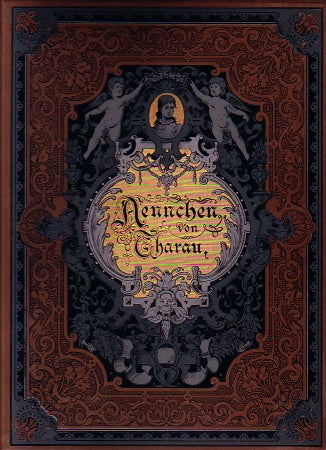
Aennchen von Tharau. Ein Lied aus alter Zeit. Von Franz Hirsch. Pracht-Ausgabe, illustrirt von Georg Knorr.
Albert, Heinrich, 1604-1651
Leipzig: Verlag von Carl Reissner
[1884]
298 x 228 mm.
Bound by W. Schaeffel. Medium brown cloth stamped in Renaissance style in light gray, dark gray, black, and gilt. "Einband von W. Schaeffel in Leipzig" on half-title verso.
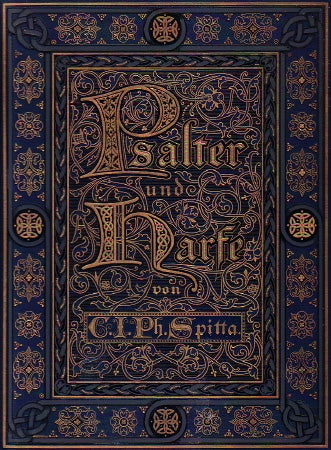
Psalter und Harfe. Von Carl Johann Philipp Spitta. Funfzigste Auflage. Jubel-Ausgabe.
Spitta, Karl Johann Philipp, 1801-1859
Bremen: Druck und Verlag von M. Heinsius
1884
300 x 230 mm.
Psalter und Harfe. Von Carl Johann Philipp Spitta. Funfzigste Auflage. Jubel-Ausgabe. Mit 24 Vollbildern, dem Portrait Spittas, Illustrationen und 42 Initialen nach Originalen von B. Plockhorst und F. Wanderer. Neu geordnet nach dem Vater Unser. Mit Einleitung und Biographie Spittas von Julius Sturm. Dark blue cloth stamped in Gothic style in light blue, black, and gilt. Upper cover stamp signed "WANDERER inv" and "H. HORN" lower left and right, indicating the cover stamp designer and engraver, respectively.

Souvenir de l'oberland bernois.
Seitz, J.
[n.p., 1885?]
102 x 154 mm.
Black cloth spine; gold embossed paper boards printed in maroon, with central onlaid printed photographs, the one on the upper cover with additional lettering.
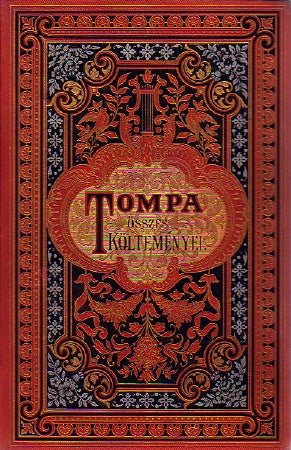
Tompa Mihály Összes Költeményei. Teljes Kiadás. Sajtó alá Rendezte Lévay József. Második Kötet.
Tompa, Mihály, 1817-1868
Budapest: Méhner Vilmos Kiadása
1885
208 x 144 mm.
Red cloth stamped in a vivid (and perhaps vaguely oriental?) adaptation of the Renaissance style in light blue, black, and gilt.
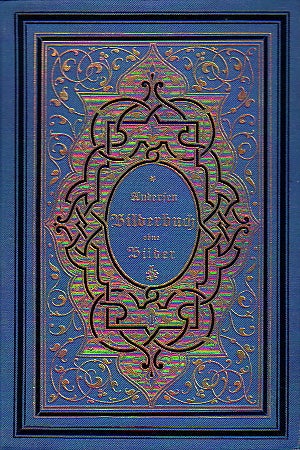
Bilderbuch ohne Bilder von H. C. Andersen. Einzige vom Verfasser besorgte deutsche Ausgabe. Neunzehnte Auflage.
Andersen, Hans Christian, 1805-1875
Leipzig: Ed. Wartig's Verlag (Ernst Hoppe)
1886
153 x 110 mm.
Bound by Julius Hager. Medium blue cloth stamped in a Grolieresque style in black and gilt. "JULIUS HAGER. BUCHBINDEREI LEIPZIG." stamped in blind on lower cover.

Paul Heyse. Der Roman der Stiftsdame. Eine Lebensgeschichte. Zweite Auflage.
Heyse, Paul, 1830-1914
Berlin: Verlag von Wilhelm Hertz (Bessersche Buchhandlung)
1887
182 x 131 mm.
Olive green cloth printed in dark pink and dark brownish red, stamped in black and gilt.

The Poetical Works of Henry Wadsworth Longfellow. With Prefatory Notice. Engravings on Steel.
Longfellow, Henry Wadsworth, 1807-1882
Edinburgh, London: Gall & Inglis; Leipzig: Rübe
[1888?]
196 x 142 mm.
Orange cloth stamped in "classical" style in a yellow to red split fountain, violet to brown ditto, blue, black, tan, and gilt, a polychrome effect worthy of a German trade binder. German publisher's name stamped on title; German price handwritten on front flyleaf. Despite these indications, the book's construction (chiefly the sewing and endpapers) reveal it as a British product imported into Germany.
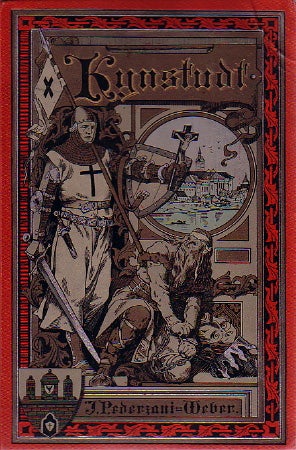
Kynstudt. Die Siege der Helden der Marienburg über die Heiden des Ostens. Kulturgeschichtliche Bilder, der reiferen Jugend erzählt von Julius Pederzani-Weber.
Pederzani-Weber, Julius, 1836-
Leipzig: Ferdinand Hirt & Sohn
1888 [i.e., 1898?]
228 x 160 mm.
Kynstudt. Die Siege der Helden der Marienburg über die Heiden des Ostens. Kulturgeschichtliche Bilder, der reiferen Jugend erzählt von Julius Pederzani-Weber. [Quote from Schiller, in German] Mit vielen Abbildungen nach Originalzeichnungen von Joh. Gehrts. Zweite Auflage. Red cloth stamped pictorially in imitation grisaille in grayish brown, gray, light gray, light blue, black, "silver," and gilt. Advertisements at back advertising new publications for 1899, indicating that this is almost certainly a re-issue of old printed sheets, probably in an updated binding.
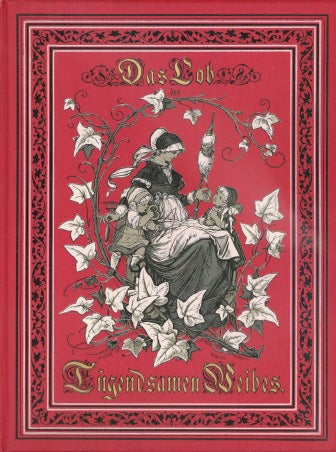
Das Lob des Tûgendsamen Weibes. Sprüche Salomonis 31. Vers 1031. 30 Compositionen von Ludwig von Kramer. Ausgeführt in 8 Heliogravuren und 22 Tondruckbildern. Mit poetischer Einleitung von Karl Gerok. Zweite Auflage.
Kramer, Ludwig von
München: Theo. Stroefer's Kunstverlag
[ca. 1889]
373 x 285 mm.
Red cloth stamped pictorially in black, white, gray, greenish gray, and "gold." Upper cover stamp signed: "M. BROD" (lower left), "MÜNCHEN" (lower right). Printed in two colors throughout.

Im Hause des Kommerzienrates. Roman von E. Marlitt. Mit Illustrationen von Heinrich Schlitt. Zweite Auflage.
Marlitt, E.
Leipzig: Verlag von Ernst Keil's Nachfolger G.m.b.H.
[1889?]
198 x 137 mm.
Bound by Leipziger Buchbinderei. Medium brown cloth stamped in a vaguely Gothic vegetal design in gray, dark gray, green, blue, tan, black, and gilt. "Leipziger Buchbinderei A. G. vorm: Gustav Fritzsche." stamped in black on lower cover. Author's real name is Eugenie John (1825-1887).
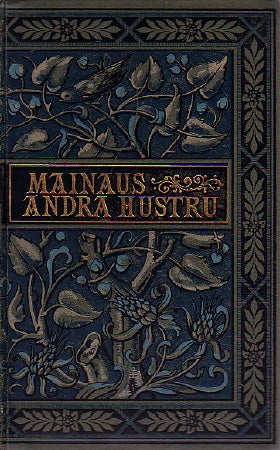
Mainaus andra Hustru. Roman af E. Marlitt. Fjärde upplagan. Med illustrationer af Alexander Zick.
Marlitt, E.
Stockholm: Albert Bonniers Förlag
[1894]
198 x 131 mm.
Grayish green cloth stamped in dark blue, light blue, tan, black, and gilt. Almost identical to, and clearly based quite closely on, the preceding; licensed? Or a plagiarism?
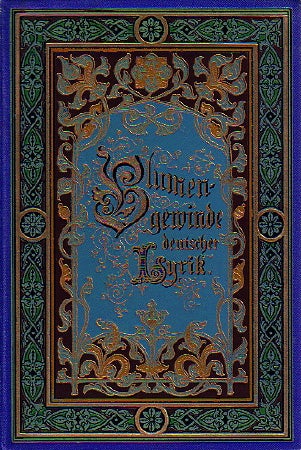
Blumengewinde deutscher Lyrik. Eine auslese neuerer Gedichte von Theodor Beytenmiller. Mit 26 Originalillustrationen von R. E. Kepler. Dritte Auflage.
Beytenmiller, Theodor, 1820-1898, comp.
Stuttgart: Emil Hänselmann's Verlag
[1890?]
182 x 130 mm.
Bright blue cloth stamped in a decorative floral style in green, brown, light blue, mustard yellow, gray, black, and gilt. Date inferred from inscription.
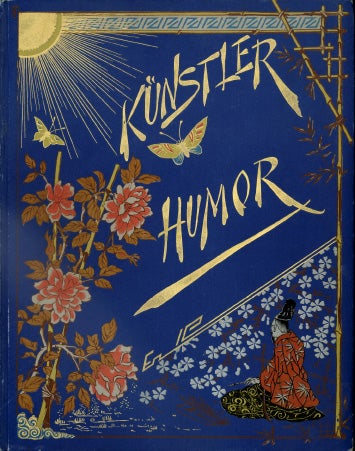
Künstler-Humor.
Berlin: Photographische Gesellschaft
[1890?]
319 x 252 mm.
Künstler-Humor. Dichtungen von V. Blüthgen, L. Fulda, J. Lohmeyer, E. Reinhold, Frida Schanz, R. Schmidt-Cabanis, Paul Schönfeld, Bernhardine Schulze-Smidt, J. Trojan, E. von Wolzogen, zu Bildern von F. Brütt, A. Conrad, Ph. Fleischer, E. Grützner, Ch. Heyden, L. Knaus, A. Rotta, B. Vautier. Bound by Julius Hager. Blue cloth printed pictorially in black, orange, yellow, light brown, reddish brown, light blue, greenish gold, and white; stamped in gilt, the gilt itself worked so as to give the impression of darker and lighter shades. "JUL. HAGER, BUCHBINDEREI, LEIPZIG." stamped in blind on lower cover. Toby E. Rosenthal's name is omitted (inadvertently?) from the list of artists on the title page.
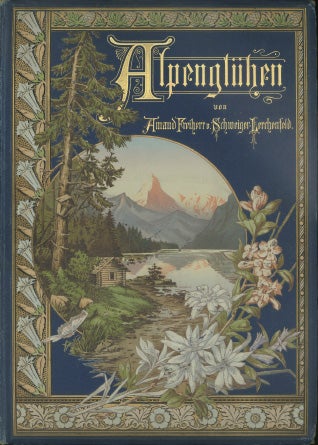
Alpenglühen. Naturansichten und Wanderbilder. Ein Hausbuch für das deutsche Volk von Amand Freiherr von Schweiger-Lerchenfeld. Mit 24 Vollbildern und 402 Illustrationen im Text.
Schweiger-Lerchenfeld, Amand, Freiherr von, 1846-1910
Stuttgart, Berlin, Leipzig: Union Deutsche Verlagsgesellschaft
[1892?]
324 x 238 mm.
Dark blue cloth stamped pictorially in brown, pink, green, tan, orange, gray, white, light gray, black, and gilt.

Kisfaludi Kisfaludy Károly Minden Munkái. Hetedik Bövített Kiadás. Sajtó alá rendezte Bánóczi József. Harmadik Kötet.
Kisfaludy, Károly, 1788-1830
Budapest: Franklin-Társalat
1893
175 x 128 mm.
Bound by Franklin-Társalat. Brilliant red cloth stamped in the typical Hungarian variation on the Renaissance style in gray, black, "silver," and gilt. "FRANKLIN-TÁRSALAT. KÖNYVKÖTÉSZETE" stamped in blind on lower cover.
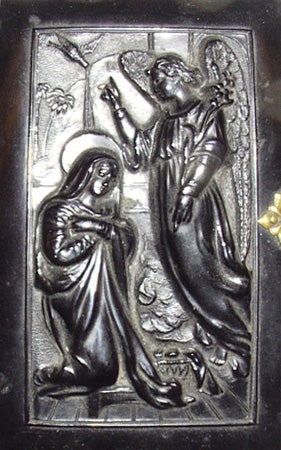
VzhÁru srdce k Pánu. Modlitební kniha pro katolické kÕesanky. Napsal Bohumil Zahradník, knçz církevní.
Zahradník, Bohumil, 1862-1939
V Praze: Nákladem A. J. Cellerina a syna
[1893?]
115 x 82 mm.
Black plastic spine and covers, upper and lower covers molded, brass clasp. Date inferred from approbation on title verso.
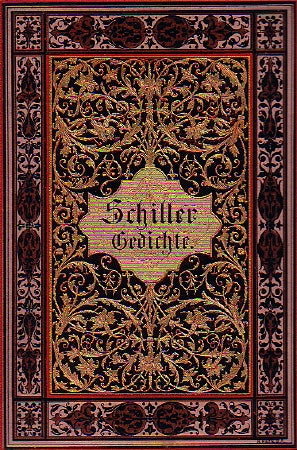
Schillers Gedichte mit Zeichnungen von J. Füllhaas. Zweite Auflage.
Schiller, Johann Christoph Friedrich, 1759-1805
Leipzig: C. F. Amelangs Verlag
[1894]
206 x 156 mm.
Red cloth printed in dark pink, brownish red, and black; stamped in gilt. Upper cover stamp signed "H. HORN G[ravier]. A[nstalt]." at lower right. Date from Amelang catalog for 1894, laid in and still present with the volume, which bears a presentation inscription dated 1897.
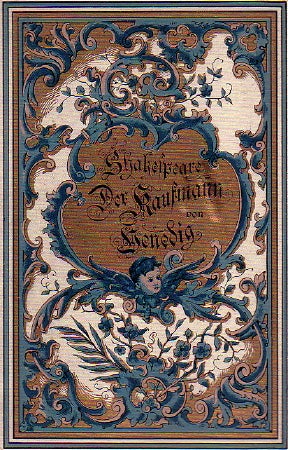
Der Kaufmann von Venedig. Lustspiel von William Shakespeare. Uebersetzt von August Wilhelm von Schlegel. Mit Illustrationen von F. Müller-Münster.
Shakespeare, William, 1564-1616
Berlin: Deutsches Verlagshaus Bong & Co.
[1896?]
230 x 156 mm.
Bound by Hübel and Denck. White smooth cloth stamped in a rococo design in blue, blue-gray, light tan, black, and "gold." "Hübel & Denck Buchbinderei Leipzig" stamped in blind on lower cover.

Sonnenschein in Schloss und Haus. Ein Jahrbuch aus dem Verlag von A. G. Liebeskind.
Leipzig: A. G. Liebeskind
1896
380 x 278 mm.
Bound by H. Fikentscher. Blue morocco-grained cloth stamped decoratively in green and gilt. "Einband von H. Fikentscher, Leipzig" on p. [iii] In original slipcase.

Fröschweiler Chronik Kriegs- & Friedensbilder aus dem Jahre 1870-71 von Karl Klein ehedem Pfarrer i. Fröschweiler. Illustriert von Ernst Zimmer.
Klein, Karl, 1838-1898
München: C. H. Beckscher Verlag Oskar Beck
[1897]
272 x 192 mm.
Bound by Leipziger Buchbinderei. Maroon cloth stamped in part pictorially in red, blue, light blue, tan, gray, greenish gold, light red, black, and gilt. "Leipziger Buchbinderei A. G. vorm. Gustav Fritzsche" stamped in blind on lower cover.

Kolumbus-Eier. Eine Sammlung unterhaltender und belehrender physikalischer Spielereien. Herausgegeben von der Redaktion des "Guten Kameraden" (Illustriert Knabenzeitung). Erster [Zweiter] Band. Vierte Auflage.
Stuttgart, Berlin, Leipzig: Union Deutsche Verlagsgesellschaft
[1897?]
2 volumes, 214 x 156 mm.
Smooth red cloth stamped pictorially in black, gray, yellow, pale blue, pink ("flesh"), gilt, and blind. The "egg" blindstamping on the upper covers is remarkable. Mixed edition: second volume in this set is first edition.

Stunden der Andacht. Ein Gebet- und Erbauungs-Buch für Israels Frauen und Jungfrauen zur öffentlichen und häuslichen Andacht, sowie für alle Verhältnisse des weiblichen Lebens. Von Fanny Neuda geb. Schmiedl. . . . Sechzehnte verbesserte Auflage.
Neuda, Fanny
Prag: Druck und Verlag von Jakob B. Brandeis
1897
181 x 124 mm.
White plastic spine and covers, upper and lower covers molded, upper cover with gilt incised decoration, onlaid plastic fretwork mount, and "gold" tablet representing the Commandments. Covers with brass edges and clasp.

Studienreisen. Freimüthige Aeusserungen über Kunst und Leben und speciell über das künstlerische und kunstgewerbliche Bildungswesen. Geschrieben, illustriert und herausgegeben von J. Stauffacher.
Stauffacher, J.
St. Gallen [Verlag von J. Stauffacher]
1897
250 x 189 mm.
Bound by Gebrüder Hug. Light gray cloth stamped pictorially in black, red, dark brown and gilt against a background printed in a darker to lighter blue split fountain. "Buchbinderei GEBRÜDER HUG & CO. Zürich" stamped in black on lower cover. Publisher from imprint at foot of spine.

Goethe's Faust Illustrirt von ersten deutschen Künstlern.
Goethe, Johann Wolfgang von, 1749-1832
Stuttgart, Leipzig, Berlin, Wien: Deutsche Verlags-Anstalt
[1898?]
304 x 230 mm.
Medium brown cloth stamped pictorially in dark brown, black, and gilt. Upper cover signed "W. F." or "F. W." at lower right. In original thin board slipcase with pasted on slip stating that this is the "Illustrirte Pracht-Ausgabe."
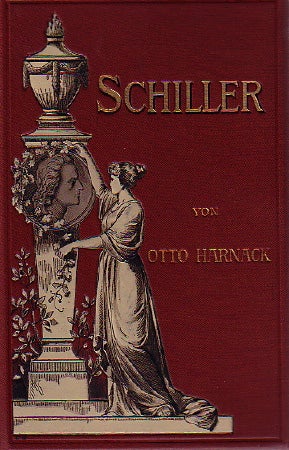
Schiller. Von Otto Harnack. Mit zwei Bildnissen.
Harnack, Otto
Berlin: Ernst Hofmann & Co.
1898
195 x 136 mm.
Bound by H. Sperling. Maroon smooth cloth stamped pictorially in white, gray, black, gilt, and blind."H. Sperling Buchbinderei Leipzig." stamped in blind on lower cover.

Trotzige Herzen. Roman von W. Heimburg. Mit Illustrationen von W. Claudius.
Heimburg, W.
Leipzig: Verlag von Ernst Keil's Nachfolger G.m.b.H.
[1898?]
198 x 134 mm.
Bound by Leipziger Buchbinderei. Blue-gray smooth cloth stamped in in an old-fashioned design in white, green, "gold," black, brown, a dark to light red split fountain roll, and gilt. "Leipziger Buchbinderei A.G. vorm. Gustav Fritzsche." stamped in black on lower cover. Author's real name is Bertha Behrens (1850-1912).

Der deutschen Jungfrau Wesen und Wirken. Winke für das geistige und praktische Leben von Karoline S. J. Milde. Zehnte Auflage.
Milde, Karoline S. J.
Leipzig: C. F. Amelangs Verlag
1898
180 x 128 mm.
Medium blue padded oilcloth stamped in a floral design in pink, yellow, white, light blue, green, tan, black, and gilt. Author's real name is Similde Gerhard (1830-1903).
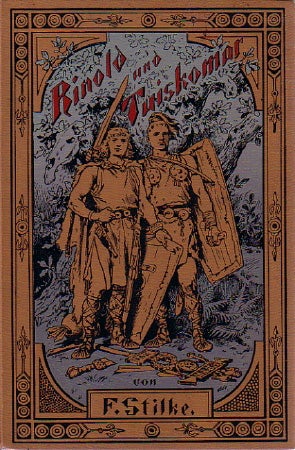
Rinold und Tuiskomar. Erzählung aus des Vaterlandes Vorzeit. Der deutschen Jugend reiferen Alters gewidmet von F. Stilke. 10 Vollbildern von Johannes Gehrts u. a. und vielen Abbildungen im Text.
Stilke, F
Leipzig: Ferdinand Hirt & Sohn
1898
224 x 161 mm.
Mustard yellow smooth cloth printed pictorially in black, red, and a light blue split fountain changing from greenish (top) to purplish (bottom) blue. Upper cover stamp signed "H. HORN" at lower left.

Gedichte von Wolfgang von Goethe. Erster Teil.
Goethe, Johann Wolfgang von, 1749-1832
Leipzig: Druck und Verlag von Philipp Reclam jun.
[1900?]
164 x 118 mm.
Bound by Hermann Crusius. Red cloth printed in pink and black, stamped in gilt. "HERMANN CRUSIUS. BUCHBINDEREI LEIPZIG." stamped in blind on lower cover.

Deutscher Zitatenschatz, eine Sammlung deutscher Zitate, Redensarten, Schlagwörter u. f. w. von D. Haek.
Haek, David, 1854- , ed.
Halle a. d. S.: Verlag von Otto Hendel
[1903]
179 x 126 mm.
Smooth gray cloth stamped in a vaguely Oriental Jugendstil design in light blue, dark blue, "gold," and gilt. "Eig. Buchbind. m. elektr. Betr." stamped in blind on lower cover.
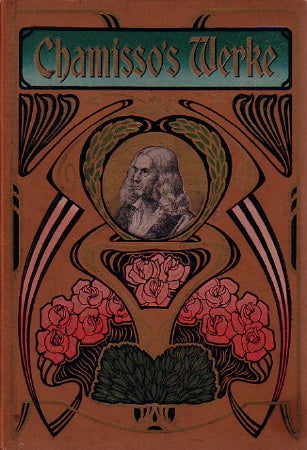
Adelbert Chamissos gesammelte Werke. Neue illustrierte Ausgabe. Herausgegeben von Dr. Karl Macke. Illustriert von Edmund Brüning.
Chamisso, Adelbert von, 1781-1838
Berlin: Verlagsdruckerei "Merkur" G. m. b. H.
[1904?]
241 x 176 mm.
Bound by Baumbach and Co. Medium brown paper boards printed in Jugendstil style in a dark to light blue split fountain roll, a deep to light pink ditto, green, black, gray, and gilt. "VEREINIGTE DAMPFENBUCHBINDEREI / BAUMBACH & CO. G.M.B.H. BERLIN-LEIPZIG" stamped in blind on lower cover. Date from inscription.
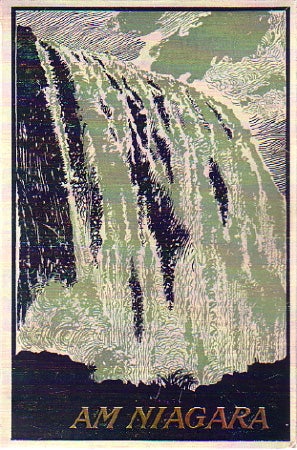
Am Niagara Gedichte von Mathias Rohr.
Rohr, Mathias
München: Jos. Roth'sche Verlagsbuchhandlung
[1905]
190 x 134 mm.
White cloth stamped pictorially in light green, black, and gilt. Poems written by a German-American journalist resident in Buffalo, New York.

Gedichte von Richard Wagner.
Wagner, Richard, 1813-1883
Berlin: G. Grote'sche Verlagsbuchhandlung
1905
199 x 145 mm.
Flexible purple-brown smooth cloth stamped in a Jugendstil manner in gilt, spine signed "R.K."?
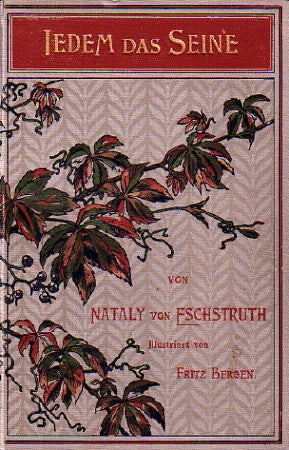
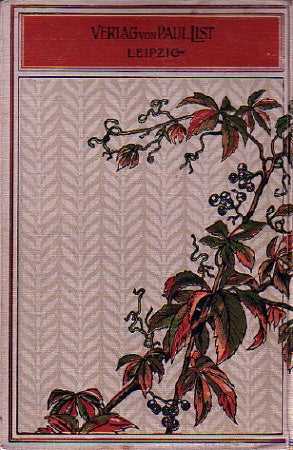
Iedem das Seine Roman von Nataly von Eschstruth Mit Illustrationen von Fritz Bergen I. [II.]
Eschstruth, Nataly von, 1860-1939
Leipzig: Verlagsbuchhandlung von Paul List
[1907]
197 x 134 mm.
Medium gray cloth in a floral design using all three cover surfaces, stamped in a lighter gray, red, brown, yellow, green, black, and gilt. Illustrations dated 1903.

Eduard Fuchs Die Frau in der Karikatur. Mit 446 Textillustrationen und 60 Beilagen. Elftes bis fünfzehntes Tausend.
Fuchs, Eduard, 1870-1940
München: Albert Langer Verlag für Litteratur und Kunst
1907
280 x 206 mm.
Gray sueded cloth stamped pictorially in Jugendstil style in black, white, tan ("flesh"), pink, and gilt. Upper cover signed "Reznicek." at lower left. A copy of the seventh thousand is known with a blindstamp on the lower cover identifying the Leipzig firm of E. A. Enders as the binder; perhaps this later printing - still in the original year of publication - was bound by a different house?
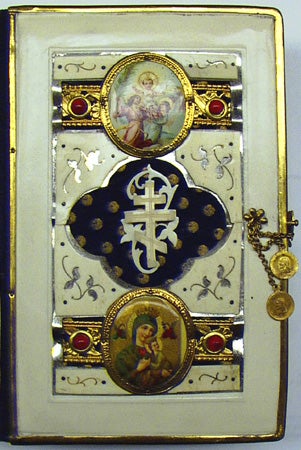
Görögszertartásu általános egyházi énekkönyv a hozzávaló imákkal. A Görög-Katholikus hivek lelki hasznára. Forditotta Danilovics János hajdu-dorogi püspöki vikarius. Kilenczedik kiadás.
Budapest: Rósza K. és Neje Kiadása
1907
180 x 128 mm.
White plastic spine and covers, upper and lower covers molded. Upper cover with central section in fretwork, velvet central medallion with "carved" plastic cross between metal bands eich with painted "icon" and "jewels." Three chains attached, each ending in medallion; brass edges; brass clasp. The ultimate in faux elegance? Prayerbook printed for Roman Catholic Hungarians in Transylvania.

Frauenspiegel von Oscar von Schönfeld.
Schönfeld, Oscar von
Berlin-Charlottenburg: Verlag Deutsches Adels-Archiv Maximilian Rosen
1907
147 x 102 mm.
Bound by Wübben und Co. # 18 of 20 copies on Japan vellum (beyond a regular edition of 600). Ivory silk printed pictorially in sepia from an intaglio plate, the only binding executed in such a manner known to the compiler. ". . . gebunden von Wübben u. Co. in Berlin." - p. [7]
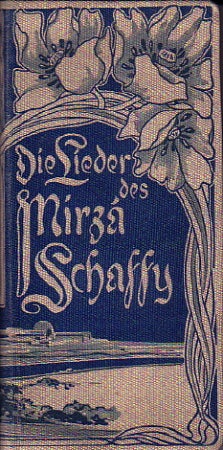
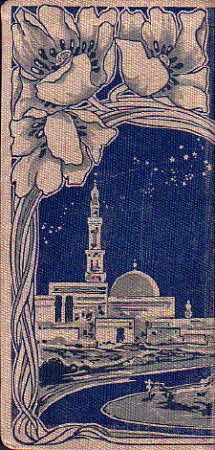
Die Lieder des Mirza-Schaffy mit einem Prolog von Friedrich Bodenstedt. Hundertzweiundsechzigste Auflage. 251. bis 255. Tausend.
Bodenstedt, Friedrich Martin von, 1819-1892
Berlin: R. v. Decker's Verlag G. Schenck, Königlicher Hofbuchhändler
1909
175 x 87 mm.
Vertically ribbed "natural" matte-finish cloth stamped in a Jugendstil oriental-pictorial design using all three cover surfaces, in dark blue and greenish gray.
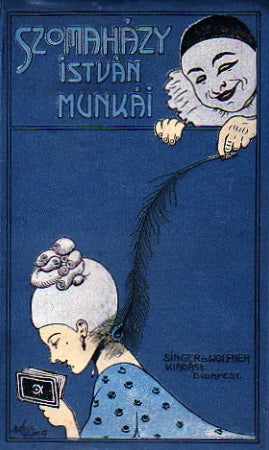
A Fehér Asztal irta Szomaházy István.
Szomaházy, István, 1864-1925
Budapest: Singer & Wolfner kiadása
1909
162 x 112 mm.
Bound by Gottermayer. Dark blue smooth cloth stamped pictorially in light gray, tan ("flesh"), light blue, and black. "GOTTERMAYER N. KÖNYVK. NÖINT. BUDAPEST." stamped in blind on lower cover. Upper cover signed at lower left: "Mober [indecipherable] 07"
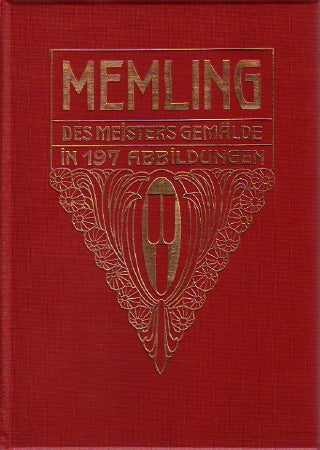
Memling des Meisters Gemälde in 197 Abbildungen. Herausgegeben von Karl Voll.
Voll, Karl, 1867-1917
Stuttgart und Leipzig: Deutsche Verlags-Anstalt
1909
259 x 194 mm.
Bound by Deutsche Verlags-Anstalt. Dark red cloth stamped in a restrained Jugendstil manner in gilt. "Buchbinderei / der / Deutsche Verlags-Anstalt / Stuttgart" stamped in blind on lower cover. In original dust jacket.

Hannover in Wort und Bild.
Kiepert, Adolf
Hannover: Verlag von Adolf Kiepert, Hofbuchhändler
1910
346 x 264 mm.
Herausgegeben vom Verein zur Förderung des Fremdenverkehrs in Hannover. Text von Adolf Kiepert mit 286 illustrationen nach Originalgemälden und Originalzeichnungen von [list of 9 names] sowie nach photographischen Originalaufnahmen. Bound by Hübel and Denck. Brown cloth stamped pictorially in blue, light orange, light green, off-white, red, gray, black, and gilt. "Hübel & Denck, Leipzig / Kgl. Bayr. Hofbuchbinderei." stamped in black on lower cover.
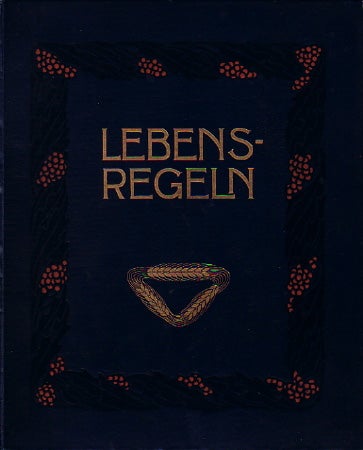
Lebens-Regeln.
Frankfurt am Main: Schirmer & Mahlau
ca. 1910?
235 x 195 mm.
Dark blue smooth cloth, upper cover stamped decoratively in black, pink, and gilt; spine lettered gilt. Chromolithographed throughout.
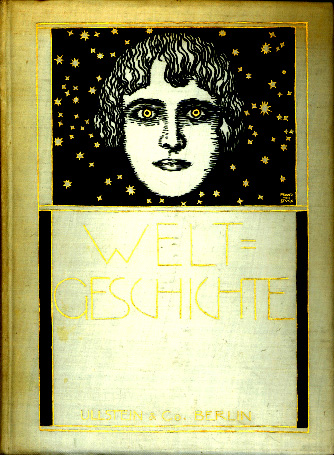
Weltgeschichte. Die Entwicklung der Menschheit in Staat und Gesellschaft, in Kultur und Geistesleben herausgegeben von Dr. J. von Pflugk-Harttung . . . [Geschichte des Orients]
Pflugk-Harttung, Julius Albert George von, 1848-1919, ed.
Berlin: Verlag von Ullstein & Co.
1910
290 x 224 mm.
White buckram printed pictorially in black and gilt. Pictorial section of upper cover signed "FRANZ / VON / STUCK" at lower right.
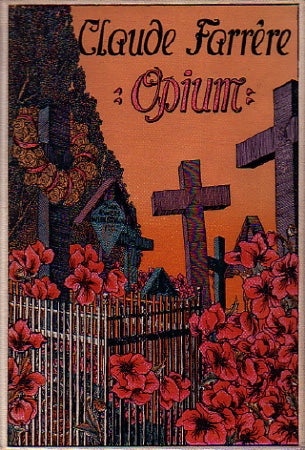
Claude Farrère Opium mit einem Vorwort von Hanns Heinz Ewers.
Farrère, Claude, 1876-1957
München und Leipzig: bei Georg Müller
1911
186 x 133 mm.
Heavily sized white cloth printed pictorially in an orange to red split fountain, brown, blue, green, and black.
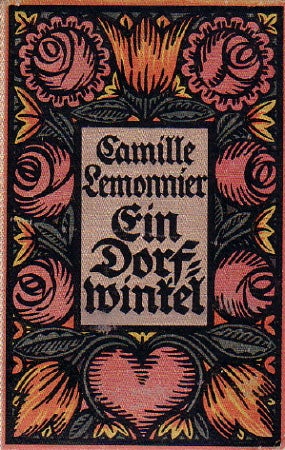
Camille Lemonnier Ein Dorfwinkel. Berechtigte Übersetzung aus dem Französischen von Jean-Paul d'Ardeschalz 13 Tausend.
Lemonnier, Camille, 1844-1913
Jena: Eugen Diederichs Verlag
1913
198 x 136 mm.
"Natural" matte finish burlap stamped in a rustic floral design in red, yellow, orange, green, and black.
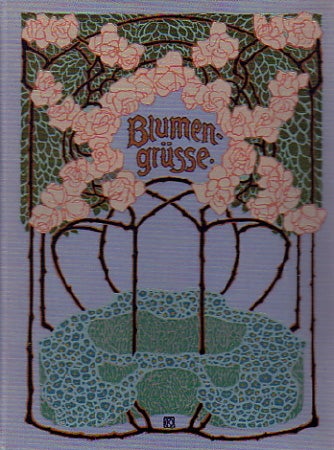
Blumengrüsse. Ein Strauss aus Deutschlands Dichtergarten in ausgewählten Gedichten von A. v. Wyl.
Wyl, A. von
Nürnberg: Theo. Stroefer, Kunstverlag
[1918?]
170 x 136 mm.
Bound by Max Baumbach. Gray cloth stamped in an almost Klimt-ian fashion in brown, orange, gold, at least three shades of green, light blue, black, and gilt. "MAX BAUMBACH / BUCHBINDEREI / LEIPZIG" stamped in blind in cartouche on lower cover. Upper cover signed "K" (in a circle, in a square), bottom center.
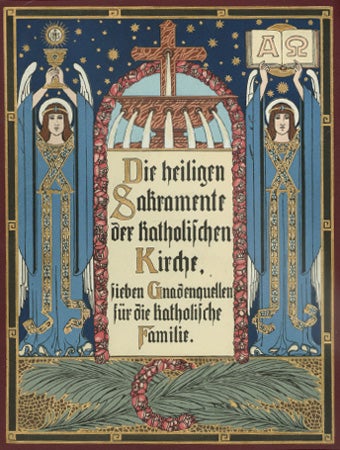
Die heiligen Sakramente der katholischen Kirche, sieben Gnadenquellen für die katholische Familie. Illustriertes hausbuch von Anton Steeger. Mit 24 Kunstbeilagen von Overbeck, sowie andern bedeutenden Künstlern. Mit bischöflicher Approbation.
Steeger, Anton
Stuttgart: Katholischer Bücher- und Schriften-Verlag (Inhaber: Philipp Brucker.)
[1920?]
292 x 244 mm.
Maroon cloth stamped in symbolic-pictorial style in red, white, blue, light blue, gray, brown, tan ("flesh"), black, and gilt.

Sein Recht Roman von E. Fischer-Markgraff 11. bis 20. Tausend.
Fischer, Elisabeth (Markgraff)
Reutlingen: Enszlin & Laiblins Verlagsbuchhandlung
[1920s?]
165 x 116 mm.
Yellow ocher smooth cloth stamped pictorially in green, white, and black. Part of a cheap series of reprints designed to be sold at the price of one mark per volume.

Der Kreidekreis. Spiel in 5 Akten nach dem Chinesischen von Klabund.
Klabund
Berlin: I. M. Spaeth Verlag
1925
185 x 115 mm.
"3. u. 4. Auflage" on verso of title page. Matte black cloth stamped in gilt and white. Double-fold sheets stabbed and sewn in the oriental manner. Author's real name is Alfred Henschke (1891-1928).