An Exhibit of Rare Books, Manuscripts, and Related Items
Georgetown University Library / Special Collections Division / 1996
Preface
The rationale for this exhibit springs from an awareness that the major changes computer technology have brought to the world of academic libraries in recent years deserve to be seen not as a wholly new circumstance, but as the latest in an extended series of technological changes that stretch back to the time of Gutenberg and even before.
The exhibit is focused to some extent on printed books, which are, when all is said and done, the main stock in trade of the academic library. But through examples culled from Georgetown's collections an attempt is also made to look at the evolution of libraries themselves; at the problems of preservation both in the first instance and in light of changing technologies; and at the broadening spectrum of information resources which now supplement the book. There is even an attempt made to trace by example, in a very limited way, part of the evolution of the computer itself, and especially so as it forms part of the world of libraries.
All of the items displayed are drawn from Georgetown's resources, chiefly from those of the Special Collections Division, but including materials from the main stacks of Lauinger Library, from the University Archives, and from the Woodstock College Archives. While many of the items are artifacts of considerable value in their own right, many others are not; together, we may hope, they suggest the rich complexity of one part of the history of human knowledge, its recording, its transmission, and its preservation.
George M. Barringer
March 1996
Case 1: The Manuscript Tradition
We think of manuscripts as unique, embodying in their existence information not available elsewhere. For correspondence, for diaries and journals, and to some extent for text manuscripts, this is the case; but much more frequently, in the case of texts, it is not. To some extent the medieval monastic scriptorium was a publishing house, and there was a flourishing business in the production of such liturgical texts as books of hours, missals, and breviaries long before the invention of printing.
More often unique are the products of a later time, such as the efforts of European missionaries and others to set down information from their cultures or those of their interlocutors in the languages of the indigenous peoples with whom they came in contact, in the process achieving the goal of reducing these oral languages to writing.
And until the very recent past the manuscript (or the typescript) was the vehicle for recording the earliest--and then the succeeding--versions of the writer's creative processes.
Super parabolas Salomonis
Bede [together with thirteen other texts, by various authors] Manuscript in Latin. [France, fifteenth century] Bound in contemporary stamped leather over boards, metal clasps (spine replaced). Provenance not known, but apparently acquired between 1935 and 1962. A collection of theological and exegetical texts, probably all copies of earlier originals. One cannot help wondering what or who--the taste of the scribe? or the desire of a prospective owner? or simply the binder?-- dictated the selection of texts included in volumes of this sort.
The Scots Psalter
O.T. Psalms. Manuscript in English. [Saint Andrews, Scotland, 1586] Written either by or for Thomas Wood, vicar and reader of Saint Andrews. Bound in later calf and marbled paper boards. Lacking Psalms 1-19 and (?) preliminary leaf or leaves. Part ( ?) of the library of John Gilmary Shea, purchased 1892. The "quintus part" of the second version of one of the most famous Scottish musical manuscripts, containing as a whole polyphonic settings of the Psalms and a few secular airs as well. Noteworthy as well for its polychrome marginal decorations. The first set of the "Scots Psalter " was produced in 1566.
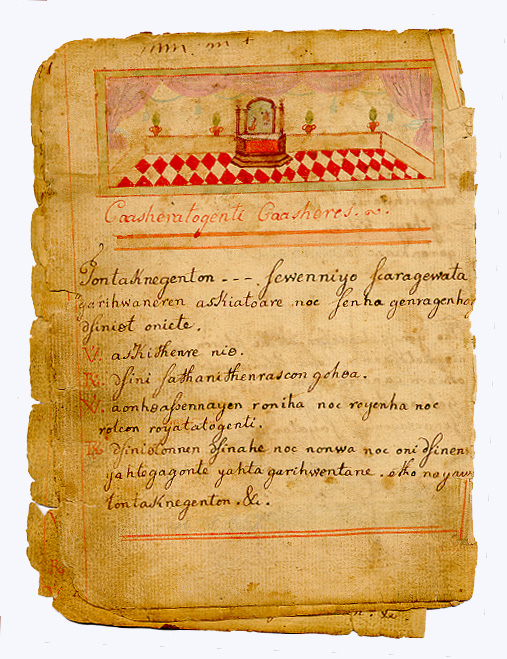
Untitled liturgical manuscript
Manuscript in Mohawk. [Lower Canada, ca. 1700] Generally attributed to Rev. Jacques Bruyas, S.J., though authorship has not been clearly established. In contemporary deer (?) hide with metal clasps. Part of the library of John Gilmary Shea, purchased 1892. Probably created for the use of Mohawk catechumens in the missionary settlements along the St. John's and St. Lawrence rivers, and probably in use during much of the eighteenth century. Harking back in its one polychrome illustration to the glories of European liturgical manuscripts.
Jami' al-tavarikh
Rashid al-Din Tabib Manuscript in Arabic script. [Persia, eighteenth century] Bound in pictorial lacquer boards. Four full-page illustrations. Gift of Archibald Roosevelt, Jr., 1983. A much later copy of an illustrated text from the medieval period setting forth the history of the Mongols.
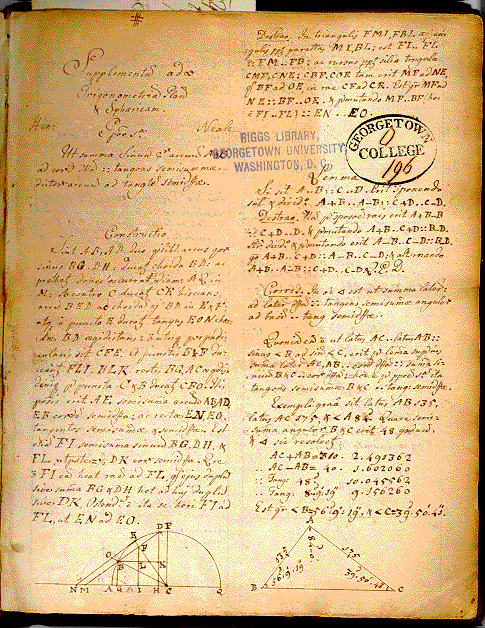
Untitled manuscript in Latin
Neale, Henry Liège? ca. 1724-30? Illustrated with charts and diagrams. Bound in contemporary calf, spine gilt. Provenance unknown, but part of the Georgetown collection prior to 1836. A collection of extensive lecture notes on a variety of scientific topics, probably taken down by Rev. Henry Neale, S.J., a native Marylander, during his course of studies at Liège (?) in the 1720s. While such notes give us a good idea of the content of the educational systems of the time, this manuscript was brought back to America by Neale as a reference source--a purpose respected when it was cataloged exactly as though it were a printed book in the early Georgetown College library.
Kama Sutra
Manuscript in Arabic script. [Afghanistan, late nineteenth or early twentieth century] Partially disbound, with 39 full-page illustrations. The text is generally attributed to Vatsyayana. Gift of David Gilsin, 1979. Most of the illustrations to the text are rather more explicit than the one shown. And the possibility must be considered that manuscripts such as this were created precisely with the idea of conveying to European visitors materials they very much wanted, but which their conventional rules of public discourse did not allow to appear in print.
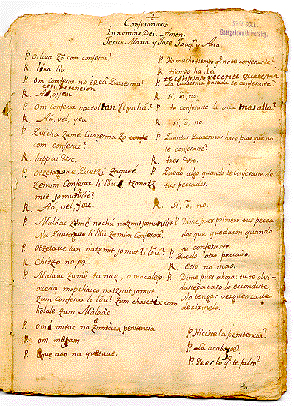
Confessionario
Manuscript in Antoniano and Spanish. [Monterey, California, second half of eighteenth century?] Unbound. Part of the library of John Gilmary Shea, purchased 1892. The manuscript provides language a priest would employ in asking a penitent member of his Native American flock about the precise nature of his sins. Human nature being pretty much a constant, considerable space is given over to possibilities dealing with the sixth Commandment in particular.
The Episode
Greene, Graham London? 1926 Typed manuscript prepared by an unnamed typing service from (presumably) a holograph original. Each of the chapters is bound up separately in the manner of the one shown. Part of the Catherine Walston Papers, purchased 1987. Apparently the only extant draft of Graham Greene's second, and never published, lengthy work of fiction, written in 1925-26, when the author was 22. In Greene's hand on the title leaf is given an alternate title: "Goodnight, Sweet Ladies."
Case 2: The Printed Word
The effects of Gutenberg's invention of printing on literacy, on education, on the regularization of the "vulgar tongues," and on the course of European history are well known. But printing brought about a revolution in libraries as well, one that has never been resolved.
The proliferation of the printed word made the collecting and saving of "everything" beyond the power of even the greatest purse and purpose. And as the technology of printing touched ever wider societal circles inevitably materials were produced which lacked the blessing of whatever cultural elite prevailed at that time and place. Traditionally, libraries have hewed quite closely to the lines of taste of the elites of their time. Yet others have not, and the purpose of the academic research library as we know it goes quite beyond the limitations of taste and tradition in seeking to record in its holdings not just what some future reader should have, but what that reader might want to have: one problem the computer does nothing to resolve.
Commentarii in omnes Divi Pauli Epistolas, ex restitutione D. Erasmi Roterodami diligenter recogniti
Ambrose, St. [Paris]: Jodocus Badius [1534] Later printing of Erasmus' edition, bound in nineteenth century Spanish calf gilt. Gift of Katherine Bowie, 1995. Beyond doubt the most memorable early images of the new print technology are found in the colophons which Josse Bade put on his title pages, ensuring the purchaser that he now had in hand a product of Gutenberg's wonderful invention.
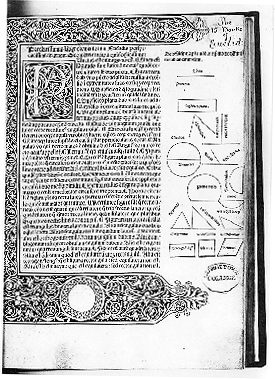
Praeclarissimus liber elementorum
Euclid [Venice: Erhard Ratdolt] [1482] First edition, rebound in recent full calf. Acquired in the mid-nineteenth century, source unknown. One of the earliest printed scientific works, remarkable for its time in its use of marginal diagrams to assist in the explanation of Euclid's propositions. The "high-speed" print technology did much to enable scientific communication and thus facilitated the centuries of discovery of Copernicus, Galileo, and Newton.
Omnium operum
Luther, Martin Jena: Christianus Rhodius 1556-58 Four volumes. Bound in nearly contemporary (1561) calf gilt, with Luther's head stamped on each upper board. Acquired (source not known) prior to 1836. The printing press made the Reformation possible. This edition of Luther's works recapitulates the numerous pamphlets he published after 1517, the ephemeral means by which he made known to an eager public the revolutionizing doctrine of salvation by grace through faith alone. Georgetown acquired this set of Luther's works before 1836, as it did also the great 1559 edition of Calvin's Institutes (on display on the third floor).
The British Apollo, or, Curious Amusements for the Ingenious. To which are added the most Material Occurrences Foreign and Domestick
[London: J. Mayo] [1708] Numbers 1-77, plus eight "supernumerary numbers." Bound up from the original issues. Gift of Charles H. Trunnel, ca. 1892. An early example of the periodical press, which over time would come to dominate the print industry and lead printers and publishers alike to search for ever faster, ever more powerful presses: the first rotary press began to print newspapers only a little over a century after The British Apollo.
A Tale of Two Cities. With Illustrations by H. K. Browne.
Dickens, Charles London: Chapman and Hall [1859] First edition, in the original eight parts (in seven). Original wrappers. Gift of Mary Ziegler Fockler, 1976. The publishing of works "in parts" brought the works of Dickens and others to a far larger buying public than would otherwise have been the case, the time-payment plan effectively outdistancing the comparatively very high cost of a novel published in three volumes, as most of the time in England were. The practice is mirrored in our own time by numerous " series" of relatively slender volumes on one or another subject, such as the famed Time-Life cookbook series.
Wallace Memorial Edition. Ben-Hur a Tale of the Christ.
Wallace, Lew New York and London: Harper & Brothers [ca. 1910] Reprint " limited edition," limited to 1,000,000 copies sold by the publishers to Sears, Roebuck; in the original cloth. Gift of Edith S. Mayfield, 1995. The cult of the limited edition began in earnest in the 1880s, with classic texts reprinted in sumptuous editions in fancy binding, in relatively small numbers. Trade publishers were quick to pick up the gimmick, however, and pursued it even to the absurd length shown here. And if the 1,000,000 copies of this edition were indeed printed, they have become scarce: this is the only copy the cataloger has seen in thirty years.
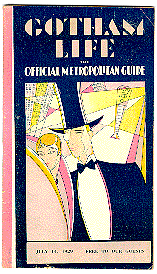
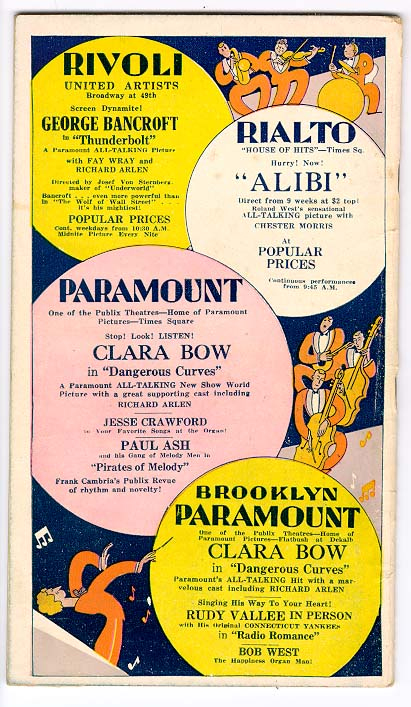
Gotham Life: The Official Metropolitan Guide. Vol. XXV, No. 13. Week of July 14, 1929.
New York: Edward A. Miller 1929 Original wrappers ( cover art by Paul Glueck). Provenance unknown. Ephemeral publications like this tourist guide (distributed free each week in every hotel room in New York in those hotels belonging to the New York Hotel Association) provided work for artists and writers unable to crack the "glossies."
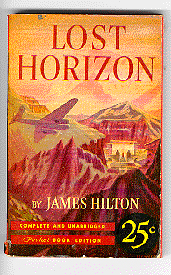
Lost Horizon
Hilton, James New York: Pocket Books [1939] First printing of the first regular volume issued by the pioneering American paperback house. In the original wrappers. Gift of the estate of Lisa Sergio, 1988. Although various publishers had attempted for almost a hundred years to start lines of paperback reprints, Pocket Books was the first to put all the requisite pieces together: low production costs, attractive cover art ( always unique to each title), an effective distribution system, and low price to the consumer.
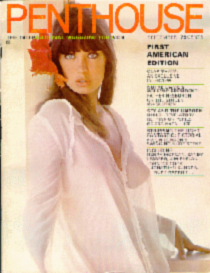
Penthouse: The International Magazine for Men
New York: Penthouse International Ltd. 1969 U.S. Volume 1, Number 1. September, 1969. " First American Edition," in the original wrappers. Gift of Homer V. Hervey, 1980. Piggy-backing on the success of Hugh Hefner's Playboy, Bob Guccione tried out his Penthouse in England for over a year before testing the American waters, and ever since both magazines (now, by the way, also available on the World Wide Web) have enjoyed commercial success and posed problems for schools, libraries, and those citizens who feel an irresistible urge to act as guardians of public morality.
Case 3: Changing Print Technologies
The earliest printing was done from matrices which gave the information on an entire page, the same as is still employed in picture printing. Movable type introduced a new era, but new processes such as lithography and new techniques such as stereotype and linotype found their places in satisfying on the one hand quite restricted and on the other quite large perceived markets. In this century we've seen the introduction of a variety of "near-print" processes employed for short-run jobs, and in the last thirty years the introduction of automated techniques for replacing the traditional pairing of type and paper.

Sorin darani
Nara? [764-770] An extract from the Buddhist Mujujokokyo sutra, with its original white-painted pagoda. Purchase ( part of University of Detroit rare book collection), 1985. Almost 700 years before Gutenberg, this prayer scroll and three others like it were produced in Japan at the command of the Empress Shotoku in editions of two hundred fifty thousand each, the entire project known as the Hyakumanto darani ("Darani in a Million Pagodas"). The process by which they were printed is still subject to scholarly debate, but after printing the scrolls were rolled and each was inserted into its own painted white pagoda, then deposited in temples in various parts of Japan.
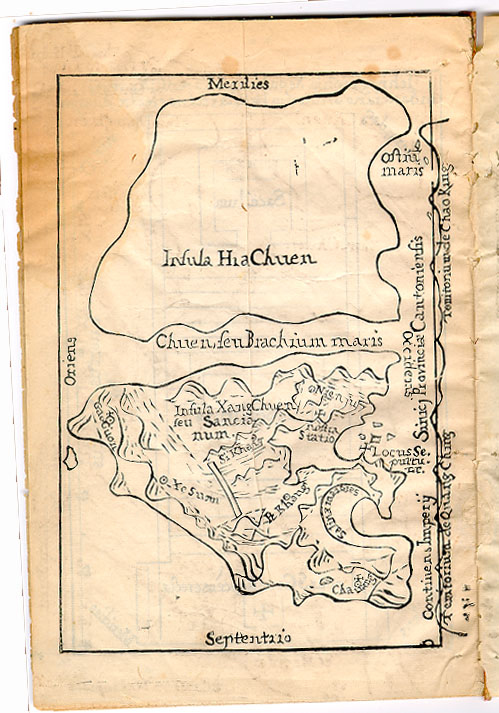
Relatio sepulturae magno orientis Apostolo S. Francisco Xaverio erectae in Insula Sanciano anno saeculari MDCC
Castner, Gaspar Peking? [1700] First edition, disbound. Part of the library of John Gilmary Shea, purchased 1892. The early Jesuits in China did not have access to European printing equipment, but they did manage to produce a small number of books. These were, like this one, printed from woodblocks on one side only of leaves folded in the Chinese fashion.
A Compilation of the Litanies and Vespers Hymns And Anthems as They are Sung in the Catholic Church Adapted to the Voice or Organ
Aitken, John Philadelphia 1787 First (only) edition of the first Catholic music book printed in America. Bound in early marbled paper boards, calf spine. Provenance unknown, but at Georgetown prior to 1937. With the exception of the contents/copyright leaf, printed entirely from engraved plates, the normal process for producing musical texts from the sixteenth century until the introduction of lithography in the nineteenth century. Texts in Latin and English. Not at all curiously, given its time and place of publication, the Compilation includes, though without words, a number of the great German chorales such as "Lasst uns erfreuen."
Le Guide du retraitant, selon l'esprit des Exercices de St. Ignace
Cotel, Pierre Amiens: Auto. Rossignol [ca. 1840?] Bound in later half roan and cloth boards. Provenance unknown, but at Georgetown prior to 1970. During the 1830s and 40s Jesuits in France, Italy, and the United States produced a number of texts for their own use printed lithographically. Exploited primarily for advertising, for music printing, and for purposes of illustration, lithography never became popular as a means of reproducing texts, and its use in cases such as this sprang probably from a market too small to justify the expense of regular printing.
Oeuvres. Tome premier.
Regnard, Jean François Paris: Dabo, Tremblay, Feret et Gatet 1819 Reprint edition, bound in marbled paper boards and calf spine, gilt. Provenance unknown. Edition printed from stereotype plates. A good notion of what people at the time hoped for from this then relatively new technology is given in the "Avis sur la stéréotypie" facing the title (translation by cataloger): Stereotyping, or the art of printing on solid plates which one saves, alone offers the means of reaching texts of perfect correctness. As soon as an error is discovered, it is corrected instantly and irrevocably; in correcting it, one is not in danger of making new ones, as happens in editions printed from movable type. Thus the public is assured of having books free from errors and of enjoying great ease in replacing, in works composed of several volumes, a volume missing, spoiled, or torn.
The Tribune Book of Open-air Sports
Hall, Henry New York: The Tribune Association 1887 First edition, in the original cloth. Gift of Willis Van Devanter, 1982. "This Book is Printed Without Type, being the First Product in Book Form of the Mergenthaler Machine which wholly Supersedes the Use of Movable Type."--printed at the foot of the verso of the title leaf. Linotype (the Mergenthaler process) and its near kin, Monotype (preferred in Britain), would shortly make printing from cast type the province of aesthetes and amateurs.
A General Account of the Development of Methods of Using Atomic Energy for Military Purposes Under the Auspices of the United States Government 1940-1945
Smyth, H. D. [Washington] 1945 First public edition, in the original wrappers (staples removed). Gift of Renee Amrine, 1976. This so-called "lithoprint" edition was distributed to the press at its initial briefing on the bombing of Hiroshima. It was preceded by two even more ephemeral and unobtainable versions, but it antedates by about six weeks the first appearance of the report in actual print.
The Long Short Cut
Garve, Andrew New York and Evanston: Harper & Row [1968] First printing, in dust jacket (ex-library copy). Gift of George M. and Penelope C. Barringer, 1983. "This is the first book for which the complete text was set by electronic composition. The text is set in 10 point Videocomp Janson, using the RCA Videocomp and computer system. The type was composed in complete page forms, written with an electronic beam on the face of the high-resolution cathode ray tube at speeds of up to 600 characters per second."--from page [167], where an early reader (not the donors) has pencilled in "AND IT WAS WRITTEN BY A COMPUTER!"
Case 4: Primary Preservation--Binding
Continuing the practice of an earlier time, bookbinders in the early centuries of printed books tended to produce bindings whose primary purpose was to protect their contents. Occasionally such bindings would be more or less ornamented, sometimes to the point where their initial purpose was disguised. Yet as printing spread and publishers aimed at a broader, lower-cost market, cheaper substitutes appeared, and occasional shortages of materials led to the cannibalizing of unwanted older manuscripts.
The nineteenth century saw the introduction of mechanized processes in bookbinding, and at the same time saw publishers, now responsible for the binding of whole editions of texts, reaching ever further in their efforts to attract purchasers by the "opulence" of their wares. And less and less attention was given to the concept of protection of the text block.
Etymologiae
Isidorus, St. [Cologne: Conrad Winters, de Homborch] [ca. 1478] Third edition. Original binding of stamped leather over oak boards (restored). From the library of Georg Kloss, donated by James Riordan, 1855. Enough of the original binding structure and the stamped upper and lower covers remain to convince us of the desire for extreme solidity that marked much of early bookbinding, and especially for volumes of considerable size.
Homiliarius Eckii contra sectas, ab ipso autore denuo recognitus.
Eck, Johann [Ingolstadt: Georg Krapf] 1536 Two volumes. Bound in contemporary alum-tawed pigskin, brass clasps intact. From the library of Rev. Thomas C. Levins, acquired 1844. The leather titling piece on the spine is a later (probably eighteenth century) addition; the original paper label giving the book's contents is pasted on the upper board. The taste for these pigskin (so-called " monastic") bindings survived, especially in Germany, into the eighteenth century.
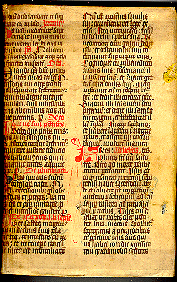
Practica ... omnibus tam Ius dicentibus quãm Advocatis utilis & necessaria
Ferrari, Giovanni Pietro Cologne: G. Calenius and the heirs of Johann Quentel 1590 Later edition, bound in a bifolium from a French manuscript of the fifteenth century. From the library of Rev. Thomas C. Levins, acquired 1844. Vellum became a popular binding material in the sixteenth century, and binders did not hesitate to supplement the supplies of new material--or substitute for them in times of scarcity--by cannibalizing earlier manuscripts.
Missale Romanum ex decreto sacrosancti concilii Tridentini restitutum
Antwerp: Ex architypographia Plantiniana 1765 Bound in contemporary full green morocco with silver edges, bosses, clasps and central medallions on both boards. Gift of Rev. Alphonse Verhoosel, S.J., 1946. This extravagant binding was created for a volume used for many generations in the family chapel of the Belgian Verhoosel-de Pelichy families, and their arms, as well as those of two related families, adorn the central medallions on the covers.
The Preacher
O.T. Ecclesiastes [London]: Longman & Co. 1849 Illuminated by Owen Jones. First edition, bound by Edmonds and Remnant (London) in leather spine with heat-pressed wooden upper and lower boards. Provenance unknown, but at Georgetown before 1970. This edition binding was designed by Owen Jones and typifies the brief mid-Victorian craze for unusual binding materials, more often encountered in the "papier-mâché" bindings adorning the productions of Henry Noel Humphreys. In both cases, the bindings were never meant to stand in rows on shelves, but to be articles of adornment for parlor tables.
Histoire de P. D'Aubusson-la-Feuillade, Grand-maître de Rhodes
Bouhours, Dominique Limoges: Barbou freres [ca. 1850] Reprint edition, in the original cloth, gilt, with multi-color onlays. From the library of Marcel A. Viti. Gift of Wheeling College, 1960s. A typical mid-nineteenth century French edition binding, a "cartonnage romantique" of the sort used for run-of-the-mill publications. Deluxe productions featured stampings created for each specific title. The use of colored onlays of leather or paper (as here) provided the reading public in general its first taste of polychrome bindings; the onlays gave way to stamping in colored inks in the late 1870s.
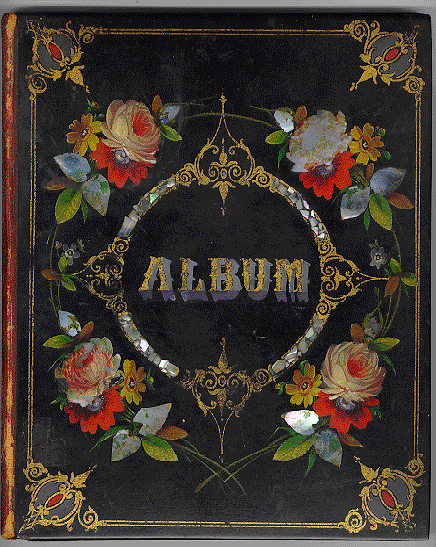
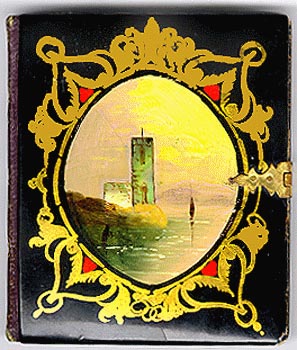
Cherished Memories
Album containing title leaf, several engravings, and blank leaves for the owner's use. Bound in contemporary American-style papier-mâché. Provenance unknown, but at Georgetown prior to 1970. Bindings of this sort were created by embedding thin slices of mother of pearl in the papier-mâché, then finishing off by stencil painting and gilding. They were used extensively for albums like this one and for daguerreotype cases, much less frequently for printed books; occasionally plaques of papier-mâché were inset in the center of leather boards. This was a more common American approach to the desire for polychrome effects than the use of onlays in the French manner.
Israelitisches Gebetbuch für die öffentliche Andacht des ganzen Jahres. Auf Anordnung der Breslauer Gemeinde-Collegien.
Joël, Manuel Berlin: Louis Gerschel; Breslau: Julius Hainauer 1872 First edition. Two volumes bound in one, in contemporary black velvet, gilt, additionally stamped in 1878 with an owner's initials and the date. Provenance unknown, but at Georgetown prior to 1970. Starting in the 1840s, the use of velvet as a casing material for volumes of religious interest was relatively frequent in Germany and the United States, if not elsewhere. As the velvet is difficult to stamp, it was frequently ornamented with inlays and metal edges.
Nebeská Cesta ku wecnymu zíwotu s wrúcnína modletbami okráfflená. Pre oboje poblawie.
Wimperk, Budapest and New York: J. Steinbreuer [ca. 1904] Bound in celluloid back and spine, upper cover in velvet and celluloid with metal onlays and stencilling, metal edges. Provenance unknown, but at Georgetown prior to 1970. The New York-based Steinbreuer firm produced similar items to this one (a Slovenian Catholic prayer book) in most of the languages of eastern Europe, including Hungarian, Polish, and Russian. These to our eyes garish and relatively inexpensive bindings satisfied the taste of large numbers of the new eastern European immigrants.
Case 5: Libraries Before Computers
Libraries have long shared common needs whatever their time or place: to identify books as their own, and to arrange them in a fashion such that they can be, when needed, retrieved. But as the number of libraries has increased, and as library users move from one to another more and more frequently, the impulse toward at least national if not universal standardization--one of the manias of the last two centuries--led to changes in the ways books were arranged. One of the commonest early systems was circumstance-driven: a set of bookcases might hold the greatest number of volumes if they were arranged by size, for instance. Succeeding systems, evolved in the European-dominated nineteenth century, have stressed arrangements based on intellectually dictated arrangements by "subject, " a scheme far better suited than size to accommodate those libraries whose stacks were now, for the first time, open to numerous researchers.
Index omnium Librorum Jeannis Le gast 1633
Le Gast, Jean Autograph manuscript, two pages, on binder's blank at front in St. Bonaventure, Opusculorum Theologicorum, Venice, 1584. Gift of the Sisters of Loretto, Nerinx, Kentucky, 1972. The catalog of the private library of a Belgian Catholic priest, containing works by Robert Bellarmine, Cornelis à Lapide, Thomas à Kempis, Ambrose Calepino, and others. More an informal list of books owned than a catalog, since the listing seems not to correspond to any logical arrangement of volumes on shelves.
Catalogue of Books, Maps, and Charts, belonging to the Library of the Two Houses of Congress. April, 1802.
Washington City: Printed by William Duane [1802] First edition, bound last in a volume of miscellaneous government documents of the years 1801-2. Gift of the estate of Mangum Weeks, 1982. The earliest printed Library of Congress catalog, recording the titles of some 960 books and 9 maps and charts, a collection destroyed when troops of the British army burned the Capitol in 1814, cataloged according to size. It was replaced by the much more famous collection sold to the Congress by Thomas Jefferson, the subject of a second catalog issued in 1815.
Alphabetical Catalogue of the Books in the Library of Georgetown College D.C.
[Washington] [1836 and later] Manuscript written by a Jesuit scholastic from notes taken by Rev. James Curley, S.J. The second catalog of the Georgetown collection (the first, by Rev.--later Bishop--James Van de Velde, is on display on the third floor), and the first attempt at a dictionary catalog. The main listing bears additions by James Ward in the 1840s, including a list of the library of Thomas C. Levins; at the front is Curley's list of books not in the main lists added through the year 1868. No works were cataloged thereafter until the 1890s.
Philosophia naturalis principia mathematica
Newton, Isaac London: J. Streater First edition. With the signature on the title of Rev. Henry Neale, S.J., who died in Philadelphia in 1748. Rebound in modern morocco. Provenance unknown, but at Georgetown before 1836. Part of the pre-1836 collection, as shown by the oval stamp at lower left with the pressmark A 310 written in. With the book is shown the original library stamp, used at least up until 1868.
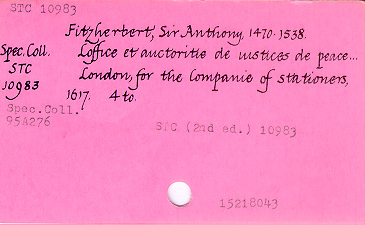
Hand-written library cards
Georgetown University Library ca. 1950 With later curatorial notes typed. When John Alden (later rare book librarian at the Boston Public Library) became assistant librarian at Georgetown, one of the tasks he undertook was the cataloging of part of Georgetown's rare book collection, gracing the entries with his fine italic hand. He took time, however, to write out only a main entry card and shelf list card for each title, operating under the assumption, no doubt, that the subject of an old book was quite unimportant.
Printed catalog cards
Library of Congress Originals issued 1904-14, as used at Georgetown up to 1993. Georgetown adopted the Library of Congress classification system in the 1930s, employing students to match books to available card sets--a duty not always accomplished with great exactness. Nonetheless, the effort provided the first subject and added-entry access to books in the library.
Classification Class J Political Science Second Edition
Library of Congress Washington, D.C. 1966 Rebound in library buckram. Purchase, 1966. Like the Dewey system before it, the Library of Congress classification system creates a subject matrix which determines where individual books will be disposed. Its near-universal acceptance in American research libraries makes browsing in any of them equally possible--or equally frustrating, given the lines of intended research.
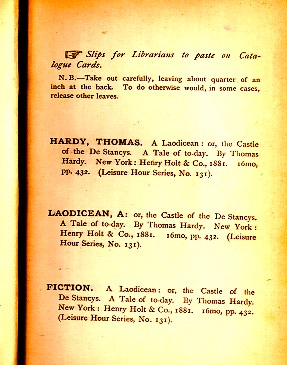
A Laodicean, or The Castle of the De Stancys. A Tale of Today.
Hardy, Thomas New York: Henry Holt and Company 1881 First American edition, in the original cloth. Gift of Eugene Meyer and Deborah Meyer Dewan, 1995. An early example of "cataloging in publication" is printed on a leaf at the front, including a cautionary warning about the manner of removing the pre-printed slips for author, title, and subject. The idea never caught on; with the advent of means of centralized cataloging and advanced communications processes, it has only fairly recently been revived.
Anglo-American Cataloging Rules ... North American Text
Chicago: American Library Association 1967 First edition. Purchase, 1967. The Rules represent perhaps the high-water mark in the attempt to reach a universally-standardized cataloging practice before the computer age. Yet as the pages displayed demonstrate, rules are meant to have exceptions and are inevitably subject to ongoing change, as revised editions have proven over the intervening years. The word "computer," so important today, does not occur in the index: McLuhan's prophecies regarding automation were not yet attainable.
Case 6: Secondary Preservation--Treatment or Replacement
If new books are more likely to show the effects of wear and tear sooner than old, it is hardly surprising that efforts aimed at preservation of their collections concern librarians now more than ever. The knowledge that most of the books printed between about 1870 and 1980 face certain destruction because of acid-tainted paper sharpens the hunt for means to treat the huge numbers of volumes involved at reasonable cost, or, at worst, to preserve the information contained in them in some other format.
But the bulk of preservation and conservation concerns even today focus on individual volumes rather than whole collections. The feeble edition bindings of the last century and a half fail almost at first touch, and we are coming to learn that some of the "cures" preached by conservators of earlier generations are as bad, if not worse, than the original disease.
Facts About Bookworms: Their History in Literature and Work in Libraries
O'Conor, J. F. X.
New York: Francis P. Harper
1898
Copy #122 of 750. Original cloth. From the library of the Georgetown College Journal, 1898. The first serious study of this renowned pest. In his preface O'Conor, at one time Georgetown's librarian, concludes thus: "A strange truth it is, that the same material that supplies food for the spiritual intellect of man should also supply food for one of the tiniest creatures in God's creation." Accompanying O'Conor's work is the still-surviving third volume of Haüy's Traité de minéralogie (1801), the subject of a telling illustration in O'Conor's analysis.
Document, signed
Carroll, Charles, of Carrollton 1796 In volume W.G No 4, 1794 to 1797, of Baltimore City chattel records. Now in the Woodstock College Archives, deposited at Georgetown in 1975. One of two such volumes in the Woodstock collection. This one bears a later typed note on the inside of the upper cover: "These chattel records were presented by Mr. H. Stafford Bullen. They came from the Baltimore city records after all such original records had been micro-filmed for official record." The routine destruction of original records was commonplace when microfilming was first introduced, yet chances are quite good that the film is no longer in a condition as good as these two volumes, which were written on good paper.
The Pacification of South Vietnam: Dilemmas of Counterinsurgency and Development
Grinter, Lawrence E. 1972 University of North Carolina at Chapel Hill, Ph.D., 1972 [Ann Arbor: University Microfilms International, 1983] Two volumes, paper wrappers. Donated by Russell J. Bowen, 1992. Facsimile reproduction has enabled the multiplication of copies of titles not originally truly "published," and it has presented an additional advantage, as summed up in words on the first leaf of the volume: "This is an authorized facsimile printed by microfilm/xerography on acid-free paper."
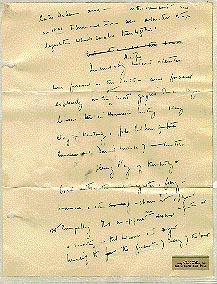
Autograph manuscript, signed
Kennedy, John F.
[1954-55?]
A leaf from his original handwritten notes for Profiles in Courage (1956). From the collections of the Gallery of Living Catholic Authors, donated to Georgetown by Webster College in 1980. The leaf has been encased in some unknown plastic material which adheres tightly on both sides. An unfortunate example of well-meaning " conservation" practice which may, or may not, prove to be reversible. The same technique was used on many of the more obviously valuable items in the Gallery's collections.
Hesperides sive De malorum aureorum cultura et usu libri quatuor
Ferrari, Giovanni Baptista Rome: Hermannus Scheus 1646 First edition. Rebound in library buckram in June, 1954, by the Heckman Bindery. Provenance unknown, but library-stamped at Georgetown in April, 1954. A classic example of "unsympathetic" conservation work, in which an amply illustrated and famed early work in natural history has been recased in a cheap and durable, but quite unattractive, binding.
Quinti Horatii Flacci Opera
Horace London: J. Pine 1733 Two volumes. First edition, the "post est" variant of the text. Bound in contemporary red morocco, gilt. Gift of Katherine Bowie, 1995. Damage to the splendid binding was hopefully, but fatally, repaired with one or another type of plastic "glue," one of the numerous magic fixes in book conservation which have done more damage than helped. Not only has the plasticizing failed, but because of the bond it forms with the leather it makes it impossible to restore properly.
The Constitution and Schedule of the Provisional Government of the Territory of Arizona, and the Proceedings of the Convention Held at Tucson
Tucson: J. Howard Wells 1860 First edition, disbound. From the library of John Gilmary Shea, purchased 1892. The Special Collections Division houses thousands of pamphlets, though not many of the rarity and historical importance of this one. All, however, when cataloged are housed in acid-free envelope folders like the one displayed in company with this first "book" to be printed in the Arizona Territory.
Borneo People
MacDonald, Malcolm London: Jonathan Cape [1956] First edition, in the original cloth. From the library of the British Embassy, donated to Georgetown in 1980. One of several test volumes de-acidified with magnesium oxide in June, 1995, by Bookkeeper Preservation Technologies. Mass de-acidification is probably the only available means by which the great portion of the library's collection can be preserved for future generations.
Travels in Arabia
Wellsted, J. R. London: John Murray 1838 Two volumes. First edition, in the original embossed cloth. Gift of John C. Hirsh, 1990. The restoration work performed on the spines of each volume of Wellsted's treatise reveals clearly that it was done, but provides a sympathetic use of the fragments of the original cloth as well as solidifying the structures of the two volumes.
Case 7: Control by Computer: The First Steps
It is virtually a truism that if a desired condition involving the manipulation of data can be formulated a computer can be programmed to produce the desired result. Thirty years ago this was not the case, and vast databases for librarians such as OCLC and RLIN were, if even dreamt of, on the very far horizon.
Advances in miniaturization and in communication have produced results undreamt-of a generation ago, but some of the steps leading to those results, and the machines which started us on the road to achieving them, even now cannot help but strike us as hopelessly primitive: what earthly use would there be for a portable computer which could not handle simple word processing?
Portable Computer Model 5100
IBM 1976 Gift of George Weil, 1988. The Model 5100, one of the earliest computers put on the market for home use, was available in two versions. The one displayed here (at left) used the APL programming language; its counterpart used either APL or Basic. Neither supported word processing software. Also displayed are the Model 5103 printer and operating manuals for the computer (which still works, by the way).
System 7 Circulation Control System
IBM 1973 Purchase. Lauinger Library's first computerized circulation system "utilizes a mini-computer with 10K core and disk storage within the Circulation Department and 2791 Series Collection Date Terminals at the charge-out desk. " (Library Bulletin, March, 1973). Daily transactions were transmitted via telephone lines to an IBM 370 in the Reiss Building. Shown are one of the "core" memory boards and a selection of the punchcards inserted in books which controlled their circulation data.
TG-6180
Tallgrass Technologies 1985 Purchase. The Special Collections Division's first mass data storage device, which could handle 80 megabytes and featured a built-in tape backup unit. It was linked to the various computers in the division work areas by 5.25-inch floppy disks and "Sneakernet."
Understanding Media: The Extensions of Man
McLuhan, Marshall New York: McGraw-Hill [1964] First edition, in the original cloth. Gift of Eugene Meyer and Deborah Meyer Dewan, 1995. McLuhan's concluding chapter, entitled "Automation: Learning a Living, " marks one of the pioneering attempts to understand the lessons which we have all had to learn in the age of the personal computer, local area networks, and the Internet.
Case 8: Emerging Information Sources
To the array of printed sources available in the past, over the last century and a half have been added others such as still photographs and slides, motion pictures and videotapes, and the many varieties of recorded sound. And in the last few decades all of these have found a place in the collections of research libraries, offering ever greater possibilities for original scholarly work while demanding a new set of responses from librarians trained to deal with books and journals and government documents.
Aikin, William E. A. Notice of the Daguerreotype. Baltimore: John Murphy, 1840
First edition. Disbound. With a presentation inscription from the author to Rev. Virgil H. Barber, S.J. Gift of Fr. Barber, date not known, but not long after the date of publication.
One of the earliest American descriptions of Daguerre's process, with which photography came of age.
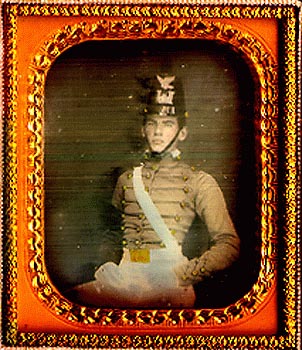
Daguerreotype portrait of General Horace Porter in his West Point cadet uniform
Unknown Photographer
[Ca. 1855-60] In the original papier-mâché case. Gift of Mrs. Horace P. Mende, 1994.
A very early, if not the earliest, portrait of a West Pointer in uniform, taken near the end of the popularity of the cumbersome Daguerre process, which produced images on copper plates.
History of the Photographic Scientific Experiments and Developments leading to the Perfection of the Vitascope
[n.p.] [ca. 1895] First (only) edition, in the original printed wrappers. Gift of Martin Quigley, 1979. The first history of motion pictures, probably written largely by W. K. L. Dickson, an associate of Edison who directed some of the earliest short films. With this is shown the name plate from the fourth Vitascope manufactured, probably in 1895 (from the Thomas Armat Papers, donated by Mary T. Armat, 1988).
The Vitascope
Raff, Norman C. New York: Raff & Gammon [1895] First edition, in the original printed wrappers. Gift of Martin Quigley, 1979. The earliest printed prospectus for marketing the newly developed machine, the first successful motion picture projector.
The Telephone: an Account of the Phenomena of Electricity, Magnetism, and Sound, as Involved in its Action. With Directions for Making a Speaking Telephone.
Dolbear, A. E. Boston: Lee and Shepard; New York: Dillingham 1877 First edition, in the original cloth. Provenance not known, but probably acquired not long after publication. Dolbear provided the first printed history of the telephone and is remembered today for that more than for his own attempts to secure the patent rights on the new invention. Had he triumphed over Alexander Graham Bell whole generations might have complained about "Ma Dolbear."
How Can We Stop Russia?
Georgetown University Radio Forum Forum # 282, April 20, 1952. Archival tape recording of the original broadcast, from the University Archives. Featured on this recording were future president Richard M. Nixon, Ambassador William C. Bullitt, and Georgetown lecturer in geopolitics Stefan T. Possony. All of the approximately 1,500 broadcasts of this program, which ran from 1949 to 1972, were recorded, and the tapes preserved.
Case 9: A Complex Present--and Future?
As the timeline on which the mingled histories of books, of libraries, and of technologies are chronicled approaches the present the rate of change in technology, as in the character of books and libraries, increases dramatically. If we've enjoyed almost a half century in which to integrate the information resources of recorded and photovisual media into our collections and planning, we've had to adjust to computer-generated sources in just a few years. And we must learn to take what consolation we need from history's lesson that victory has never gone to the side of the Luddites.
An Inquiry into Ulysses: The Corrected Text
Kidd, John Boston: James Joyce Research Center, Boston University 1989 First edition, in the original printed wrappers. Gift of the James Joyce Research Center, 1989. This is copy #35 of 100 copies which were issued with the text recorded in WordPerfect 5.0 on a 3.5-inch disk, and with instructions for use of the disk file bound in at the end of the reprint. An early publication in electronic format, displaying its makers' insecurity in its accompanying and dominating printed version.
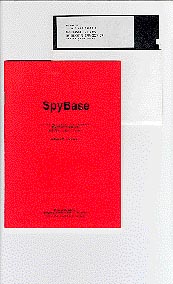
SpyBase: An Indexing System for Law Enforcement Intelligence Operations and Other Research Projects
Prunckun, Henry W. Wayville, South Australia: Slezak Associates 1991 First edition, in the original printed wrappers. Gift of the author, 1992. With the program, on a 5.25-inch floppy disk. The first example of software added to the Russell J. Bowen Collection on Intelligence, Spying, and Covert Activities, which extends to some 14,500 titles.
Caviar 2250 AT Compatible Intelligent Drive
Western Digital 1993 Purchase. A "deceased" 200 megabyte hard disk. It is worth comparing, to understand the rapid progress of miniaturization, this drive with the memory board from the IBM System 7, which with a number of such boards had a " core" memory of only 10 kilobytes. The addition of a tantalizing model name shows the development of the medium as a commercial venture, leaving behind both the austere model numbers and hippie-ish company names of earlier times.
HomePC
[Manhasset: CMP Media] [1995] Volume 2, number 12. December, 1995. Original wrappers, with the accompanying free disk containing America Online software. Gift of George M. and Penelope C. Barringer, 1995. To understand something of the speed of technological change we need only look at the timeline that shows McLuhan's then very difficult analysis of automation in 1964; George Weil's clumsy, but indeed portable, personal computer in 1976; the publication of Henry Prunckun's very specialized software in 1991; and the provision of "free" software with this magazine aimed entirely at the home entertainment market.
Welcome to EIRC
Georgetown University. Lauinger Library. Electronic Information Resource Center. 1996 Broadside. The printed introduction to the library's wealth of electronic resources. Shown also are a sampling of other, more specific sheets aimed at explaining individual aspects of the possibilities available in EIRC. A signpost, perhaps, to a very different kind of library yet to evolve.