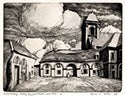
Monastery, Parey sous Montfort - Haute Vosges
DePol, John, 1913-2004
1947
Etching
6 x 8 in
Based on 1945 drawing in situ Our exhibition begins with an example of John DePol's work in etching, an "avocational pursuit" that engaged him for approximately a decade before he produced his first wood engraving in 1947. DePol recently had returned from war-time duty as a sergeant in the U.S. Army Air Corps, in England, France, Germany, and Northern Ireland. While overseas he made a drawing of the monastery of Parey-sous-Montfort, near the town of Vittel in the Vosges Mountains of Eastern France, where his unit was stationed for a few months. The monastery served also as a school, and DePol described his experience there in the third paragraph of his 1985 typed manuscript displayed herewith. The image was drawn and etched on the plate at his mother's apartment on 12th Street in the Village, and then printed at the Art Students League, where DePol had studied printmaking since 1938.
Monastery, Parey sous Montfort - Haute Vosges
DePol, John, 1913-2004
New York : Security-Columbian Banknote Company
Offset Christmas Card
6 1/8 x 8 1/8 in.
The Monastery, at Parey sous Montfort, Haute Vosges, France
DePol, John, 1913-2004
ca. 1950
Wood Engraving
3 1/2 x 5 1/2 in.
These Christmas cards from the DePols depict scenes in and around the spa town of Vittel in Haute Vosges, France, where the artist spent part of his wartime duty.
Etching : Monastery, Parey-sous-Montfort, Haute Vosges
DePol, John, 1913-2004
August 1985
Manuscript
typed; unpublished
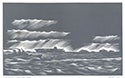
Atlantic Convoy
DePol, John, 1913-2004
1943, (printed 1993)
Wood Engraving
5 1/8 x 8 1/2 in.
This represents the Block Island, a medium-sized escort carrier that transported Sergeant DePol to Northern Ireland in July 1943. It was on its maiden voyage, and was hit by a torpedo the following year. DePol recalled in his "G.I.'s Recollections", published in Ireland Remembered (see case N5), "We were in convoy with seven other vessels composed [sic] of cargo ships, service vessels and troop-carrying merchantmen. We headed south and were joined by the cruiser ‘Augusta' as escort. Surrounded in a protective screen of eight destroyers we then turned northward into cold, wet, foggy weather."
To Jim Fraser, Fairleigh Dickinson University
DePol, John, 1913-2004
March 15, 1993
Letter (unpublished)
"(to accompany print ‘Atlantic Convoy 1943')"
GI Stove
DePol, John, 1913-2004
New York : Security-Columbian Banknote Company
1973
Wood Engraving; Holiday Card
5 1/2 x 3 3/4 in.
From a drawing made in 1944-45 Signed "Thelma & John" Printed letterpress from the original blocks by Security-Columbian Banknote Company, New York, 1973 The "GI Stove" is a view of DePol's office in Vittel with his portable typewriter and a field phone on the table at left; his canteen cup and a can are on the stove at right.
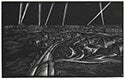
Chipping Ongar Aerodrome 1945
DePol, John, 1913-2004
1995
Wood Engraving
5 1/4 x 8 1/2 in.
The original drawing for this engraving was made on New Year's Day, 1945 at the aerodrome north of London near Chelmsford.
To Jim Fraser, Fairleigh Dickinson University
DePol, John, 1913-2004
March 18, 1995
Letter (unpublished)
Chipping Ongar Aerodrome, 1945....
Domjulien, Haute Vosges, France
DePol, John, 1913-2004
New York : Security-Columbian Banknote Company
1971
Wood Engraving; Christmas Card
3 3/4 x 5 1/2 in.
From a sketch made in 1944 Signed "Thelma & John" Printed letterpress from the original blocks by Security-Columbian Banknote Company, New York, 1971 The town of Domjulien is near Vittel and Parey Sous Montfort, depicted in the etching in case N1.
Chapel in Belmont, Haute Vosges, France
DePol, John, 1913-2004
Iron Horse Press
ca. 1949
Wood Engraving; Christmas Card
3 x 4 in.
Wood engraving affixed to Christmas card from John & Thelma DePol Sketched on site 1945; printed at Iron Horse Press, ca. 1949
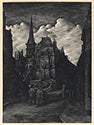
Bishopsgate, London
DePol, John, 1913-2004
1948
Wood Engraving
7 x 5 1/8 in.
sketched on site 1945; engraved 1948 Bishopsgate was one of the medieval entranceways to the city of London. DePol made two versions of this bomb-damaged London street from an on-site sketch made during the war. The earlier engraving, looking much the same as this one, was smaller.
An autobiographical sketch
DePol, John, 1913-2004
Journal of the Society of American Wood Engravers (Winter/Spring 1991): 4-9.
County Derry
DePol, John, 1913-2004
1959
Wood Engraving
5 1/2 x 7 3/4 in.
Preservation Print - Print Club of Albany / No. 241 In 1947, John DePol returned to Northern Ireland with his wife Thelma to revisit some of the sites where he had served during the war. DePol sketched some forty different subjects during their stay, which were converted into original prints after he returned to New York. They were featured in an exhibition at the Fairleigh Dickinson University in 1982 and published in the exhibition catalogue Ireland Remembered. DePol's final print of the series, County Derry, a scene "just north of Magherafelt, near Moneymore," was engraved in 1959.
Ireland remembered
DePol, John, 1913-2004; Hitchings, Sinclair, 1933-; Weber, Renee
Madison, N.J. : The Friends of the Library, Fairleigh Dickinson University
1982
Catalog designed by John Anderson of the Pickering Press. John DePol collaborated with John Anderson over a forty-year period beginning in 1952. During the summers of 1979-85 they both taught in the book arts program at Fairleigh Dickinson University. DePol taught wood engraving and Anderson hand-press printing in the production of fine-press book editions
Ireland Remembered / John DePol : an exhibition
DePol, John, 1913-2004
Madison, N.J. : Florham-Madison Campus Library, Fairleigh Dickinson University
November 1982
Exhibition Poster
Poster designed and printed by John Anderson at the Pickering Press.
Ireland Remembered, reception invitation
DePol, John, 1913-2004
Madison, N.J. : Florham-Madison Campus Library, Fairleigh Dickinson University
November 1982
Two lovely beasts
DePol, John, 1913-2004
1950
Wood Engraving
5 x 4 in.
Liam O'Flaherty's Two Lovely Beasts and Other Stories was one of the last works written by the famous Irish novelist and storyteller (1896-1984). The first edition (1948) was not illustrated; DePol's wood engravings - his first book illustrations, executed only three years after he began to focus on wood engravings - appeared in the second edition two years later, and included this bleakly bucolic scene that accompanied the title work. Then his heart began to beat wildly as he watched the two calves cavort together with their tails in the air. He became intoxicated by the idea of possessing them both. "Two lovely beasts!" he whispered. (10-11) Set in rural Ireland during the Second World War, the story is a dark parable of the several vices and virtues - pride, envy, wrath, charity, fortitude, temperance, and so forth - reflective of the author's youthful enthusiasm for collectivist politics, expounded as the master of the house is persuaded by a desperate widow neighbor to buy her orphaned calf and to raise two male calves on his twenty barren acres. According to A Catalogue Raisonné of His Graphic Work, "DePol, still a neophyte, summoned enough courage to call upon the publishing office of Devin-Adair Co., asking if he might illustrate a book for them. This small publishing company often published books about Ireland or by Irish writers, so DePol's portfolio of ‘Irish etchings' gave him convincing authority. Nevertheless, he was surprised when he was hired to illustrate Liam O'Flaherty's Two Lovely Beasts and Other Stories." (19) Devin-Adair again hired DePol six years later to illustrate The Stories of Liam O'Flaherty. The Two Lovely Beasts commission was fortuitous: As the Catalogue Raisonné, published five decades later, noted, "To most, DePol is known as a book illustrator, rather than a printmaker, and it is this work that has established his reputation." (ibid.)
Two lovely beasts and other stories
O'Flaherty, Liam, 1896-1984
London: Victor Gollancz Ltd.
1948
South Street
DePol, John, 1913-2004
1950 (printed 1997)
Wood Engraving
5 3/8 x 3 in.
The seasons, or, life in the country : a short story engraved on wood
DePol, John, 1913-2004
Flushing, N.Y. : Press of the Iron Horse
1953
Places & things : a few, miscellaneous wood engravings
DePol, John, 1913-2004
New York : Endgrain Press
1951
The wood engravings of John De Pol
Kent, Norman, 1903-1972
American Artist (v. 20 n. 3 iss. 193, March 1956): 44-49
March 1956
A master of the technically demanding woodcut and linocut methods, Norman Kent wrote this perceptive profile of DePol as his reputation and success were reaching the levels that would distinguish him for the remainder of his career. In one especially cogent summation of the craft that reflects on DePol particularly, Kent wrote: "Wood engraving in the United States has never attained popularity and yet it is one of the most expressive arts in the whole family of printmaking methods. Perhaps the reason for its relatively small number of successful practitioners is because it requires so much patience and hard work to master it; so much concentrated effort to bring a pictorial composition to life that its labor pains frighten all but the most hardy; and further, because only collectors of exceptional taste and acquisitiveness have given it the encouragement its virtues deserve." (45)
Self portrait
DePol, John, 1913-2004
1955
Wood Engraving
10 x 8 in.
This exhibition includes both photographic and self-portrait images representing John DePol during most of the span of his long life, from his childhood at age seven in Greenwich Village to the photo that accompanied the publication of a catalogue raisonné of his graphic work from 2001, when he was 88. The particularly handsome 1955 Self-Portrait depicts the 42-year-old artist at the time of his induction into the National Academy of Design. While the light that illuminates the bust-length figure comes from the right, the viewer's eye is led to the lower left with the faint lamp atop a modest desk and the two wood-engraving tools on it. Inscribed "For Norman - with best wishes from...", this is the print that was reproduced in the profile (in the case to the left) of DePol written by woodcut and linocut artist Norman Kent (1903-1972) for American Artist in 1956 (and whose work also is represented well in the Georgetown University Fine Print Collection). Two whimsical self-portraits include the other in this case, on the artist's business announcement from the 1950s; and in the corner case to the left, on an announcement for DePol's surprise 75th birthday party. For a distinguished in-studio photo portrait at age 78, see the "Autobiographical Sketch" from the Journal of the Society of American Wood Engravers in N3.
A brief account of the between-hours press
White, Lewis F. (Lewis Felix), b. 1895, DePol, John, 1913-2004, Grauer, Ben
New York: The Privy Council Press
1952
Designing & engraving on Wood, all manner of Illustrations for publishers, printers & advertisers
DePol, John, 1913-2004
Business announcement, Jackson Heights (N.Y.)
ca. 1950s
An apology for printers
Franklin, Benjamin, Goodman, Randolph, Wittenberg, Philip, 1895-1987, DePol, John, 1913-2004
New York: Book Craftsmen Associates
1955
Silence Dogood Letters
Franklin, Benjamin; Morris, Charles V.
New York
1969
Benjamin Franklin: printer at work : including a dissertation on liberty and necessity, pleasure and pain
Wroth, Lawrence C. (Lawrence Counselman), 1884-1970
New York
1974
Benjamin Franklin, the diplomat
Laska, Vera, 1923-, Morris, Charles V.
New York
1982
In appreciation : a keepsake for craftsmen
DePol, John, 1913-2004
New York: Club of Printing House Craftsmen
1969
Franklin Keepsakes
DePol's more than 400 illustrations for the Printing Week Library of Benjamin Franklin Keepsakes have been described as a "labor of love". Sponsored by the Club of Printing House Craftsmen of New York and other organizations, these modestly sized books were distributed as souvenirs at the annual Printing Week celebratory and awards dinners in New York, to commemorate the birthday (January 17) of Benjamin Franklin - who, among his many great contributions to the political and intellectual foundations of this nation, vocationally was a printer. Published every year except one between 1953 and 1983, the series totaled 30 original keepsakes, and two compilations, In Appreciation: A Keepsake for Craftsmen (1969), a memorial to printer/designer Lewis F. White (DePol's first commercial employer); and thirty, a retrospective of the series distributed at the 1988 dinner in dedication to the memory of the project's founding editor, printing industry executive Charles V. Morris, who died the year after the last keepsake was issued. Initially comprising works by Benjamin Franklin, later titles included contemporary works about Franklin. The Georgetown University Library has fourteen of the keepsakes and compilations. "We have good reason to be grateful to John for giving so generously of his invaluable time to illustrate the thirty little books in the Printing Week Library of Benjamin Franklin Keepsakes," wrote the project's founding editor, Charles V. Morris, quoted in thirty from an unpublished letter. A collaborative project, the Franklin Keepsakes series, which began with The Way to Wealth, was launched by Morris as editor; Maxwell J. Baumwell as typographer; Leo Joachim, publisher of Printing News, as publisher; Lewis White as book designer (and later, A. Burton Carnes); Tony Urso as printer; and John DePol as art director and illustrator. In a Printing News article describing DePol's history with the Franklin Keepsakes, it related that "[a]lthough Charles Morris edited the books...Mr. DePol was left to his own devices to choose how to illustrate each volume, which included block initials, spot art, or full-fledged illustrations of incidents in the book at hand."* The Franklin Keepsakes displayed here represent titles from each of the four decades during which the series was published, as well as the In Appreciation volume. * Brett Rutherford, "Franklin Keepsake Illustrator John DePol's Art Defies Suppression", Printing News (v. 150 n. 26, 14 July 2003):2.
The Christmas tree auction
Bacmeister, Ernst, b. 1874, Kleist, Herbert, 1902-1986, DePol, John, 1913-2004
Madison, N.J.: Golden Hind Press
1954
The boy who laughed at Santa Claus
Nash, Ogden, 1902-1971, DePol, John, 1913-2004
New York: Cooper & Beatty, orig. Curtis Publishing Company
1937
The first Christmas : a wood engraving by my daddy
DePol, John, 1913-2004
ca. 1950s
Color Wood Engraving; Christmas Card
2 1/4 x 2 3/4 in. (folded paper dimension)
Untitled (Holy Family on the flight to Egypt)
DePol, John, 1913-2004
ca. 1950s
Color Wood Engraving; Christmas Card
2 x 2 in. (folded paper dimension)
Winter in the country
DePol, John, 1913-2004
1952
Color Wood Engraving; Christmas and New Year Card
2 3/4 x 4 1/2 in.
12 cuts for Connecticut Gazette '57
DePol, John, 1913-2004
1957
Wood Engraving
2 1/2 x 2 5/8 in.
Conn. Gazette June 1957 / 132 1957 wood engraving 2 1/2 x 2 5/8 in. Conn. Gazette June 1957 / 126 1957 wood engraving 2 1/2 x 2 5/8 in. Conn. Gazette June 1957 / 133 1957 wood engraving 2 1/2 x 2 5/8 in. Conn. Gazette June 1957 / 128 1957 wood engraving 2 1/2 x 2 5/8 in.
Henry Sienkiewicz
1959
Wood Engraving
4 x 3 1/4 in.
This portrait was produced for the frontispiece illustration to Portrait of America: Letters of Henry Sienkiewicz, published by Columbia University Press in 1959. The subject was a Polish novelist, and winner of the 1905 Nobel Prize for Literature. Perhaps his most famous work was the historical novel Quo Vadis, set in first-century Rome.
Commerce Street, showing New York's narrowest house
DePol, John, 1913-2004
Comet Press
1967
Color Wood Engraving; Holiday Card
3 3/4 x 6 in.
The Church of Saint Luke in the fields
DePol, John, 1913-2004
1981
Color Wood Engraving
4 1/2 x 7 1/4 in.
"During [the 1950s] one also sees DePol's continuing fascination with architecture, and especially New York City's lower Manhattan, from the façades of the city's churches to the grandeur of her skyline. These portraits of buildings, churches, and houses are architecturally accurate and technically accomplished, displaying the lines as well as the spirit of the artist's hometown." (Five Decades of the Burin, 2004, p. 4) "His woodcuts were noted both for their technical excellence and their artistry....[h]is passion for old New York lent character to the buildings he conjured in his chiaroscuro images." (The New York Times, 18 December 2004) DePol's enthusiasm for architecture and urban scenes is represented throughout this exhibition, and The Church of Saint Luke in the Fields provides an opportunity to explore his creative method through a favored subject. That the images and ambience of lower Manhattan were ever-present in DePol's consciousness is evident not only from his artistic output and the accounts of others, but from his own recollections as well, such as in the Villager essay shown here. "[F]or many years, 'til only recently, I passed St. Luke's on my way to work admiring it as I went by, always hoping for a moment to stop and visit it. Alas, I never did. The things we miss because of the rush of our lives." DePol's wistful reminiscence of the 1821 "Federal"-style church reflected the destruction of the Saint Luke's interior by fire in 1981. This wood engraving was published to assist with fund-raising efforts to rebuild and restore the historic landmark; DePol's longtime business collaborator Donald Wesely joined the effort, providing as he did so many times the commentary that accompanied the keepsake print. Among the many archival sources acquired by the Library through Mr. Wesely's generosity were photographic negatives and contact sheets produced by DePol in preparation for his wood engravings. Shown here is one of the several sheets with views of Saint Luke's, and an enlargement of one shot (outlined image "6") that particularly comes closest to the vantage point depicted in DePol's composition. None shows a view of the church exactly as DePol depicted it in the final version; indeed, one can observe the careful liberties that he has taken to give the austere structure an elegant prominence with its neighbors among the lush foliage. He has receded the pediment-adorned main structure behind the tower so that it would not compete with the landmark's most prominent feature, and simultaneously has elongated the tower (which was, according to Wesely's essay, possibly a later addition). The trees, too, are shorter and further from the tower, again to frame it and to soften the competition from neighboring structures. Of course, the sky is composed entirely from other or imagined sources.
Artist explores memories of the west village area of his boyhood
DePol, John, 1913-2004
The Villager
Nov. 18, 1981
Untitled
DePol, John, 1913-2004
ca. 1981
black-and-white emulsion photograph contact sheet, ca. 1981; views of The Church of Saint Luke in the Fields are among those included here
It thundered once on the wooden planking of the mules...
DePol, John, 1913-2004
1983
Wood Engraving
6 1/4 x 3 3/4 in.
"Rejected proof recycled into writing paper...!"
Father Abraham
Faulkner, William, b. 1808
New York: Random House
1983
designed by Ken Botnick and Steve Miller Faulkner's twenty-four-page manuscript of Father Abraham, from the Arents Collection at the New York Public Library, was published first in 1983 in this limited edition volume with wood engravings by John DePol. Written in 1926-27, it is Faulkner's initial attempt at writing his novel about the Snopes family, which was published as The Hamlet in 1940. Editor James B. Meriwether described Father Abraham as "not a fragment, not quite a finished work."
Father Abraham : publication announcement
Faulkner, William, b. 1808
Jordan Davies-NYPL
1983
Key Faulkner tale is published at last
Mitgang, Herbert
The New York Times (Jun. 1, 1983): C14
Jun. 1, 1983
Self-portrait
DePol, John, 1913-2004
Great Barrington, Mass.: Penmaen/Busyhaus Publications
1985
Wood Engraving
8 x 6 in.
Included in the portfolio entitled Face to Face: Twelve Contemporary American Artists Interpret Themselves in a Limited Edition of Original Wood Engravings. With an introduction by Leonard Baskin and a dedication print by Lynd Ward (Great Barrington, Mass.: Penmaen/Busyhaus Publications, 1985). The portfolio included twelve wood-engraved self-portraits by Fred Becker, Jack Coughlin, John DePol, Fritz Eichenberg, Raymond Gloeckler, James Grashow, Judith Jaidinger, Stefan Martin, Michael McCurdy, Barry Moser, Gillian Tyler, and Herbert Waters.
Face to face : twelve contemporary American artists interpret themselves
Penmaen/Busyhaus Publications
1985
Untitled self-portrait for "Face to Face"
DePol, John, 1913-2004
1989
Christmas Card
reproduced on Christmas card from Gleeson Library Associates, University of San Francisco
Some garden accessories
DePol, John, 1913-2004
drawn and engraved on wood, 1979; printed 1983
Wood Engraving
4 x 6 1/8 in.
The making of this engraving was the subject of the talk given at the Heritage of the Graphic Arts Spring series in New York, March 1979. In 1989 Some Garden Accessories was awarded the William Levin prize at the annual exhibition of the National Academy of Design in New York.
California flora
McClintock, Elizabeth, DePol, John, 1913-2004
San Francisco: The Book Club of California
1995
with twelve wood engravings by John DePol This booklet was a keepsake prepared for members of the Book Club of California. According to Donald R. Fleming's Introduction to the text, California Flora "is the second (following Avifauna of 1990) of a series originally projected by Oscar Lewis with a view to presenting a new perspective on the great natural resources and beauties of our state."
John Depol & self
Photographer Unknown
October 1975
pair of black-and-white emulsion photograph prints, mounted on construction paper
4 1/2 x 6 1/2 in. each print
Gift of Donald Wesely
working together on "Keepsake" projects in the conference room dedicated to his work
Untitled (John DePol at his desk)
Photographer Unknown
ca. 1975
black-and-white emulsion photograph print
9 1/4 x 7 3/8
Gift of Donald Wesely
Graphic arts dictionary : of the words, phrases, and terminology most commonly used in the graphic arts industry
Sheehan, William., Wesely, Donald
New York: Security-Colombian Banknote Corporation
1968
Manuscript
Wesely, Donald
1968
"Our first official contact! / 1968" from the desk of Donald Wesely
Letter from Don(ald) Wesely to Marty Barringer
Wesely, Donald
Oct. 22, 1998
The U.S. Banknote Corporation keepsakes
DePol, John, 1913-2004
John DePol began work as a free-lance engraver in 1955. Much of his time was engaged by the Security Columbian Banknote Company (which became known as the United States Banknote Corporation), where he had an office in the former CEO's suite until his official "retirement" in 1978 (see his retirement announcement on the north wall). In collaboration with Donald Wesely, who was employed in the USBC customer service department, the two produced a total of nineteen keepsake editions between 1974 and 1981, with text by Wesely printed on a passe-partout folder and a John DePol wood engraving presented on the opposite side. In an essay written by Mr. Wesely in 1991, he recalled his association with DePol: My first official contact, most fleeting and slight, was in 1968, when John supplied an original wood engraving to be used on the front cover of a Graphic Arts Dictionary, compiled for the United States Banknote Corporation, a booklet on which I assisted the editor. I was intrigued and impressed by the difference I saw in John's art, the quality of his achievement, the ingenuity of the pattern, and the arrangement of the elements. And this was in a medium with which I was totally unfamiliar and therefore needed to have explained to me in some detail. From that point on, our association grew.... I remember him approaching me (preoccupied, as I was, with rush proofs and printing), with the suggestion that we might perhaps be able to produce some Keepsakes for the Company. Would I consider supplying texts for his wood engravings? Then, the customer service office of a financial printer could be and usually was a frantic hive, so much so that it often seemed impossible that any order could ever be achieved out of the surrounding tumult and apparent chaos.... But John is not, and never was, easily discouraged.... Ultimately but reluctantly, I agreed. Yes, well, we could give it a try. Perhaps it might prove of interest. Maybe it would work. It did! The problem for me as a mostly unpublished writer was to compose a lively text to fit in a prescribed space, to find and present some pertinent facts about the subject, and to complement and appreciate what John had accomplished in his engravings. I found this a pleasurable task. The fact that we so often operated under a deadline was more often a stimulant than an obstacle.... All of the ideas originated with John and none would have been realized without his lively determination and complete dedication. This, I believe, is a facet of John's talent of which many of his current admirers are not sufficiently aware: his ability to organize and to inspire.... At the time John decided to retire, we had many more projects outlined, for whose themes he had taken many splendidly evocative photographs, primarily of lower west side Manhattan. I had prepared drafts of texts. John had schematized approach and layout. But unfortunately the working relationship ended. We found ourselves without a "sponsor".... John De Pol has never ceased fully to employ his creativity. And I remember our "limited partnership" (to borrow a term from financial printing, as the milieu in which we functioned), with great pleasure, and as one of much personal benefit and reward.
West side - Manhattan
DePol, John, 1913-2004
November 1975
Color Wood Engraving
5 1/4 x 8 1/2 in.
USBC Keepsake The church spires in the center distance of this desolate, urban scene are from St. Raphael's church on 41st Street. The train tracks in the center, between 10th Avenue on the left and 9th Avenue on the right, "are the tracks of the New York Central Railroad, where boxcars used to shuttle back and forth, between the yards and the warehouses, having arrived on the island of Manhattan via barge from across the Hudson River."
Intersection
DePol, John, 1913-2004
September 1978
Color Wood Engraving
4 3/4 x 9 1/8 in.
USBC Keepsake Intersection represents a corner in the Washington Street produce market that became transformed over the years. DePol recalled visiting the market as a boy and sketching there, but by the time he made this engraving the area had been "entirely cleared" and replaced by an apartment complex.
The Bowery
DePol, John, 1913-2004
May 1975
Wood Engraving
6 3/8 x 4 1/8 in.
USBC Keepsake In the printed brochure, the artist described this scene in lower Manhattan which he had engraved in 1951: "...Oliffe's - the druggist is still there... The elevated of course is gone. This street is the Bowery. The one just ahead is Doyers, the smallest, curved, crooked street in Chinatown..."
Backyards
DePol, John, 1913-2004
1981
Color Wood Engraving
5 1/2 x 9 1/4 in.
Backyards was created as a keepsake edition but never produced as such. This scene from the West Village is on the west side of Greenwich Street, immediately south of 11th Street. DePol recalled his childhood experiences growing up in that neighborhood, on Hudson near Barrow. "In the old days, there was the elevated railroad, the "Ninth Avenue L" on Greenwich Street - many horsedrawn trucks - wagons - and many a ride we hitched onto - sometimes we would be chased off. There were twin Trolley tracks on Hudson. I gazed at them from my window during snowstorms,... And from these windows, I watched the Victory Parades of World War I."
John DePol : a retrospective
University Art Gallery, State University of New York at Binghamton
Feb. 5 to Mar. 1, 1969
John W. Long Library, Lycoming College
DePol, John, 1913-2004
1962
printed portfolio
11 x 8 3/4 in.
from 1812-1962 / Sesquicentennial / Lycoming College/ in Williamsport, Pennsylvania / Six Wood Engravings / by John DePol The Lycoming College suite was among the many works included in the first solo exhibition devoted to John DePol's work, held at the State University of New York at Binghamton in 1969. The exhibition included several of the pieces from or based on DePol's wartime years in the British Isles and France, shown here on the north wall.
John DePol N.A. with old rarity and broom : a self-portrait
DePol, John, 1913-2004
ca. 1988
Wood Engraving
4 1/2 x 2 1/2 in.
reproduced on "The Crisis Years", invitation to surprise seventy-fifth birthday party, Upper Nyack, N.Y.
Buying printing can be such good fun at the Pickering Press : sales office as seen by John De Pol
DePol, John, 1913-2004
ca. 1980s
business announcement, Philadelphia
To celebrate the life and career of John Depol
John Cotton Dana Library, Rutgers University, Newark, N.J.
Mar. 19, 2005
Memorial service announcement
John DePol, 91, noted book artist
Berkin, George
Newark, N.J.: The Sunday Star Ledger
Dec. 19, 2004
John De Pol, 91, an artist who excelled at woodcuts
Saxon, Wolfgang
The New York Times
Dec. 18, 2004
Five decades of the Burin: the wood engravings of John DePol
Murray, Timothy D. (foreword), Godine, David R. (intro), DePol, John, 1913-2004
Newark: University of Delaware Library, and Jaffrey, N.H.: David R. Godine, Publisher
2004
Georgetown University Library
Ant
DePol, John, 1913-2004
1995
Wood Engraving
6 x 2 1/8 in.
This charming montage of creatures was created as a bookmark for the University of Alabama Library's edition of Naturalist (Island Press/Shearwater Books, 1994), the autobiography of renowned evolutionary biologist Edward O. Wilson, a myrmecologist (see the letter in this case to Steve Miller, a librarian and professor at the university as well as a book designer with whom DePol had worked on previous occasions).
Letter : John DePol to Steve Miller, University of Alabama
DePol, John, 1913-2004
Mar. 27, 1995
John De Pol and the Typophiles : a memoir and record of friendships
Brody, Catherine Tyler
New York: The Typophiles
1998
Georgetown University Library
Paul A. Bennett
DePol, John, 1913-2004
1998
Color Wood Engraving
from Brody, John De Pol and the Typophiles, p. 13.
John De Pol and the Typophiles : a memoir and record of friendship
The Veatchs Arts of the Book
1998
publication announcement
American iron hand presses
Saxe, Stephen O., DePol, John, 1913-2004
Council Bluffs, Iowa: The Yellow Barn Press, and Madison, N.J.: The Library, Fairleigh Dickinson University
1991
This book was "the first attempt to list and describe in detail" the development of the major industrial era iron hand presses in America. Beginning with the Stanhope Press in 1800 and progressing through to the Ruggles Press of circa 1859, the book covers fourteen different presses, and their various designers, construction and uses. Each chapter is accompanied by one of DePol's wood-engraved portraits of the presses. As described, in the book's introduction, "What actually distinguishes one press from another is not the material or shape of the frame,... It is the mechanism of the press, the means of pressing the paper against the ink type, that is important.... Most rely on some form of leverage to move an inclined piece of steel into a vertical position, causing it to exert pressure (usually downward). It is this pressure that makes the impression." The force created by the pressure of the printing process became so great that the traditional wooden press frames became replaced by iron ones. An appreciation of DePol published by The Book Club of California in 2001 mentioned that "[s]ome of DePol's most elegant work" was that in American Hand Presses. (Donald R. Fleming, "A Sketch of John Depol", The Book Club of California Quarterly News-Letter, v. 66 n. 4, Fall 2001, p. 109).
American iron hand presses
The Yellow Barn Press
1991
publication announcement
Vaughan House, Cummington
DePol, John, 1913-2004
1994
Wood Engraving
2 3/4 x 4 in.
Vaughan House in Cummington, Massachusetts, was the home to an influential literary hand press founded in 1939 by Henry A. Duncan (1917-97). Hailed in Newsweek magazine (1982) as the "father of the post-World-War II private-press movement," Duncan produced a number of important first editions by authors such as Wallace Stevens and Williams Carlos Williams at his Cummington Press. This engraving was created for the Typophiles (see case E2).
John DePol: a catalogue raisonné of his graphic work
Fisher, James Howard, Friedl, Eleanor, 1940-, Brody, Catherine Tyler
San Francisco: The Book Club of California
2001
John DePol : a catalogue raisonné of his graphic work
The Book Club of California
2001
publication announcement
A book's many forms
DePol, John, 1913-2004
1987
Wood Engraving
6 5/8 x 4 5/8 in.
This print was created for the journal of the American Printing History Society, Printing History, Vol. 9, No. 1 (1987).
From dark to light
DePol, John, 1913-2004, Digby, John, Digby, Joan, Gelfand, Morris A. (Morris Arthur), 1908-
Roslyn, N.Y.: Stone House Press
1988
This volume celebrates DePol's work for Morris Gelfand's Stone House Press from 1982-88. During this time, DePol's commissions for Stone House included book illustration as well as keepsakes, printed broadsides, and ephemera such as the Christmas card displayed here. When Gelfand became president of the Typophiles (see case E2) in 1990, he asked DePol to produce keepsake editions that were distributed at the society's quarterly luncheons. DePol created more than one-hundred wood engravings throughout his twelve-year, free-lance association with Stone House Press.
The stone house
DePol, John, 1913-2004
ca. 1982
Color Wood Engraving
2 3/4 x 4 1/2 in.
reproduced on holiday card from M(orris) A. Gelfand, The Stone House Press
William Morris : master printer
Colebrook, Frank, DePol, John, 1913-2004, Peterson, William S.
Council Bluffs, Iowa: Yellow Barn Press
1989
Kelmscott House
DePol, John, 1913-2004
1988
Wood Engraving
5 3/4 x 3 5/8 in.
Kelmscott House, in the Hammersmith section of London, was William Morris' home from 1878 to his death in 1896 and is close in proximity to his Kelmscott Press, founded in 1890.
William Morris: master printer
Yellow Barn Press
1989
publication announcement
William Morris
DePol, John, 1913-2004
1984
Color Wood Engraving
4 7/8 x 3 1/2 in.
This portrait served as the frontispiece to the book on William Morris (1834-96), published and printed at Neil Shaver's Yellow Barn Press in Iowa. This volume was the first re-printing, since its publication in 1896, of a lecture delivered by Frank Colebrook at the Printing School of the St. Bride Foundation Institute in London. His address was devoted to the significant contributions of the recently deceased master to the field of fine press printing. According to William S. Peterson in the book's introduction, Morris' celebrated Kelmscott Press was "probably the best known private press since the invention of printing," with "a profound influence on modern book design and production."
South street seaport
DePol's 1950 wood-engraved view (in case S1) of the Fulton Fish Market - and the pier-side warehouses, factories, and high-rises that surround it in lower Manhattan's South Street Seaport area - was an image and theme that would return throughout his career. It reflects his keen interest in architecture; his deep familiarity with the pictorially interesting details of the Manhattan neighborhoods in which he lived and worked; his careful sense of composition at the diminutive scale; and his tonal facility with the challenging wood engraving medium. Almost a half-century after it was engraved, the block was printed anew and its reproduction adorned the brochure for DePol's 1998 exhibition at Rutgers University; the DePol's 1997 holiday letter; and a reception invitation to his 1997 exhibition at the South Street Seaport Museum. DePol had a long association with the Museum, which was founded in 1967 as part of an effort to preserve the historic structures of the area while promoting its economic renewal. His work was shown at the Museum in 1978, and he was profiled in an article at that time in the Museum's membership newsletter, "South Street People: John De Pol" (which also reproduced the 1950 wood engraving). In 1982, he gave a five-session lecture introduction to the art of wood engraving at the museum. His work was included with that of eight other distinguished wood-engraving artists in The Wood Engraving Portfolio, a 200-edition set issued by the Museum. His last exhibition at the Museum was the fittingly titled John DePol's New York: An exhibition of Etchings and Wood Engravings in 1997.
South street
DePol, John, 1913-2004
1950 (printed 1997)
Wood Engraving
5 3/8 x 3 in.
South street people: John De Pol in the south street packet
DePol, John, 1913-2004
New York: South Street Seaport Museum
February 1978
The art & technique of wood engraving : featuring lectures and demonstrations by Mr. John DePol
DePol, John, 1913-2004
New York: South Street Seaport Museum
Nov. 3, 1982
The wood engravers portfolio
DePol, John, 1913-2004
South Street Seaport Museum/Browne & Co., Stationers
1988
prospectus
John DePol's New York
DePol, John, 1913-2004
New York: South Street Seaport Museum
Nov. 13, 1997
reception announcement
South street 1950
DePol, John, 1913-2004
1997
reproduced in Christmas letter from Thelma and John DePol, 1997
The lower Hudson River from the Erie-Lackawanna pier in Hoboken
DePol, John, 1913-2004
1975
Color Wood Engraving
3 3/4 x 5 5/8 in.
Another standout work that captures DePol's artistic and personal relationship to lower Manhattan is The Lower Hudson River from the Erie-Lackawanna Pier in Hoboken, issued as a keepsake by the United States Banknote Corporation in 1975. This image was reproduced on the reception invitation for DePol's 1998 exhibition at Rutgers University.
Scenes of New York : a celebration of the work of John DePol, eminent wood engraver
DePol, John, 1913-2004
Newark, N.J: John Cotton Dana Library, Rutgers University
Sept. 11, 1998