Introduction
Drawn from the wealth of resources by and about Lynd Ward in Lauinger Library's Special Collections Division, this exhibition focuses on his original designs for book illustrations, primarily those for children. His extensive achievement in the medium of wood engraving, which established his reputation as an illustrator, is a subject we hope to develop in a future exhibition. A comprehensive overview of the artist's work in all media was exhibited in the Gunlocke reading room soon after the family decided to donate more than 1,000 works of art as well as most of his personal and business correspondence to the library in the early 1980s. The pieces in the current exhibition, executed in watercolor and a variety of drawing media, reveal Lynd Ward's unique talent as an illustrator, beginning with Prince Bantam (1929) the first of many collaborations with his wife as author, and ending with The Silver Pony (1973), just a few years before ill health caused his retirement from the field.
Background on the Artist
As a young boy growing up in Illinois, Massachusetts and New Jersey, Ward's moral outlook was shaped by the principles of his father, a Methodist minister sympathetic to social causes such as Chicago's Settlement House and the Russian Revolution. His artistic vision was sparked by such picture books as Gustave Doré's Bible illustrations and a story about toys coming to life. These images, preserved in memory, initiated a process of thinking in visual images. This enabled him to create the type of dynamic imagery which could tell a story without the benefit of words. Ward described this process in the article summarized below.
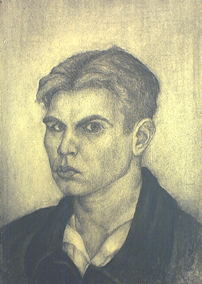
Lynd Ward received his fine arts degree from Columbia University's Teacher's College in 1926, marrying his future collaborator and fellow graduate May McNeer the same year. While honeymooning in Europe they settled in Leipzig where Ward enrolled in the National Academy of Graphic Arts, studying the techniques of printmaking and book design for a year. Some early compositions from this period are preserved in Special Collections, including the penetrating charcoal Self-portrait reproduced here.
He returned to America at a time when book illustration was a relatively open field, and his first story comprised entirely of woodcut images, God's Man, was published in New York in 1929, establishing his reputation as an illustrator when the artist was only twenty-four. God's Man was succeeded by five others in the same genre, all in great demand throughout the Depression years. During this time Ward played an active role in the field of publishing, founding Equinox Press, a cooperative for established figures in the New York book publishing circle. He also was named director of the graphic arts division of the Federal Writers Project in New York City from 1937-39. The publication of a multi-volume edition of Les Misérables in 1938 inaugurated a series of classics Ward produced for George Macy's Limited Editions Club and its trade publication offshoot, the Heritage Press.
Ward returned to the story-in-pictures format later in his career with a trio of picture books: The Biggest Bear (1952), which received the Caldecott Medal, Nic of the Woods (1965), and The Silver Pony (1973), which was distinguished with a Caldecott Honor and the second place selection for the Boston Globe-Horn Book Award. Throughout his successful career spanning five decades, Ward contributed illustrations to more than 100 books for children and adults.
Note:
To learn more about Ward's wood engravings, refer to the brochure for the 1986 memorial exhibition at Associated American Artists, New York, entitled Lynd Ward: Wood Engravings 1929-1977; also the substantial catalogue, Storyteller Without Words: the wood engravings of Lynd Ward with text by the artist (New York: Abrams, 1974).
LuLen Walker
Art Collection Coordinator
Lynd Ward Describes the Process of Book Illustration
The following synopsis and excerpt is from Ward's article "Making Pictures for a Book," published in the Instructor magazine (August 20, 1953).
When the artist first reads a manuscript for a book, a series of visual images begins to form in his mind. Since an artist thinks in images, he creates something like a "private little movie" that is projected in his head by the words from the manuscript. He then consults with the publisher to find out what kind of book they want to create and in what format, i.e. size, length, number of illustrations, whether they want color or black and white illustrations, etc. The illustrator begins to research the subject so he will be able to create an accurate portrayal. For his book The Biggest Bear, Lynd Ward went to the zoo to observe the behavior of bears, and to the Museum of Natural History to study them in greater detail. For a story on Martin Luther, he turned to the work of Albrecht Dürer and Lucas Cranach for period details and consulted books on costume, architecture and home furnishings of the period.
Once he feels he "knows" the subject, the artist can begin to plan out the illustrations on a number of pieces of paper, cut to the size specified by the publisher, making a rough layout of each page in the book from beginning to end. At this point he begins to revisit the mental pictures stored in his mind's eye since first receiving the manuscript, and making sketches of some of the most important ones, placing the pages where they belong in the sequence of the story. During this stage, he is concerned with showing the development of the main character, and planning the key pages with color illustrations and how certain colors might affect the emotional impact of the story. The final step is to work out each of the rough sketches using watercolor, ink or whatever medium seems best suited to the reproduction process selected by the publisher. In the words of the artist:
"My own method in color work is to make a fairly loose pencil drawing on the paper or illustration board, to block in the position of the main figures and background elements, and indicate the way the area is divided between the important units of the picture. Then I brush in the main colors fairly quickly so that the over-all effect is indicated in a general way right at the start. I find that this gives me not only a much better feeling about the picture from the very beginning but also enables me to change and adjust specific colors as I go along. A yellow, for example, that seems all right just on the white paper by itself, may have to be changed quite a bit if it appears later against a large area of the sky.
So, by working from large areas down to smaller, and by saving details until the last... you finally end up with a finished picture. When you have in this way finished all the pictures that were planned in that early rough form, when you have wrapped them up and sent them to the publisher, and when he, in turn, has had them reproduced, and printed in their proper places with words all neatly set in type, then you have a book. And that is what you started working for."
Checklist of the Exhibition
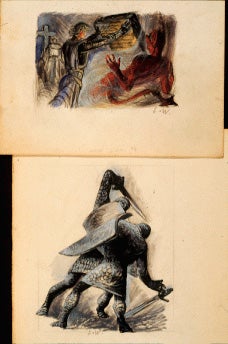
Idylls of the King
Limited Editions Club
1953
Gouache on paper
Arthur, 15 x 20 cm.; Fighting Knights, 22.7 x 20.2 cm.
Unpublished illustrations for the book by Alfred, Lord Tennyson
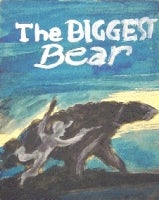
The Biggest Bear
Houghton Mifflin
1952
Gouache on illustration board
19.7 x 16 cm.
Book jacket design for the book by Lynd Ward
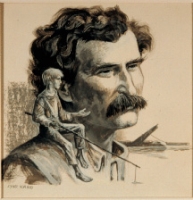
America's Mark Twain
Houghton Mifflin
1962
Gouache on illustration board
28 x 25.5 cm.
For the book by May McNeer
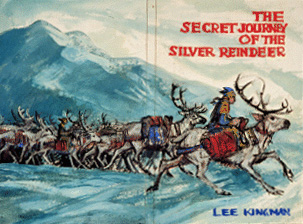
The Secret Journey of the Silver Reindeer
Doubleday
1968
Gouache on paper
24.4 x 32.8 cm
Book jacket designs for the book by Lee Kingman
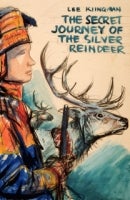
The Secret Journey of the Silver Reindeer
Doubleday
1968
Gouache on paper
24.3 x 16 cm.
Book jacket designs for the book by Lee Kingman
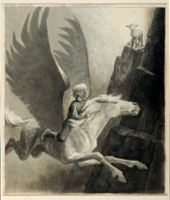
The Silver Pony: a story in pictures
Houghton Mifflin
1973
Gouache on illustration board
43 x 38 cm.
Book jacket designs for the book by Lynd Ward
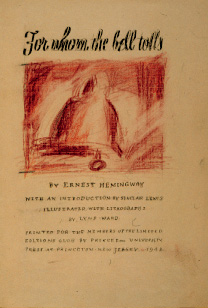
For Whom the Bell Tolls
Limited Editions Club
1942
Title page mock-up
24.6 x 16.7 cm.
For the book by Ernest Hemingway
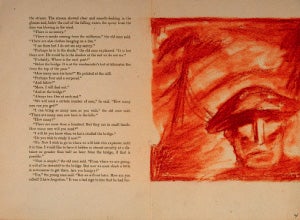
For Whom the Bell Tolls
Limited Editions Club
1942
Pastel dummy illustration
24.6 x 16.7 cm
For the book by Ernest Hemingway
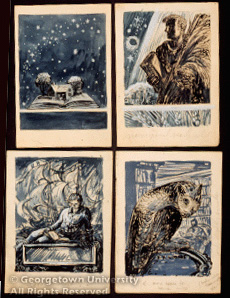
Book Plates
Antioch Press
1945
Four watercolor on paper sketches
12.5 x 9 cm. each
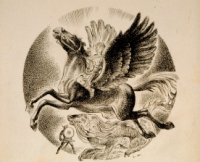
Story and Verse For Children
Macmillan, third edition
1965
Ink on paper
37.5 x 27.8 cm.
Unpublished illustrations for the book by Miriam Blanton Huber
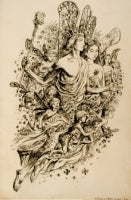
Five Plays from Shakespeare (Midsummer Night's Dream)
Houghton Mifflin
1964
Ink on fiber board
30.2 x 20 cm.
For the book edited by Katherine Miller
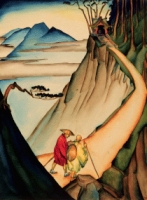
Prince Bantam, being the adventures of Yoshitsune the brave and his faithful henchman, great Benkei of the Western Pagoda
Macmillan
1929
Watercolor on illustration board
40 x 28 cm.
Unpublished illustration for the book by May McNeer
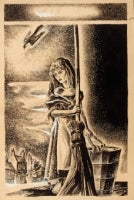
Les Misérables: Cosette
Limited Editions Club
1938
Ink on illustration board
38.3 x 25.7 cm. each
Frontispiece illustration for the book by Victor Hugo
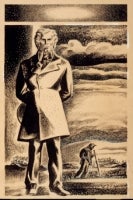
Les Misérables: Jean Valjean
Limited Editions Club
1938
Ink on illustration board
38.3 x 25.7 cm. each
Frontispiece illustration for the book by Victor Hugo
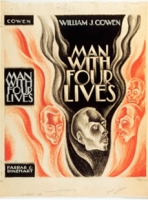
The Man with Four Lives
Farrar
1934
Watercolor on paper
41.5 x 38 cm.
Book jacket design for the book by William J. Cowen
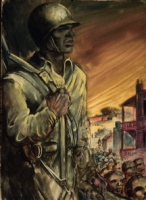
North Star Shining
Morrow & Co.
1947
Opaque watercolor on illustration board
28 x 20.2 cm.
For the book by Hildegarde Hoyt Swift
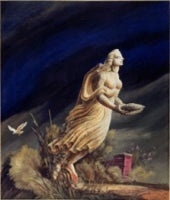
The Running of the Tide
Houghton Mifflin
1948
Gouache on illustration board
63 x 52.5 cm.
Book jacket design for the book by Esther Forbes
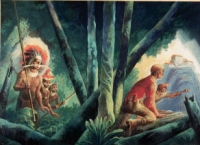
Explorer's Digest
Houghton Mifflin
1955
Gouache on illustration board with mylar text overlay
36.2 x 48.8 cm.
Book jacket design for the book by Leonard Clark
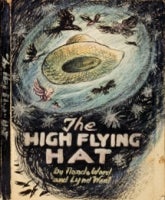
The High-Flying Hat
Ariel Books
1956
Watercolor on paper jacket design
20.7 x 16. 9 cm.
For the book by Nanda Ward
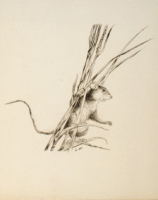
The High-Flying Hat
Ariel Books
1956
Ink on paper illustration
27.7 x 27.7 cm.
For the book by Nanda Ward
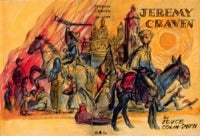
Jeremy Craven
Houghton Mifflin
1958
Watercolor on paper
21.8 x 32.4 cm.
Book jacket design for the book by Joyce Collin-Smith
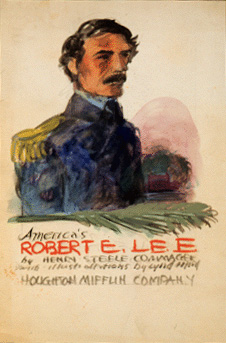
America's Robert E. Lee
Houghton Mifflin
1951
Watercolor on paper
23.4 x 17.5 cm.
Title page illustration for the book by Henry Steele Commager
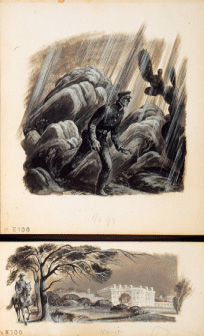
America's Robert E. Lee
Houghton Mifflin
1951
Two gouache illustrations
25.8 x 22 cm.; 10 x 22.6 cm.
For the book by Henry Steele Commager
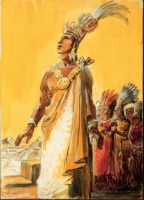
Mexican Story
Farrar, Strauss and Giroux
1953
Watercolor on paper
35.5 x 27.7 cm.
For the book by May McNeer
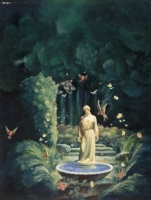
A Cup of Sky
Houghton Mifflin
1950
Gouache on illustration board
38 x 30.3 cm.
St. Francis statuary
Book jacket design for the book by Donald Culross Peattie and Noel Peattie
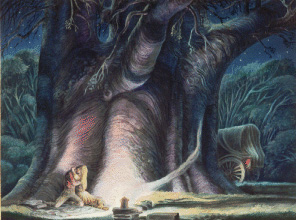
The Curve and the Tusk
Gouache on illustration board
38 x 45.4 cm.
For the story by Stuart Cloete
Published in Colliers magazine (January 26, 1952)
Released in book form by Houghton Mifflin, 1952
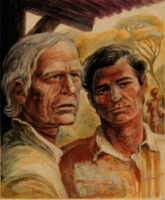
The Curve and the Tusk
Gouache on illustration board
30.5 x 25.2 cm.
For the story by Stuart Cloete Published in Colliers magazine (January 26, 1952) Released in book form by Houghton Mifflin, 1952
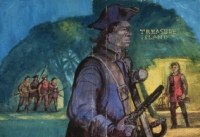
Treasure Island
Dell
1963
Gouache on paper
22 x 32.5 cm.
Book jacket design for the book by Robert Louis Stevenson
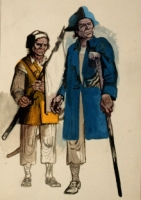
Treasure Island
Dell
1963
Gouache on paper
25 x 19 cm.
Interior illustration for the book by Robert Louis Stevenson
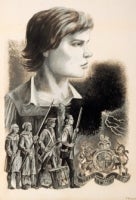
Early Thunder
Coward-McCann
1967
Gouache on illustration board
35.5 x 25.5 cm.
Frontispiece illustration for the book by Jean Fritz
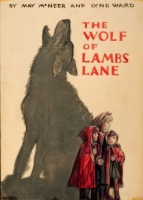
The Wolf of Lamb's Lane
Houghton Mifflin
1967
Watercolor on paper
35.5 x 25.2 cm.
Book jacket design for the book by May McNeer
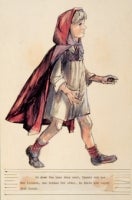
The Wolf of Lamb's Lane
Houghton Mifflin
1967
Interior dummy
35.5 x 25.2 cm.
For the book by May McNeer
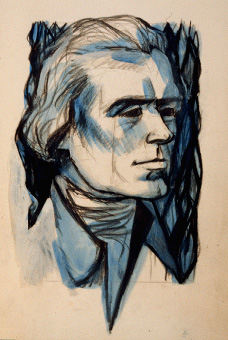
America's Thomas Jefferson
The Limited Editions Club
1967
Charcoal and watercolor on paper
27.8 x 18.2 cm.
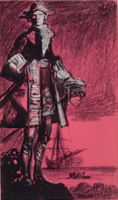
The Master of Ballantrae
Heritage Press
1965
Ink and gouache on colored paper
25.6 x 15.2 cm.
For the book by Robert Louis Stevenson
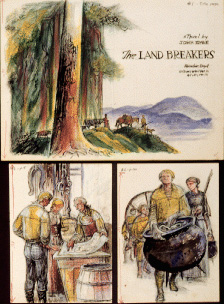
The Land Breakers
Winter 1965
Watercolor and ink on paper
Book jacket design, 21.6 x 29.5 cm. Two illustrations, 18.5 x 13.5 cm. each For the story by John Ehle Published in Reader's Digest, Vol. I (Winter 1965)