Introduction
In conjunction with the First Year Academic Workshop, Lauinger Library highlights items from its General and Special Collections that illustrate themes in The Map of Love by Ahdaf Soueif. The novel's characters are connected through their journeys: through their actual journeys to and from Egypt, and through their intellectual journeys leading them to family, friendship, and love. As with Anna Winterbourne's "Egypt collection" of journals, letters, and objects, much of this exhibition focuses on objects from travels: letters, maps, books, and art.
This is the third annual First Year Academic Workshop exhibition in Lauinger Library's Kerbs Exhibit Area. Ahdaf Soueif: The Map of Love introduces students and researchers to a selection of the vast amount of specialized Library resources on the Arab world and the Middle East available for use.
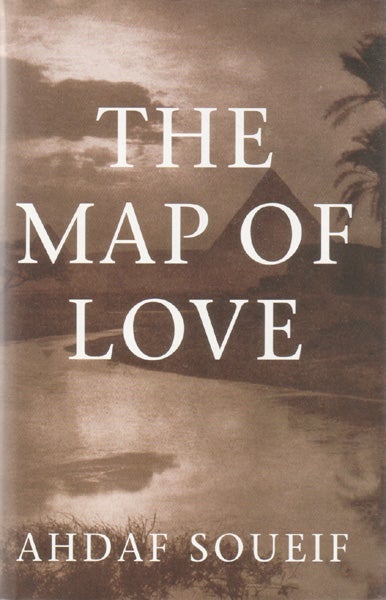
The Map of Love (hardback)
by Ahdaf Soueif
London: Bloomsbury, 1999
Georgetown University Lauinger Library Special Collections, Booker Prize Collection

The Map of Love (paperback)
by Ahdaf Soueif
New York: Anchor Books, 2000
Georgetown University Lauinger Library Special Collections, Booker Prize Collection
Family Tree
From the beginning pages of The Map of Love, an illustration of the relations which connect the story's main characters.
In the Eye of the Sun
by Ahdaf Soueif
London: Bloomsbury, 1992
Georgetown University Lauinger Library, New Acquisition
Sandpiper
by Ahdaf Soueif
London: Bloomsbury, 1996
Georgetown University Lauinger Library
I Saw Ramallah
by Mourid Barghouti
Translated by Ahdaf Soueif
With a Foreword by Edward W. Said
(Cairo: The American University in Cairo Press, 2000).
"This compact, intensely lyrical narrative of a return from protracted exile abroad to Ramallah on the West Bank in the summer of 1996 is one of the finest existential accounts of Palestinian displacement that we now have," writes Said in the Foreward to this book. He also praises the translation, "Soueif's excellent translation makes precisely this rather special tone available now to readers of English. The Palestinian experience is therefore humanized and given substance in a new way."
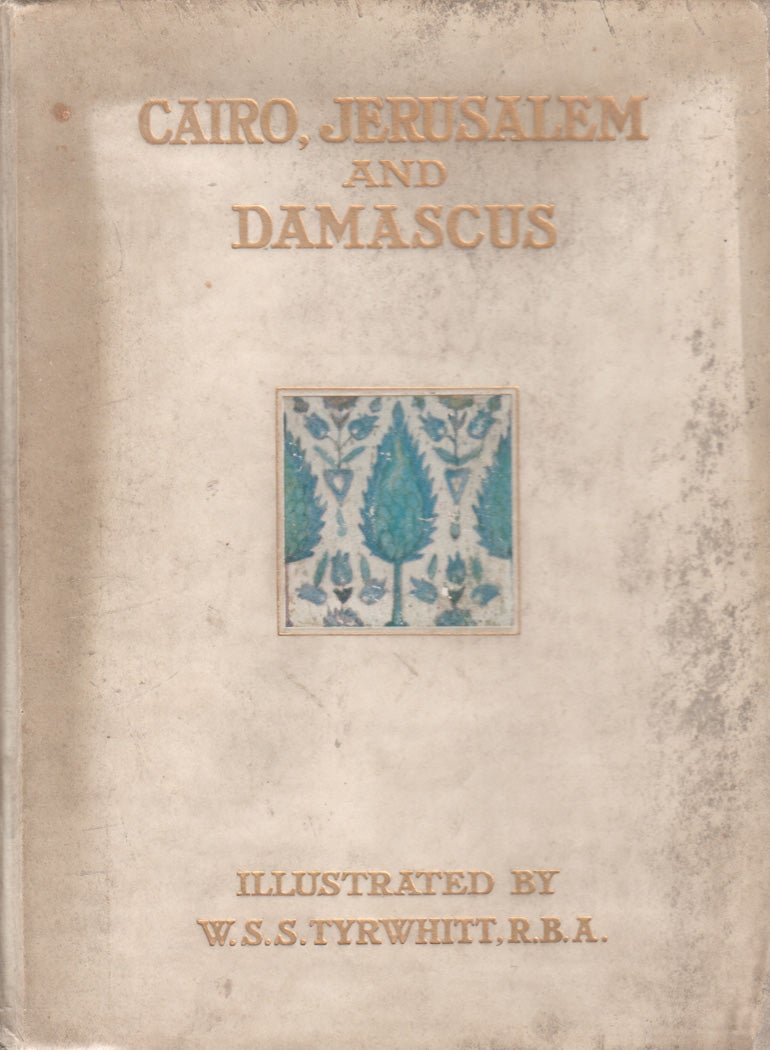
Cairo, Jerusalem and Damascus
Margoliouth, D. S. (David Samuel), 1858-1940
with Illustrations by W.S.S. Tyrwhitt
London: Chatto & Windus, 1907
Georgetown University Lauinger Library, Special Collections, Shandelle Collection
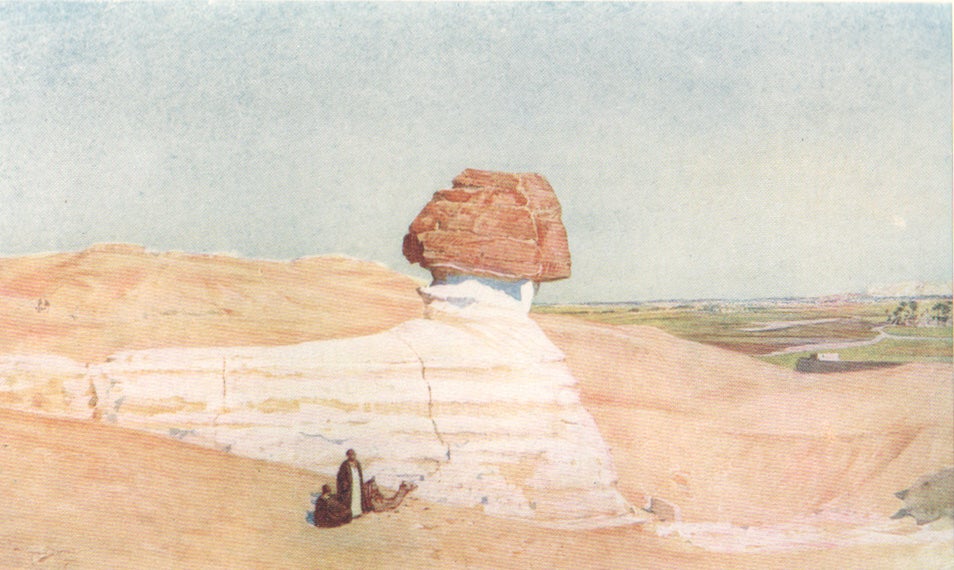
The Sentinel of the Nile
Tyrwhitt, W.S.S.
London: Chatto & Windus, 1907
Georgetown University Lauinger Library, Special Collections, Shandelle Collection
lllustrations from Cairo, Jerusalem and Damascus

A Courtyard Near the Tent-makers' Bazaar, Cairo
Tyrwhitt, W.S.S.
London: Chatto & Windus, 1907
Georgetown University Lauinger Library, Special Collections, Shandelle Collection
lllustrations from Cairo, Jerusalem and Damascus:
1909 Letter Written About Egypt
Autograph Letter, dated January 6, 1909, from Sir Shane Leslie to his brother, Norman Leslie regarding the latter's visit to Egypt. Sir Shane writes, "My dear Norman, I was most interested to get your letter from Egypt. It does seem in a curious predicament as a nation. The Egyptians must be real Orientals. Few have ever been able to fathom the heart of the East...I agree with you that the British occupation has been beneficial but what business we ever had to go there I know not..."
Sir Shane Leslie (1885-1971) grew up in Ireland and was educated at King's College, Cambridge. He became an Irish Nationalist and, for a time, worked in Washington, D.C. Norman Leslie, a captain in the Rifle Brigade, was killed during the First World War.
This item, from the library's Special Collections, provides an example of a letter regarding Egypt's position during the time period that Anna Winterbourne was writing and receiving correspondence.
From the Sir Shane Leslie Papers,
Georgetown University Lauinger Library,
Special Collections Division, Manuscripts Collection.
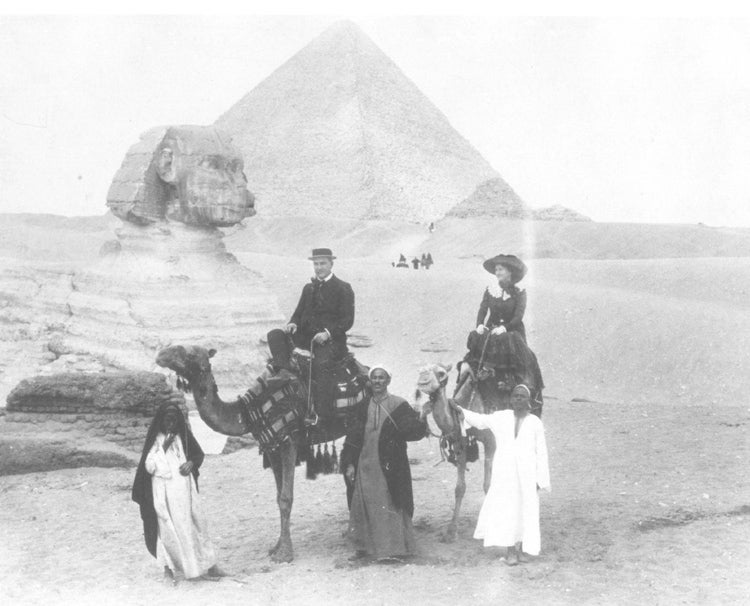
Photograph of Travelers in Egypt
Leslie, Shane, 1885-1971
Georgetown University Lauinger Library,Special Collections Division, Manuscripts Collection
Visitors to the Sphinx and Great Pyramid located in the area of Giza near Cairo; ca. ?

Le Fumeur Egyptien, ca. 1865-1868.
Gerome, Jean-Léon, 1824-1904
etching on laid paper
11 x 8.6 cm
Georgetown University Fine Print Collection
Gift of John B. Rackham, 1997
Jean-Léon Gérôme was one of the most renowned and successful of the "academic" painters and sculptors in France in the late nineteenth century, artists who had undergone rigorous formal training to produce refined works of art based upon careful observation. Many of his works reflected a trend known as "orientalism," which depicted, in art and literature, actual or imagined scenes and people of the Near and Middle East. Gérôme had visited Egypt and other locales on several visits. Le Fumeur Egyptien (The Egyptian Smoker) is one of only four etchings that he completed. In time, place, and circumstance, Le Fumeur Egyptien is not far removed from the setting of The Map of Love.
1869 Egypt Diary
Barnum, Francis, 1849-1921
From the Rev. Francis A. Barnum, S.J. Papers,
Georgetown University Lauinger Library,
Special Collections Division, Manuscripts Collection
This diary, kept by Georgetown University Archivist Francis A. Barnum, S.J. (1849-1921), records the events of his trip across the Sinai Desert in 1869. Fr. Barnum writes, "After having spent two months on the Nile, I returned to Cairo, and began the necessary preparations for the long journey through the great Deserts of the Siniatic Peninsula..." He speaks of purchasing tents, furniture and cooking utensils, selecting camels and dromedaries, and entering into negotiations with the envoys of the Sheiks of the different tribes, through whose territory the route lay.
The Rev. Francis A. Barnum, S.J., was born in Baltimore in 1849. After joining the Society of Jesus, he spent time traveling the world, lived for many years in Alaska, and finally settled at Georgetown, where he was made archivist. He died in 1921.
Fr. Barnum's travel journal touches on some of the same topics recorded by Anna Winterbourne in her diary.
Boyle of Cairo
Boyle, Clara
Kendal: Titus Wilson & Son, 1965
Georgetown University Lauinger Library
This book, written by the wife of Harry Boyle, is referred to near the end of The Map of Love when Isabel gives it as a gift to Amal, who discovers that the letter presented to Lord Cromer in 1906 was actually written by Boyle. Photograph of Lord Cromer and his staff taken from this book.
"I leaf again through Clara Boyle's memoir, looking at the pictures, reading a paragraph here and a sentence there. Suddenly I am arrested by a phrase I have come across before: 'How can one arrive at the planet Souad?'
An hour later I am still sitting with the book on my knee and, on the table in front of me, the letter Anna had in such agitation given to her husband as he planted the young cypress tree for Nur back in 1906. Oh, how angry I am, and how I wish I could tell him! 'If people can write to each other across space,' Isabel had asked, 'why can they not write across time too?' But how do you write to the past? Once more I read Clara Boyle's words, written in 1965:
About 1906 there had been some disagreement between Lord Cromer and the Foreign Office in connection with a point of policy to be followed in Egypt. Lord Cromer had sent a dispatch to London, which had had no effect.
As a last resort Harry then submitted a paper which was to give a true picture of the workings of the oriental mind; it was supposed to be the translation of a letter which had reached him secretly, and as such it was transmitted to the Foreign Office. Only Lord Cromer himself knew the truth - that the original letter was written by Harry Boyle himself."
quoted from The Map of Love, page 492-493.
"Isabel is delighted at my obvious pleasure as we study the photograph of Harry Boyle, looking just as I had imagined him, with a long, straggly moustache and a crumpled collar, and there is even a photograph of Toti."
quoted from The Map of Love, page 489.
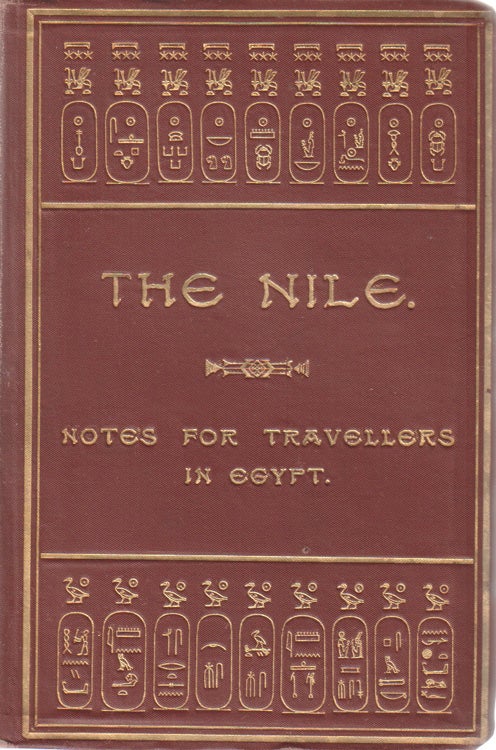
The Nile: Notes for Travellers in Egypt
Budge, E. A. Wallis (Ernest Alfred Wallis), Sir, 1857-1934
London: Thomas Cook & Son, 1902
Georgetown University Lauinger Library, Special Collections
"Egypt"
Washington, DC: Central Intelligence Agency
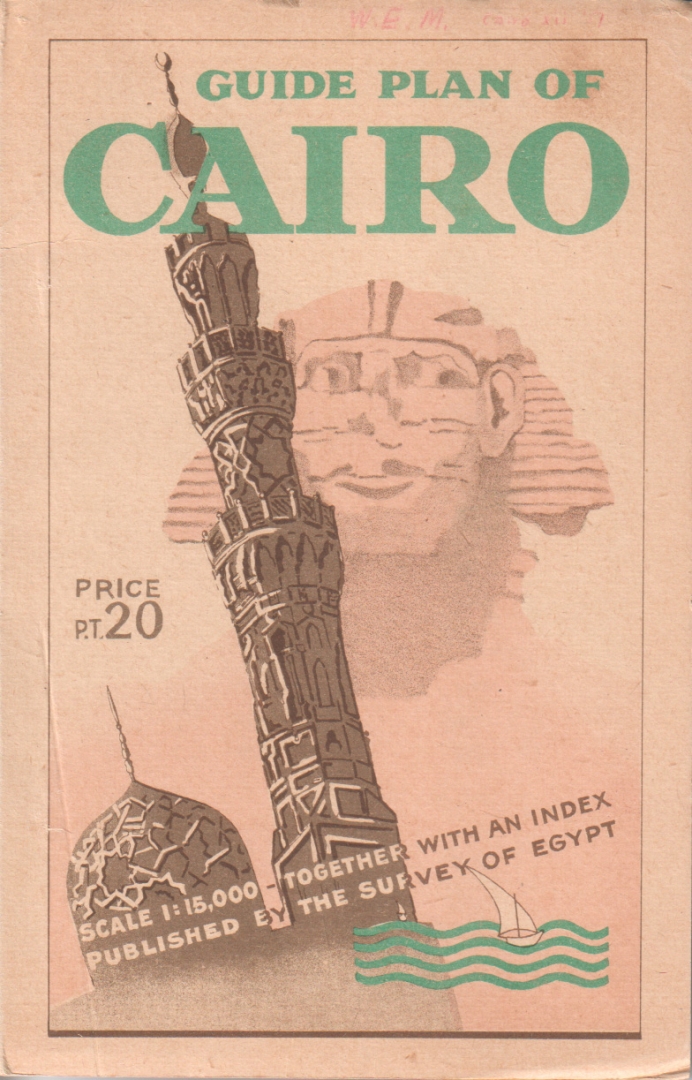
Guide Plan of Cairo
The Survey of Egypt, 1947
Georgetown University Lauinger Library
Special Collections, Manuscripts Collection
From the William E. Mulligan Papers
"The British Empire, 1815-1914."
In Historical Atlas of Britain, p. 142.
Edited by Malcom Falkus and John Gillingham
New York: Continuum, 1981
"The United States Since 1900"
In Atlas of World History, p. 240
Edited by Patrick O'Brien
New York: Oxford University Press, 1999
Georgetown University Lauinger Library
Plate featuring Pharaonic Scene
from the private collection of Brenda Bickett
Painting on Papyrus, modern reproduction
from the private collection of Brenda Bickett
Ahdaf Soueif: The Map of Love was prepared by Brenda Bickett, Middle Eastern and Islamic Studies Bibliographer; Karen H. O'Connell, Reference Librarian; and Heidi M. Rubenstein, Manuscripts Processor.