Introduction
To welcome Georgetown’s students and faculty back to campus for the 2000-2001 academic year, and to greet our many friends who enjoy coming to see our exhibitions, the Special Collections Division of the Lauinger Library presents this exhibition entitled “Printmakers A to Z: Selections from Georgetown’s Collections.”
Our students may find a hidden metaphor for this new academic year in four of the exhibition’s prints. It begins with Louis Rhead’s “Midsummer Holiday” now come to an end, replaced by Louis Schanker’s “Acrobats” struggling with the onset of Fall Semester class loads and their inevitable exams, culminating in Ronau Woiceske’s “Deep Winter” with its Christmas holidays and the inter-semester break. But, as was the case with Grant Wood’s stoic “February” horses, students must also “return to the gate” with the Spring Semester’s call to the 2nd half of the academic year now just begun.
All are the work of American artists except “L’Oiseau de Bourges” by England’s Malcolm Osborne, “Octobre” by Belgium’s Raoul Ubac, the abstract of three figures in a landscape by Germany’s Mac Zimmermann, and the self-portrait by Sweden’s Anders Zorn. These four were included in recognition of Georgetown’s significant and growing collections of British, French, German, and other European artists of note.
The exhibition’s title was chosen to accommodate our intent to present a brief survey of some of the famous, and some of the not-so-famous prints in the University’s fine print collections, without recourse to some unifying theme, letting the alphabet impose the only loose constraint needed.
For some letters, because of the size of the print selected, our gallery space dictated a single print for that letter. For others, the space invited a pairing with another print, either by the same artist, or by another whose surname bore the same first letter. As you will note, such pairings can make for strange matte fellows. Fortunately we were able to cover all the letters of the alphabet, including the elusive letter “X,” whose two prints share their space with the letter “Y.”
Joseph A. Haller, S.J.
Georgetown University Library
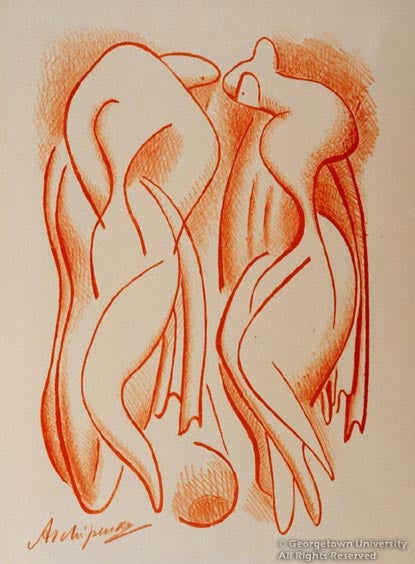
Bathers
Archipenko, Alexander, 1887-1964
1950
Lithograph
Notice how Archipenko, with a few strong lines, has endowed these two bathers with the qualities and simplicity of a piece of abstract sculpture.
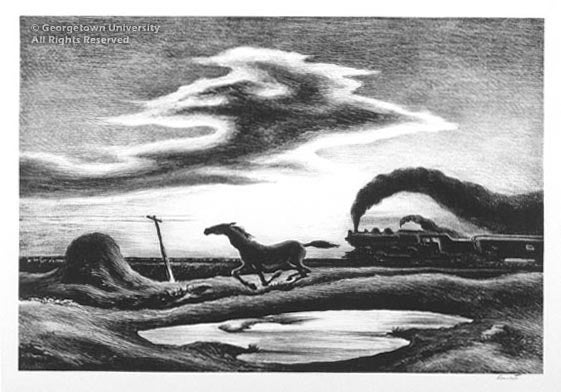
The Race
Benton, Thomas Hart, 1889-1975
1942
Lithograph
Benton, along with fellow artists John Steuart Curry and Grant Wood, ushered in America's Regionalist movement with their imagery of the rural scene. Here is his "Race" between an unbridled horse and a train. See a couple of Curry's and Wood's horses coming up below.

Land of Plenty
Bloch, Lucienne
c.1935
Woodcut
This is her strong social commentary on the 1930s with a destitute family separated by barbed wire from those towering power lines and fields of tall corn. Bloch, a daughter of composer Ernest Bloch, worked with Rivera on his ill-fated Rockefeller Center fresco.
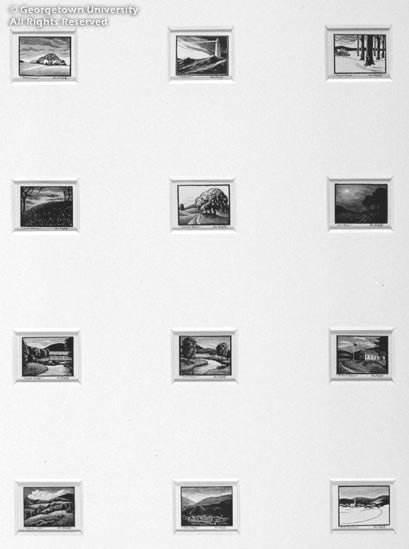
A New England Calendar
Cheffetz, Asa, 1896-1965
c.1933
12 miniature landscapes
With this set, Cheffetz won 2nd prize at the Chicago World's Fair Print Exhibition in 1934. Note their tiny pencil signatures and their titles; when Cheffetz signed the twelve separate prints of his “A New England Calendar,” each measuring 3/4" x 1", he inscribed them as follows:
Snowbound Covered Bridge
Seacoast Trout Brook
Sugarbush District School
April Shower Autumn Hills
Spring's Bloom Valley Village
June Moon White Christmas
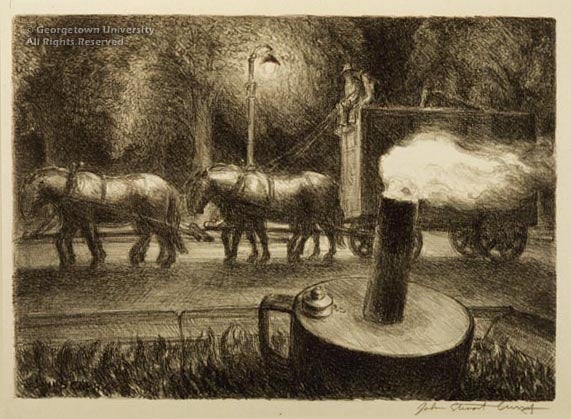
To the Train
Curry, John Steuart
1932
Lithograph
Curry, like Benton, gained fame as a Regionalist. His travels in 1932 with the Ringling Brothers inspired a number of scenes from circus life, including these horses pulling a wagon of props "To the Train" at the close of the show.
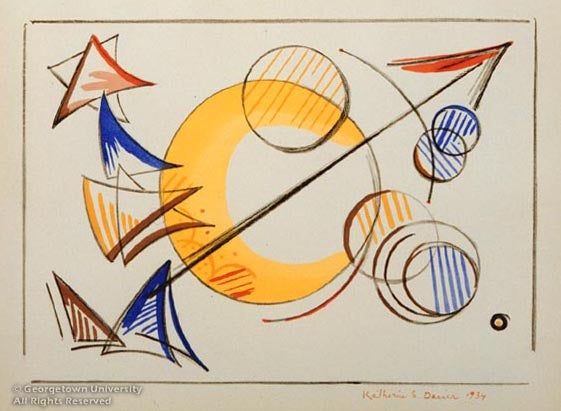
Variation 12
Dreier, Katherine S., 1877-1952
1937
Lithograph with pochoir colors
From "40 Varia." Dreier first created this important modernist print as a hand-colored lithograph in 1934, part of a set of 40 color variations. Marcel Duchamp took them to Paris in 1937 and there he supervised their coloring and signatures in pochoir. This is "Variation 12" from the resulting portfolio edition of 65.
Ferry Boat
Dwight, Mabel, 1895-1955
1930
Lithograph
"Ferry Boat" is one of Mabel Dwight's delightful satires on life in New York. In the mid-1930s, she wrote "Satire in Art" for New York's WPA Federal Arts Project.
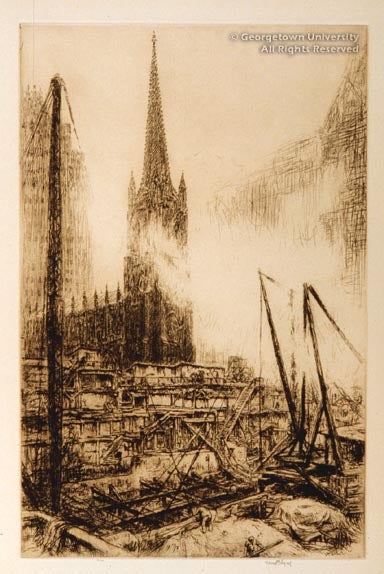
No.1, Wall Street
Eby, Kerr, 1890-1946
1930
Etching
In this etching, Eby has recorded the laying of the foundations for the building, "No-1, Wall Street," going up on the former site of the Irving Trust Company at the intersection of Broadway and Wall Street in front of Trinity Church.
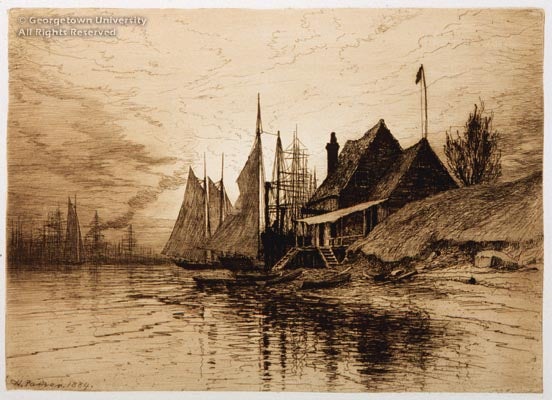
Evening, New York Harbor
Farrer, Henry, 1843-1903
1884
Etching
Farrer, a leader in America's painter-etcher movement of the 1880s, and a president of the New York Etching Club, was noted for the tonal and atmospheric qualities of his evening landscapes. His "Evening, New York Harbor" of 1884 is one of his best...
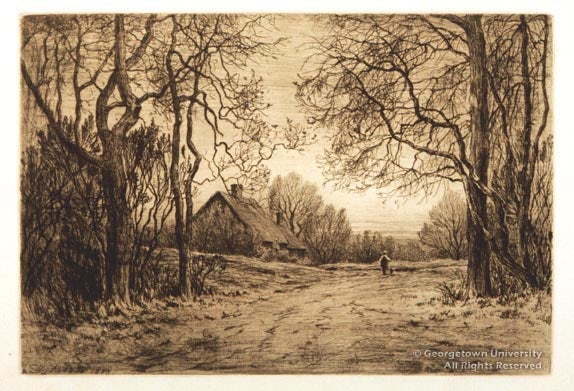
Winter Evening
Farrer, Henry, 1843-1903
1884
Etching
. . and his pastoral "Winter Evening" of 1883 is another fine example of his work.
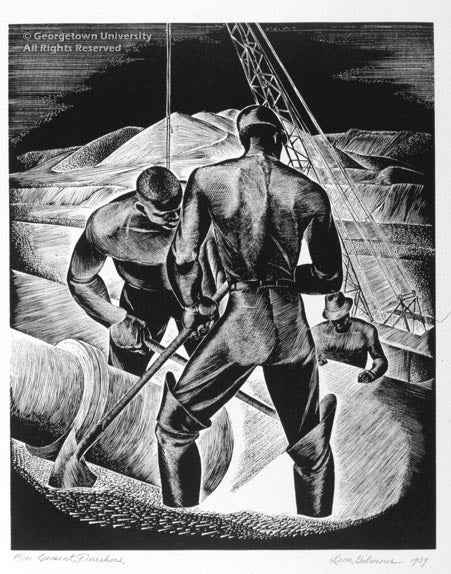
Cement Finishers
Gilmour, Leon, 1907-1996
1939
Wood engraving
A one-time laborer turned artist, Gilmour studied wood engraving in 1931 with his friend, Paul Landacre. By 1939 he had engraved his masterpiece, "Cement Finishers," with its three laborers hard at work on one of the federal public works projects of the 1930s.
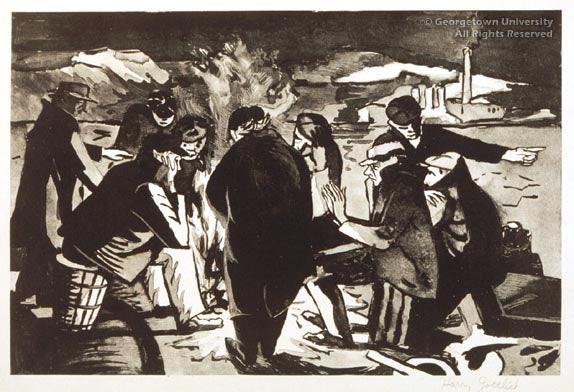
Waiting for Work
Gottlieb, Harry, 1895-1992
c. 1935
Lithograph
Gottlieb, a member of the Woodstock artists community and a sometime member of the Communist party, did this strong lithograph of social protest in the depths of the depression with its unemployed workmen huddled in pain and anger around a winter's fire.
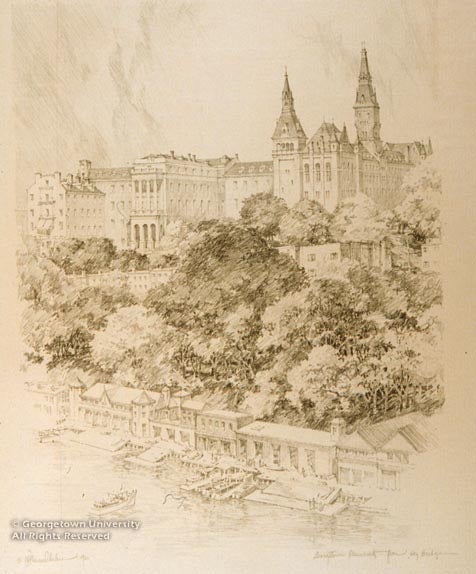
Georgetown from Key Bridge
Himmelheber, Joseph B., 1902-1951
1930
Lithograph
Himmelheber, a long-forgotten Washington artist of some note, gained recognition for his finely crafted lithographs of the city's landmarks, bridges, and cityscapes, many of which were reproduced in the Sunday editions of the old Washington Times.
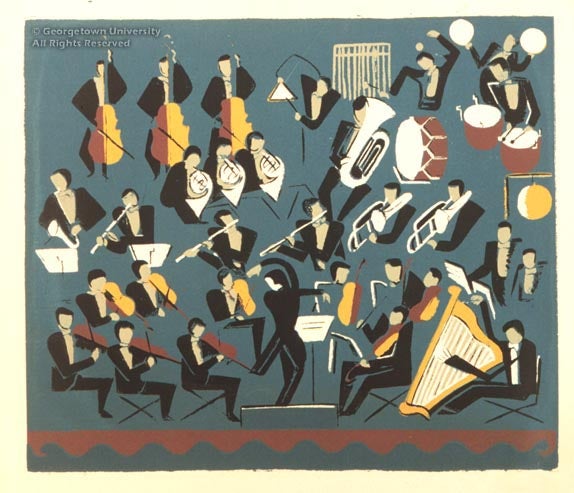
Symphony
Ibling, Miriam, 1895-1985
1941
Serigraph
A midwestern printmaker who taught at the Walker Art Center in Minneapolis, Ibling produced this early serigraph entitled "Symphony" in 1941. Might it have been inspired by a performance of the Minneapolis Symphony?
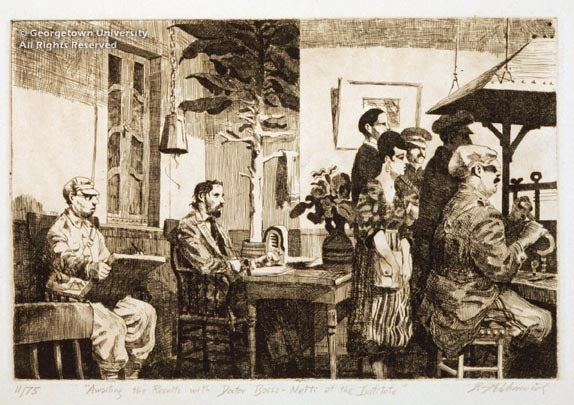
Awaiting the Results...
Itchkawich, David
c.1970
Etching
"Awaiting the Results with Doctor Bassa-Netti at the Institute" is the full title. Without Itchkawich's giveaway in the doctor's name, this enigmatic scene might have passed for the recording of Ibling's "Symphony," rather than the birth of a child.

Night Tower
James, Frederic, 1915-1985
c.1950
Lithograph
Note how, with a masterful control of lithographic contrasts of light and darkness, Frederic James has recorded this night scene of oil drilling. Compare it with Frederick Yost's night of steel making below.

The Rape of Ganymede
Kendall, Kenneth G., b.1921
printed by Lynton Kistler
1952
Lithograph
Kendall, a Hollywood actor, sculptor and painter, did a total of six lithographs. In this one, he retells the story from Greek mythology of Zeus, in the form of an eagle, abducting Ganymede, and carrying him off to Mt.Olympus. The actor, Steve Reeves, was his model.
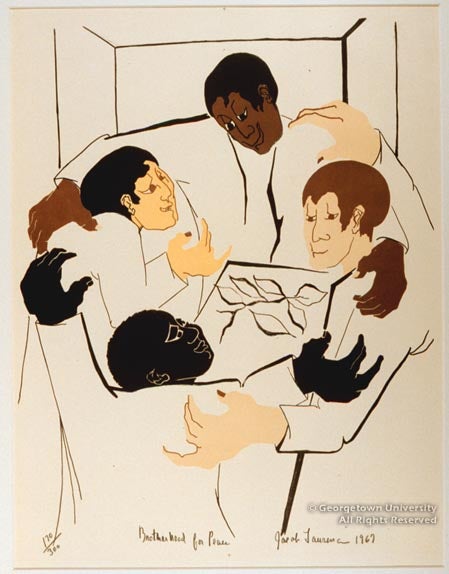
Brotherhood for Peace
Lawrence, Jacob, 1917-2000
1967
Color lithograph
Jacob Lawrence, who died earlier this year, was one of the great African-American printmakers of the 20th century. His work focused on the history, life and culture of his people on the American scene.
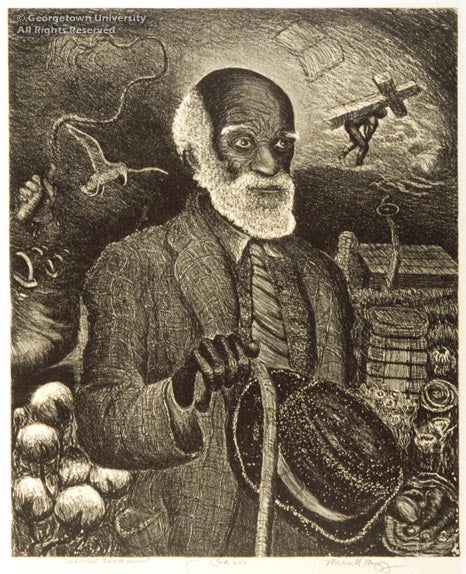
Andrew Goodman
Mauzey, Merritt, 1898-1973
1946
Lithograph
Mauzey, raised on a Texas cotton farm, was self-taught in the art of lithography. His award-winning portrait of the elderly "Andrew Goodman" was inspired by his remembrances of the freed cotton-farm slaves he had known in his youth.
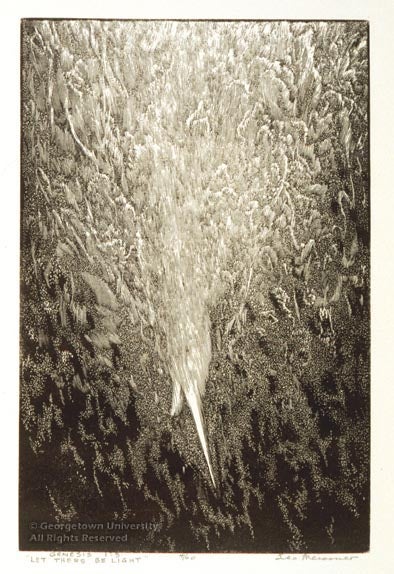
Genesis I.3
Meissner, Leo, 1895-1973
1969
Wood engraving
"Genesis I.3" by Meissner was selected to follow "Andrew Goodman" for its message, "Let there be light," and for its remarkable tonal qualities as a wood engraving, similar to those found in Mauzey's lithograph.
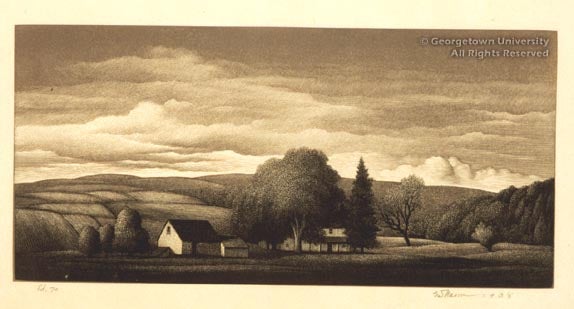
Pennsylvania Landscape
Nason, Thomas, 1889-1971
1938
Chiaroscuro wood engraving
Here is Nason's "Pennsylvania Landscape," a chiaroscuro wood engraving. Its key block carries the design, to which is added a tint block of color, giving the print its subtle shadings and tones.
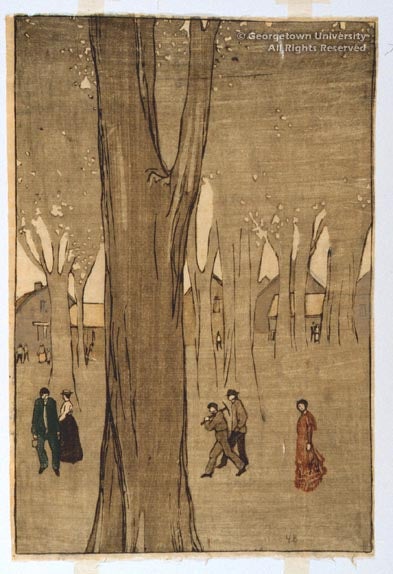
Village Green - Twilight
Nordfeldt, B.J.O., 1878-1955
1906
Color woodcut
Born in Sweden in 1678, Nordfeldt's family migrated to Chicago when he was thirteen. By 1900, he was studying the art of Japanese woodblock printing. By 1906, he did this early masterpiece, "Village Green - Twilight."
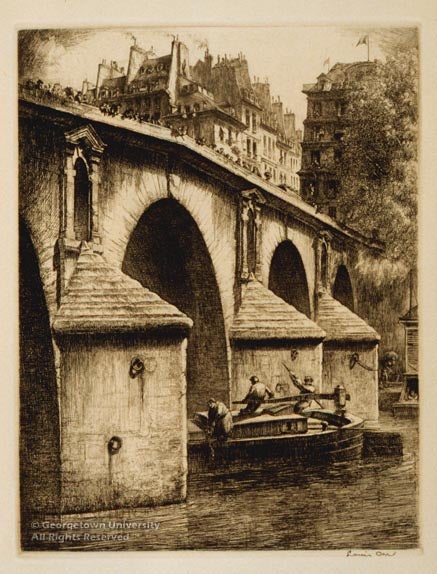
Le Point Marie-Paris
Orr, Louis, 1879-1966
n/d
Etching
Orr, after completing his studies in Paris, stayed on to record WWI's devastation of the city's landmarks in his prints which won for him membership in the French Legion of Honor. Here is a later print of his of "Le Ponte Marie" in Paris.
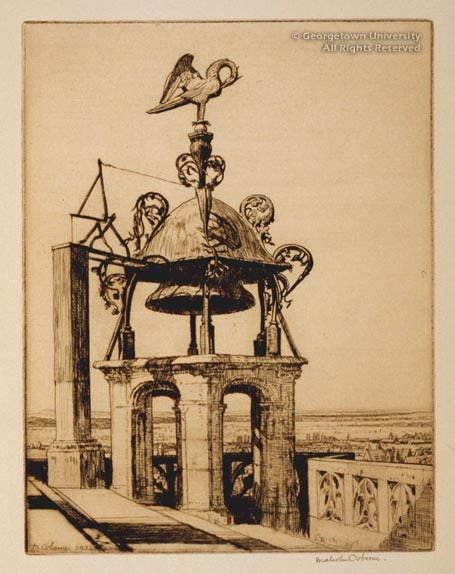
L'Oiseau de Bourges
Osborne, Malcolm
1932
Etching
Osborne, the distinguished British etcher, was commissioned by the Printmakers Society of California to create this print as one of the Society's presentation prints for its membership in the early 1930s.
Return of the Prodigal
Pierce, Constance, b.1946
1990
Color monoprint with collage
Pierce is a Washington printmaker noted for her monotypes. In this, her "Return of the Prodigal," note her use of a bit of collage. She is also represented in Washington's National Museum of Women in the Arts.
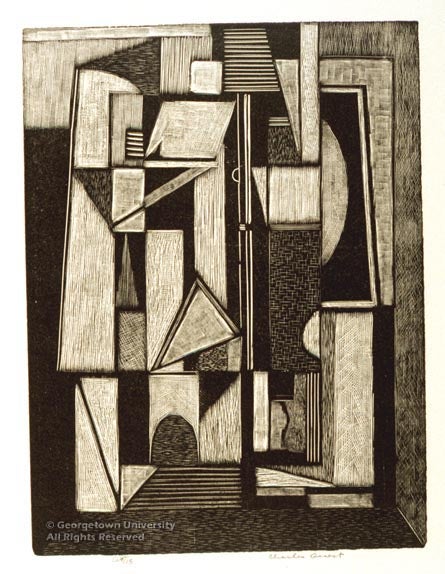
Abstraction - New York : state 1 & state 2
Quest, Charles F., 1904-1993
1947, 1948
Wood engravings
Represented in 43 museums, and recipient of over 50 awards, Quest is a recognized master of the woodblock, both in color and in black and white. In "Abstractions -New York," note how he moved from its state 1 to state 2 in sharpening up its image.
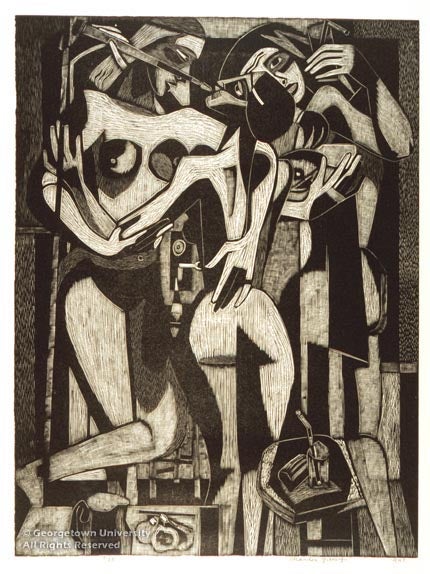
Break Forth into Singing
Quest, Charles F., 1904-1993
1947
Wood engravings
Also note Quest's use of strong line and compact form in rendering the human figure in his "Break Forth into Singing," a wood engraving done in the same year.
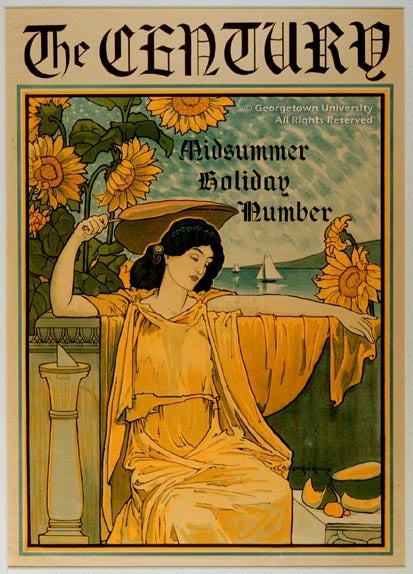
The Century (a poster), Midsummer Holiday Number
Rhead, Louis John, 1857-1926
1895
Color lithograph
Rhead, a painter and illustrator of English birth, established his American reputation designing covers and posters for Harpers, St. Nicholas, and The Century magazines in the late 1880s and early 1890s. Here is one of his finer ones.
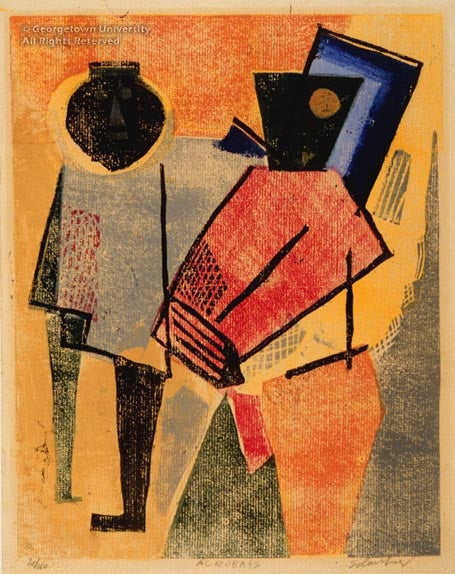
Acrobats
Schanker, Louis, 1903-1981
1939
Color woodcut
Schanker, after a study of Japanese woodcut techniques, took up the medium in the late 1930s and early 1940s and proceeded to create the bulk of his color woodcut oeuvre. Here is his "Acrobats" of 1939, together with his "St. George & the Dragon" done in 1941.
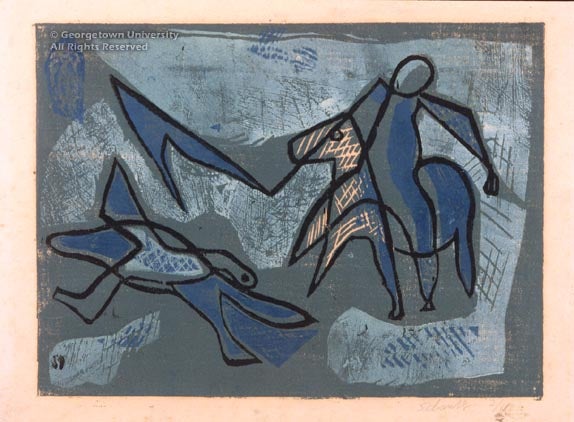
St. George & the Dragon
Schanker, Louis, 1903-1981
1941
Color woodcut
Schanker, after a study of Japanese woodcut techniques, took up the medium in the late 1930s and early 1940s and proceeded to create the bulk of his color woodcut oeuvre. Here is his "Acrobats" of 1939, together with his "St. George & the Dragon" done in 1941.
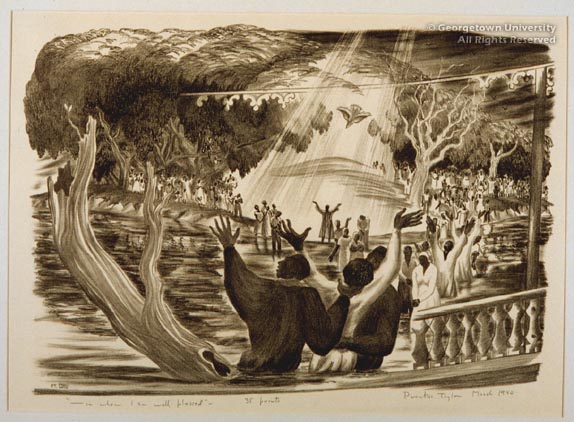
In Whom I Am Well Pleased
Taylor, Prentiss, 1907-1991
1940
Lithograph
Taylor, a long-time member and counselor of the Washington Print Club, celebrated the life and culture of the African-American community in many of his prints. Here is his rendering of one of their baptismal services.
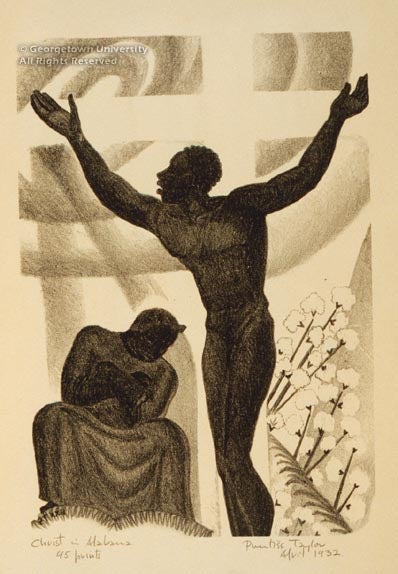
Christ in Alabama
Taylor, Prentiss, 1907-1991
1932
Lithograph
He also gave his unstinting support in their protests for justice along with his friend, Langston Hughes. Here is his "Christ in Alabama," published in Hughes' book, Scottsboro Limited, in protest over the Scottsboro Case.
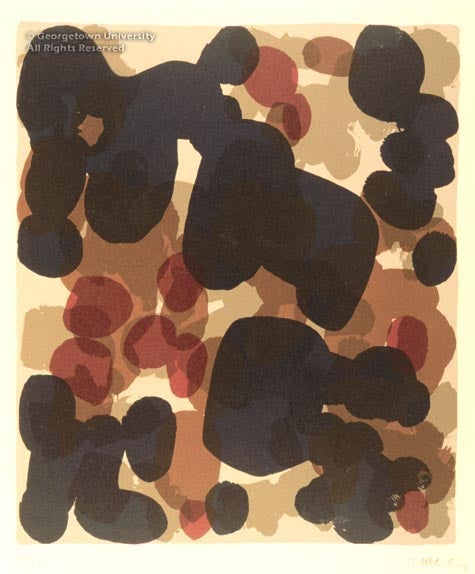
Octobre
Ubac, Raoul, 1910-1985
n/d
Color lithograph
Ubac was a Belgian painter, sculptor, and printmaker of the Cobra school. In printmaking, he was noted for his color abstracts, a number of which were published in Derrière la Miroir in the 1950s and 1960s.
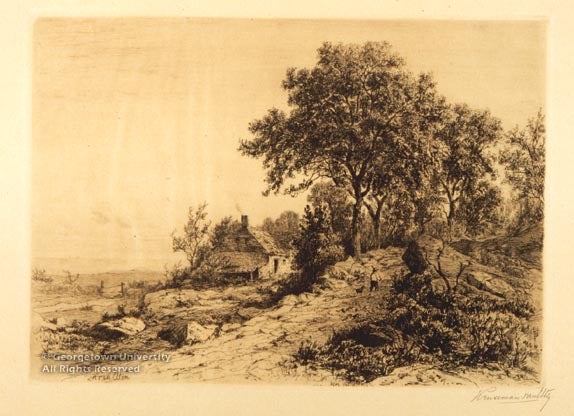
A Lakeside Cottage
Van Elten, Kruseman
c.1880
Etching
Van Elten, a member of the New York Etching Club, and London's Society of Painter-Etchers, is noted for his rural landscapes of New York, New Jersey, and New England. Here is a good example.

Carroll Cottage, Montgomery County Maryland, (Forest Glen)
Volkmar, Charles, Jr., 1841-1914
1859
Etching
This is a lettering proof of a long-forgotten Baltimore artist, Charles Volkmar, Jr. It is one of our better serendipitous finds of 1999. "Carroll Cottage...," located in what is now known as Forest Glen, Maryland, was the home of the mother of John Carroll, the Founder of Georgetown University.
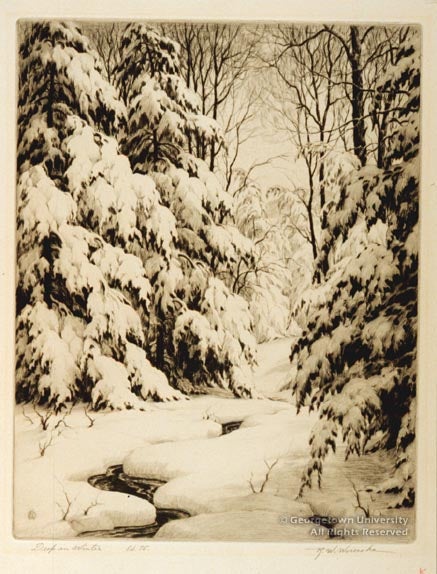
Deep in Winter
Woiceske, Ronau, 1887-1953
circa 1930s
Etching and drypoint
Woiceske was a distinguished printmaker noted for his etchings, drypoints, and aquatints of the winter landscape, of which this proof of his "Deep in Winter" is a fine example.
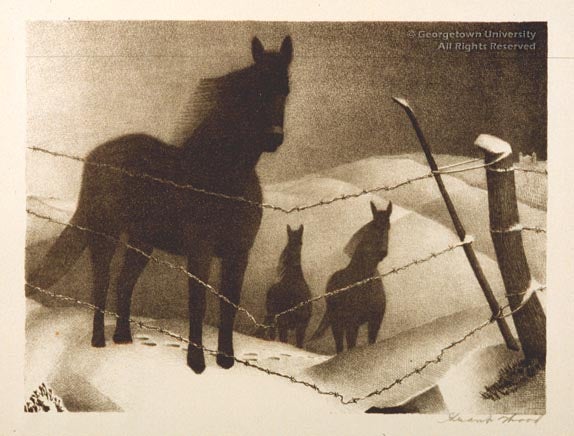
February
Wood, Grant, 1892-1942
1940
Lithograph
Wood, like his fellow artists Benton and Curry, gained fame as a Regionalist. Here are three of his horses, standing stoically by the gate, waiting for rescue from the "February" cold of a late winter's wind-driven snow.
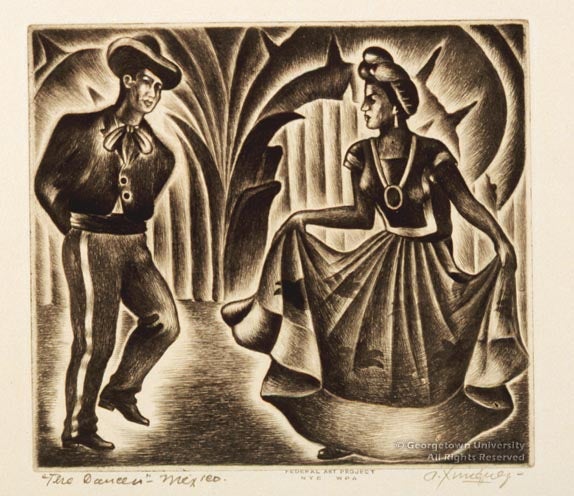
The Dancers - Mexico
Ximenez, Alfredo
n/d
Etchings (FAP/NYC-WPA)
Alfredo Ximenez is one of America's forgotten artists of the 1st half of the 20th century. All we know about him is that he worked as a WPA artist in New York during the great depression. His "Dancers" is also in the New York Public Library Collection and his second is "Mexican Canal." Neither is dated.
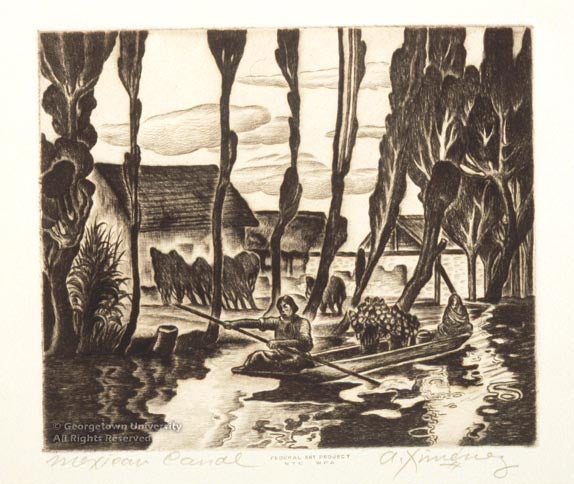
Mexican Canal
Ximenez, Alfredo
n/d
Etchings (FAP/NYC-WPA)
Alfredo Ximenez is one of America's forgotten artists of the 1st half of the 20th century. All we know about him is that he worked as a WPA artist in New York during the great depression. His "Dancers" is also in the New York Public Library Collection and his second is "Mexican Canal." Neither is dated.
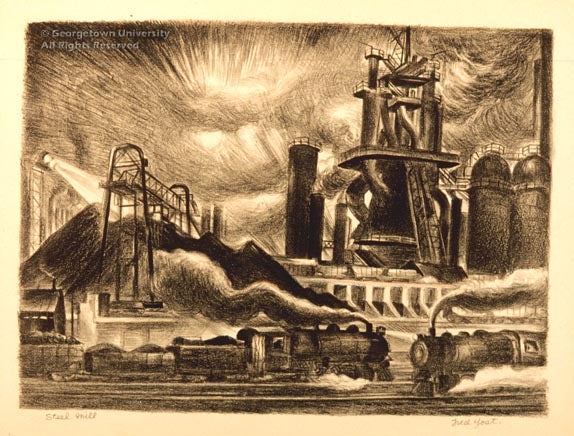
Steel Mill
Yost, Frederick J., 1888-1968
n/d
Lithograph
Yost was an emigre Ohio artist who studied at the Art Students League with Sloan and Henri. His "Steel Mill" is a night scene of a blast furnace in full operation. Compare it with James' night of oil drilling above.
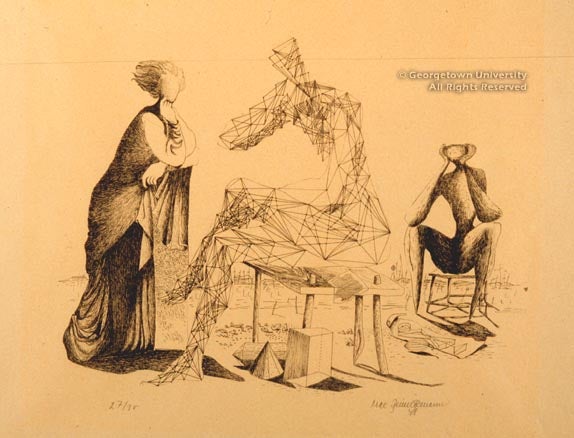
Abstract - three figures
Zimmermann, Mac, 1914-1966
1948
Lithograph
Zimmermann was a German printmaker noted for his cubist and surrealist imagery. He participated in many international exhibitions, and took the graphic arts prize at the 1956 Lugano Bienniel.
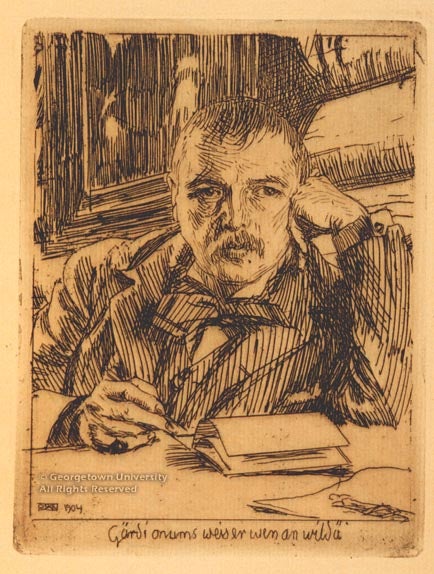
Self-portrait
Zorn, Anders, 1860-1920
1904
Etching
Someone suggested that, if we are able to close the exhibition with a print by Anders Zorn, Sweden's internationally acclaimed printmaker, painter, and sculptor, we need say nothing more. Here is his self-portrait of 1904.