An exhibition of prints, paintings, & drawings including all of his WWI etchings to mark the opening of the fall term, 1989.
Introduction:
Lester G. Hornby (1882-1956) is one of the surprising number of early 20th century American artists who achieved great acclaim during their vital years and yet lived to see their works, during the ensuing decades, largely neglected. That condition is now being reversed for many of them.
In Hornby’s case, during the past five years a catalogue of his prints has been published and a number of exhibitions of his work have been mounted. Georgetown’s exhibition, which features a complete set of his World War I etchings of 1918, includes some of Hornby’s best.
Hornby received his early training at the Rhode Island School of Design and the Art Students League in New York. He then journeyed to Paris where he developed his technique further at the major art academies there. Hornby’s progress was rapid; he received his first international recognition in Paris in the prestigious Salon d’Automne of 1907.
Completely captivated by Paris and the French countryside, Hornby spent most of his productive years in France, returning intermittently to America. In his latter years, he played an active role as teacher and artist in the Rockport art colony, dying there at his cottage in 1956.
Hornby’s style and technique lie within the Whistlerian tradition. Hornby printed all of his own etchings, experimenting with the subtleties of plate tone as a means of enhancing mood in his images. Several of his etchings are in color, one of which is in this exhibition. Most of his etchings were produced during the first two decades of this century.
Understandably, his dominant subject matter is Paris and the French countryside – typically incorporating a pronounced human element. In addition to his World War I collection of prints, this exhibition includes a sampling of his images of Paris, and the Cape Ann region.
Hornby’s works are well represented in major public collections, including the Metropolitan Museum, Boston Museum of Fine Arts, Art Institute of Chicago, Philadelphia Museum of Art, Library of Congress, Corcoran, and the National Museum of American Art in Washington, Bibliotheque National in Paris, and the Victoria and Albert Museum in London.
Betty Minor Duffy
Exhibition Format
The exhibition is presented in four sections: Part I features a complete set of Hornby’s World War I etchings, augmented by three pencil drawings and five watercolors. Part II adds a brief glimpse of Hornby’s work on Cape Ann, both in etching and in drypoint. Part III samples Hornby’s sense of the human element in Parisian life, and includes one of his color etchings. Part IV concludes with three examples from Hornby’s later years.
Checklist
The prints, drawings, and paintings in this exhibition are listed alphabetically under the headings of its four-part format. Dimensions are given in centimeters, height preceding width, measured to the plate mark for prints, and to the sheet, panel, or sight size for the other works. Each of the prints is further identified by its checklist number in Lester G. Hornby: Painter-Etcher, by Peter Hastings Falk.
With the exception of one drawing and four watercolors lent by an anonymous private collector, all works in this exhibition are from Georgetown’s permanent collection, acquired in part with funds provided by the University’s Charles Marvin Fairchild Memorial Endowment.
-
Part I: World War I
Etchings of 1918:
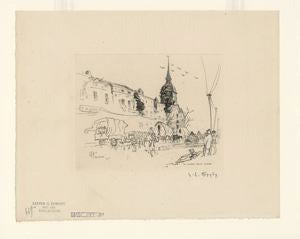
The Advance, Romagne
13.8 x 17.4 cm Ed. 70
F. 217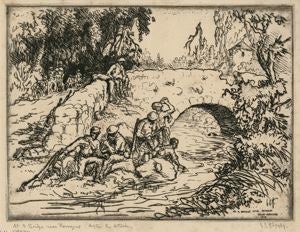
After the Attack, at a Bridge Near Romagne, Argonne-Meuse
18.6 x 24.6 cm Ed. 60
F. 194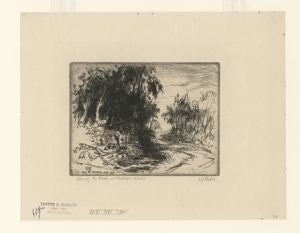
Along the Road near Belleau Woods
12.0 x 15.7 cm Ed. 70
F. 215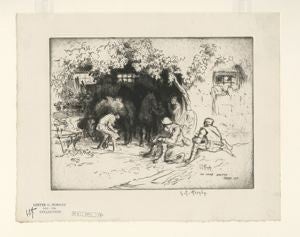
An Army Smithy in the Marne Valley
17.9 x 24.0 cm Ed. 60
F. 203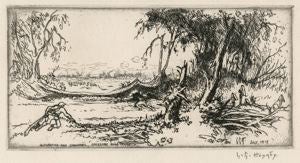
Automatics and Shrapnel, on the Soissons Road
9.7 x 19.6 cm Ed. 70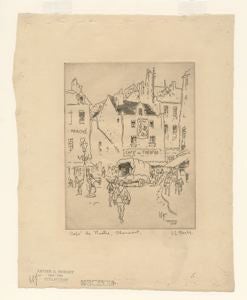
Café du Theatre, Chaumont
17.4 x 13.7 cm Ed. 90
F. 202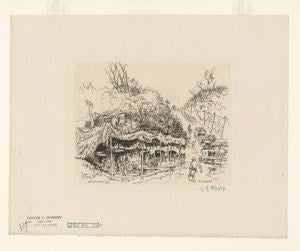
Camouflaged Auto Shelter, Cheppy, Argonne-Meuse
13.8 x 17.6 cm Ed. 90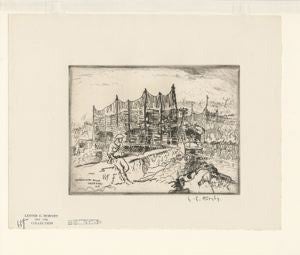
Camouflaged Bridge, Varennes
14.9 x 19.4 cm Ed. 80
F. 192 (2nd state)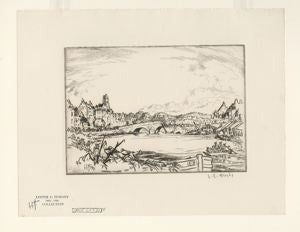
Chateau-Thierry
14.8 x 21.1 cm Ed. 90
F. 188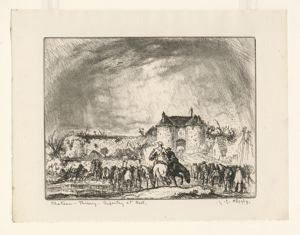
Chateau Thierry, Infantry at Rest
18.5 x 24.1 cm Ed. 60
F. 201A Dogfight in the Air, at Cunel
19.7 x 24.7 cm Ed. 70
F. 219 (2nd state)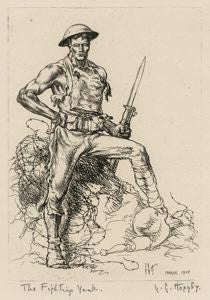
The Fighting Yank
21.0 x 14.9 cm Ed. 40
F. 206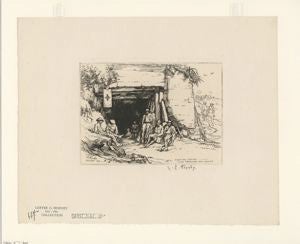
First Aid Station in an Abandoned Gun-Pit, Argonne
12.0 x 16.8 cm Ed. unknown
F. 220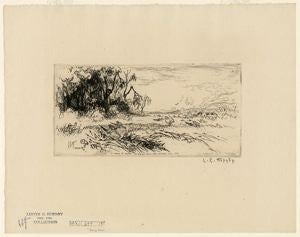
“Going Over” Through a Wheat Field Near Soissons
9.7 x 19.6 cm Ed. 70
F. 189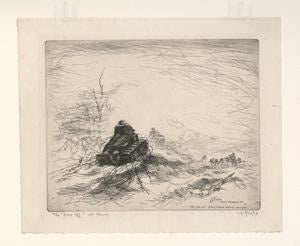
The “Jump Off.” Tanks With Pioneer Infantry…Beyond Bantheville
19.7 x 24.5 cm Ed. 50
F. 208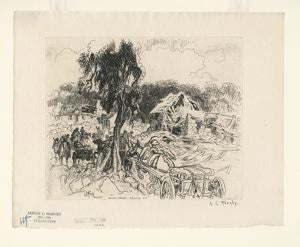
Machine Gunners, Buzancy, Argonne
18.6 x 22.7 cm Ed. 30
F. 210 (2nd state)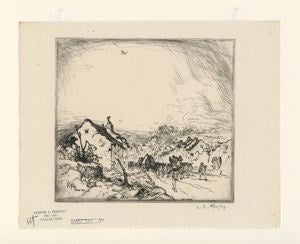
The Marne Advance at Vaux
19.2 x 20.8 cm Ed. 90
F. 190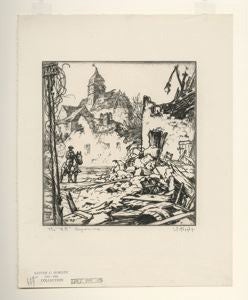
The M.P., Argonne-Meuse
18.6 x 17.4 cm Ed. 90
F. 196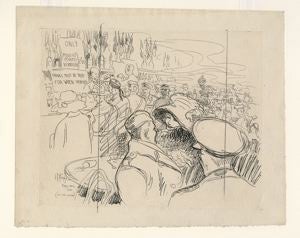
The Night of the Armistice, Casino de Paris (a preliminary study)
19.9 x 24.8 cm Ed.
Not in Falk – possibly unique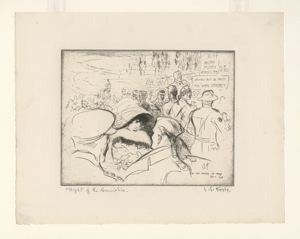
The Night of the Armistice, Casino de Paris
15.6 x 20.0 cm Ed. 60
F. 193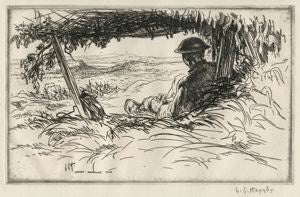
The Observer, Valley of the Meuse
12.2 x 19.7 cm Ed. 80
F. 211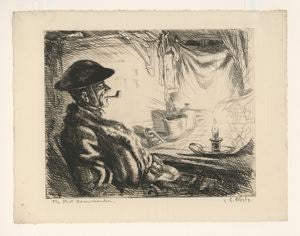
The Post Commander, Argonne
20.0 x 24.9 cm Ed. 12
F. 221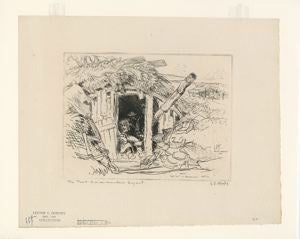
The Post Commander’s Dugout, Bantheville
14.9 x 19.8 cm Ed. 90
F. 212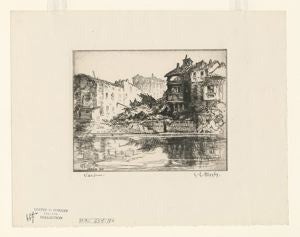
Ruins Along the Meuse, Verdun
13.6 x 17.5 cm Ed. 80
F. 186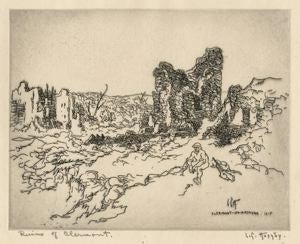
Ruins of Clermont-en-Argonne
13.8 x 17.5 cm Ed. 80
F. 205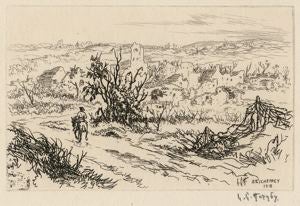
Seicheprey
11.0 x 17.5 cm Ed. 80
F. 205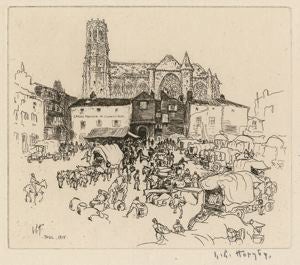
Supply Train in the Market Place, Toul
15.0 x 17.2 cm Ed. 80
F. 1993000 Miles from Turner’s Corner
19.8 x 25.2 cm Ed. 10
F. 222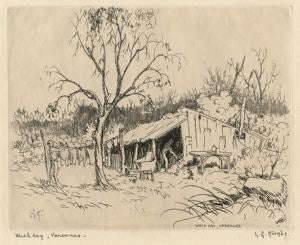
Wash Day, Varennes
13.8 x 17.6 cm Ed. unknown
F. 195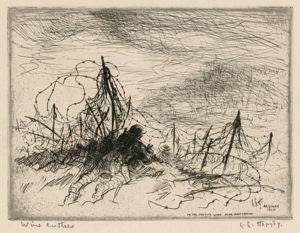
Wire Cutters, Early Morning, Near Montfaucon
14.8 x 19.7 cm Ed. 90
F. 207Drawings
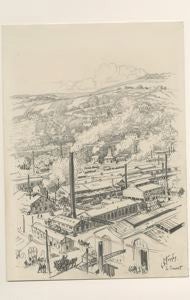
Le Creusot, 1918
Pencil drawing
35.5 x 25.3 cm, sheetUnloading Fords, St. Nazaire, August, 1918
Pencil with watercolor|
30.9 x 22.6 cm, sight
[anonymous loan]Unloading Tobacco, 1918
Pencil drawing
3.9 x 22.6 cm, sheetWatercolors
Artillery Advancing with the Approach of Evening – Marne, 1918
Watercolor
28.8 x 44.5 cm, sight
[anonymous loan]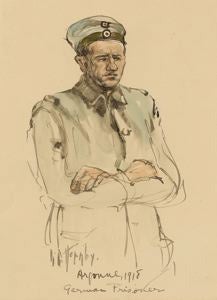
German Prisoner, Argonne, 1918
Watercolor
20.2 x 13.9 cm, sight
[anonymous loan]Guarding American Tracks, St Nazaire, 1918
Watercolor
15.9 x 30.5 cm, sight
[anonymous loan]Making Armor Plate, 1918
Watercolor
30.5 x 23.7 cm, sight
[anonymous loan]Observation Post near Montfaucon, Argonne, 1918
Watercolor
30.4 x 23.7 cm, sheet -
Part II: Cape Ann
Etching & Drypoints:
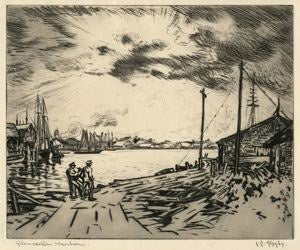
Boatyard, Gloucester Harbor, c. 1935
Drypoint
22.5 x 27.6 cm ed. unknown
F. 245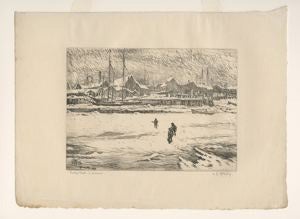
Rocky Neck in Snow, 1919
Etching
16.4 x 22.8 cm ed. 40
F. 230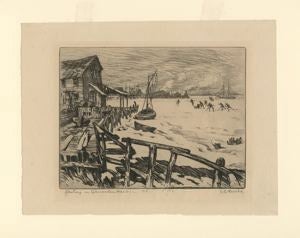
Skating in Gloucester Harbor, 1919
Drypoint
14.9 x 19.5 cm ed. unknown
Early state before signature in plate
F. 234[a] -
Part III: Paris
Etchings & Drypoint:
A La Gaité, Montparnasse, 1907
Color etching
11.8 x 17.6 cm Ed. 50
F. 34Dans le Jardin du Palais Royal, 1909
Etching
20.0 x 29.6 cm Ed. 60
F. 44[Les Spectacles, Paris], c. 1935
Drypoint
15.8 x 21.3 cm ed. unknown
Not in FalkThe Little Rendez-Vous, 1911
Etching
14.9 x 14.9 cm ed. 60
F. 35 -
Part IV: Later Work
Paintings & Drawing:
Native Shop in London Street, Trinidad, no date
Drawing: pencil, color pencils, and crayon
26.7 x 21.5 cm, sheet[Trees in Blossom], no date
Oil on paper
30.7 x 40.5 cm, sheetThe Village of Senlisse, 1934
Oil on board
38.0 x 46.0 cm